 Add to Chrome
 Add to Firefox
 Add to Edge
Rethinking the Efficiency and Effectiveness of Reinforcement Learning for Radiology Report Generation
Mar 04, 2026
Radiologists highly desire fully automated AI for radiology report generation (R2G), yet existing approaches fall short in clinical utility. Reinforcement learning (RL) holds potential to address these shortcomings, but its adoption in this task remains underexplored. In this paper, we revisit RL in terms of data efficiency and optimization effectiveness for R2G tasks. First, we explore the impact of data quantity and quality on the performance of RL in medical contexts, revealing that data quality plays a more critical role than quantity. To this end, we propose a diagnostic diversity-based data sampling strategy that enables comparable performance with fewer samples. Second, we observe that the majority of tokens in radiology reports are template-like and diagnostically uninformative, whereas the low frequency of clinically critical tokens heightens the risk of being overlooked during optimization. To tackle this, we introduce Diagnostic Token-weighted Policy Optimization (DiTPO), which directly optimizes for clinical accuracy by using a diagnostic F1 score as the reward signal. Unlike standard RL approaches that treat all tokens equally, DiTPO explicitly models the varying importance of different tokens through rule- or gradient-based mechanisms to prioritize clinically relevant content. Extensive experiments on the MIMIC-CXR, IU-Xray, and CheXpert Plus datasets demonstrate that our framework achieves state-of-the-art (SOTA) performance while requiring substantially fewer training samples in RL. Notably, on MIMIC-CXR, our framework attains an F1 score of 0.516 using only 20% of the RL training samples.

Segment Together: A Versatile Paradigm for Semi-Supervised Medical Image Segmentation
Nov 20, 2023
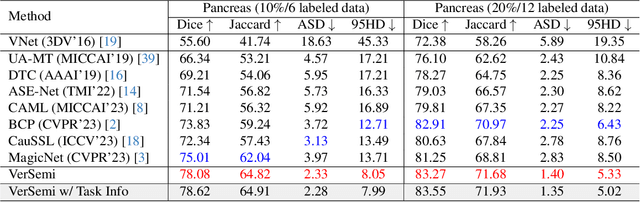
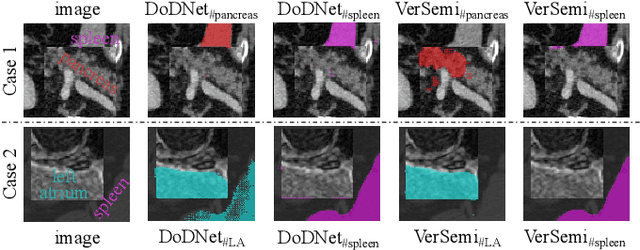
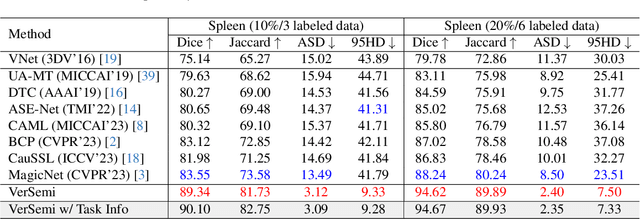
Annotation scarcity has become a major obstacle for training powerful deep-learning models for medical image segmentation, restricting their deployment in clinical scenarios. To address it, semi-supervised learning by exploiting abundant unlabeled data is highly desirable to boost the model training. However, most existing works still focus on limited medical tasks and underestimate the potential of learning across diverse tasks and multiple datasets. Therefore, in this paper, we introduce a \textbf{Ver}satile \textbf{Semi}-supervised framework (VerSemi) to point out a new perspective that integrates various tasks into a unified model with a broad label space, to exploit more unlabeled data for semi-supervised medical image segmentation. Specifically, we introduce a dynamic task-prompted design to segment various targets from different datasets. Next, this unified model is used to identify the foreground regions from all labeled data, to capture cross-dataset semantics. Particularly, we create a synthetic task with a cutmix strategy to augment foreground targets within the expanded label space. To effectively utilize unlabeled data, we introduce a consistency constraint. This involves aligning aggregated predictions from various tasks with those from the synthetic task, further guiding the model in accurately segmenting foreground regions during training. We evaluated our VerSemi model on four public benchmarking datasets. Extensive experiments demonstrated that VerSemi can consistently outperform the second-best method by a large margin (e.g., an average 2.69\% Dice gain on four datasets), setting new SOTA performance for semi-supervised medical image segmentation. The code will be released.
Discrepancy Matters: Learning from Inconsistent Decoder Features for Consistent Semi-supervised Medical Image Segmentation
Sep 26, 2023Semi-supervised learning (SSL) has been proven beneficial for mitigating the issue of limited labeled data especially on the task of volumetric medical image segmentation. Unlike previous SSL methods which focus on exploring highly confident pseudo-labels or developing consistency regularization schemes, our empirical findings suggest that inconsistent decoder features emerge naturally when two decoders strive to generate consistent predictions. Based on the observation, we first analyze the treasure of discrepancy in learning towards consistency, under both pseudo-labeling and consistency regularization settings, and subsequently propose a novel SSL method called LeFeD, which learns the feature-level discrepancy obtained from two decoders, by feeding the discrepancy as a feedback signal to the encoder. The core design of LeFeD is to enlarge the difference by training differentiated decoders, and then learn from the inconsistent information iteratively. We evaluate LeFeD against eight state-of-the-art (SOTA) methods on three public datasets. Experiments show LeFeD surpasses competitors without any bells and whistles such as uncertainty estimation and strong constraints, as well as setting a new state-of-the-art for semi-supervised medical image segmentation. Code is available at \textcolor{cyan}{https://github.com/maxwell0027/LeFeD}