 Add to Chrome
 Add to Firefox
 Add to Edge
The Llama 4 Herd: Architecture, Training, Evaluation, and Deployment Notes
Jan 15, 2026
This document consolidates publicly reported technical details about Metas Llama 4 model family. It summarizes (i) released variants (Scout and Maverick) and the broader herd context including the previewed Behemoth teacher model, (ii) architectural characteristics beyond a high-level MoE description covering routed/shared-expert structure, early-fusion multimodality, and long-context design elements reported for Scout (iRoPE and length generalization strategies), (iii) training disclosures spanning pre-training, mid-training for long-context extension, and post-training methodology (lightweight SFT, online RL, and lightweight DPO) as described in release materials, (iv) developer-reported benchmark results for both base and instruction-tuned checkpoints, and (v) practical deployment constraints observed across major serving environments, including provider-specific context limits and quantization packaging. The manuscript also summarizes licensing obligations relevant to redistribution and derivative naming, and reviews publicly described safeguards and evaluation practices. The goal is to provide a compact technical reference for researchers and practitioners who need precise, source-backed facts about Llama 4.

Self-supervised Pretraining of Visual Features in the Wild
Mar 05, 2021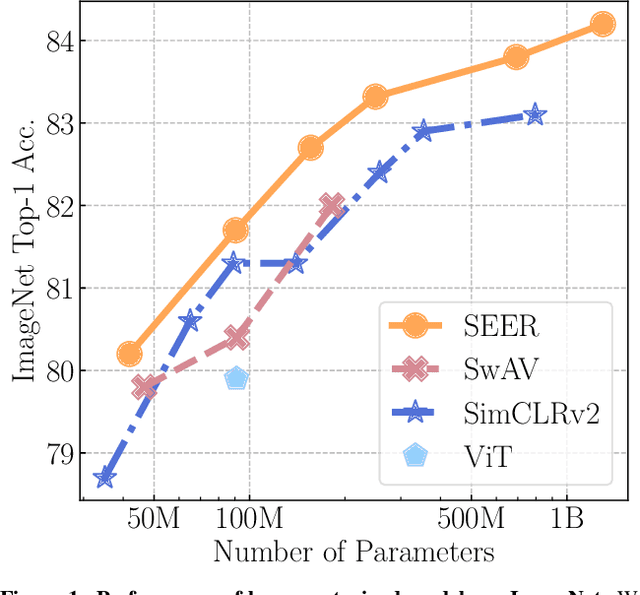
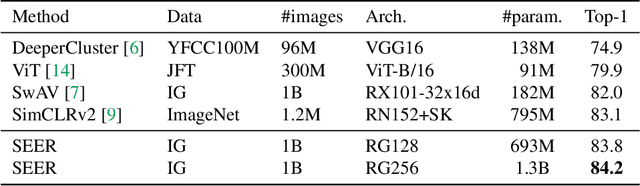
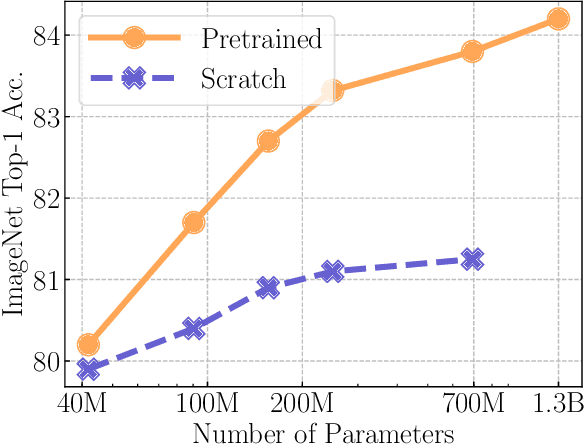
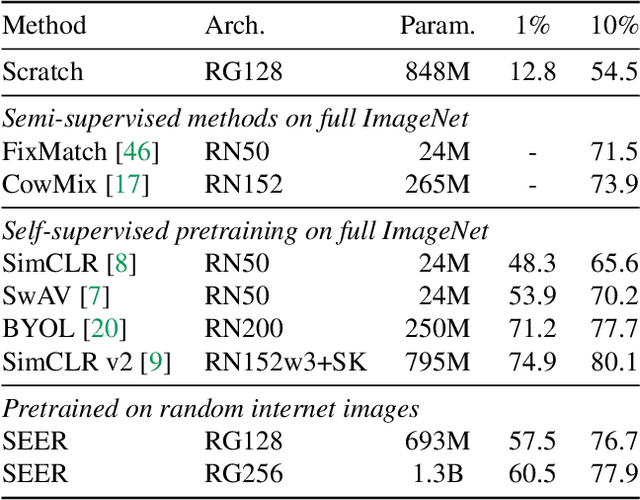
Recently, self-supervised learning methods like MoCo, SimCLR, BYOL and SwAV have reduced the gap with supervised methods. These results have been achieved in a control environment, that is the highly curated ImageNet dataset. However, the premise of self-supervised learning is that it can learn from any random image and from any unbounded dataset. In this work, we explore if self-supervision lives to its expectation by training large models on random, uncurated images with no supervision. Our final SElf-supERvised (SEER) model, a RegNetY with 1.3B parameters trained on 1B random images with 512 GPUs achieves 84.2% top-1 accuracy, surpassing the best self-supervised pretrained model by 1% and confirming that self-supervised learning works in a real world setting. Interestingly, we also observe that self-supervised models are good few-shot learners achieving 77.9% top-1 with access to only 10% of ImageNet. Code: https://github.com/facebookresearch/vissl