 Add to Chrome
 Add to Firefox
 Add to Edge
Optimized Design for IRS-Assisted Integrated Sensing and Communication Systems in Clutter Environments
Aug 08, 2022
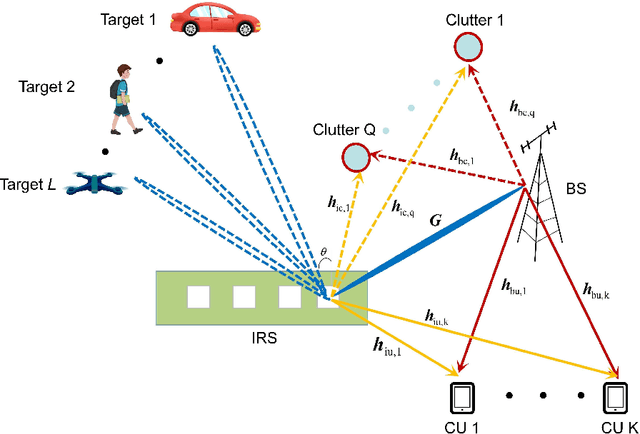
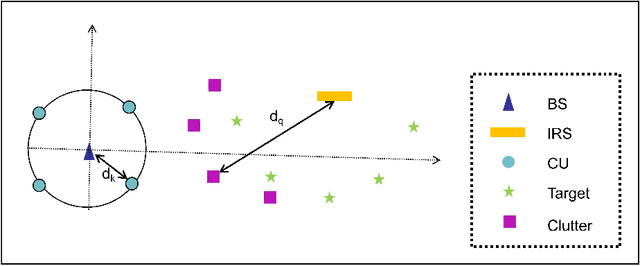
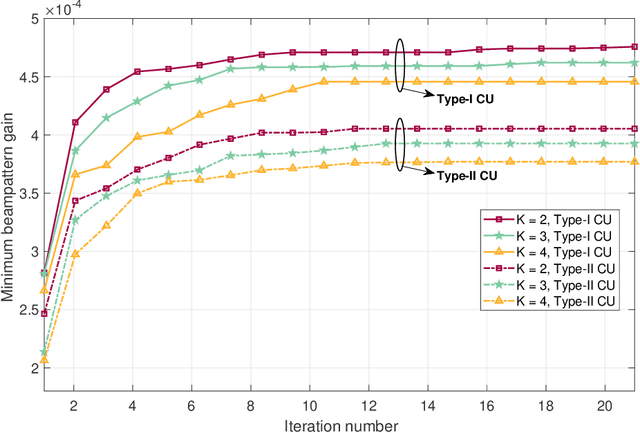
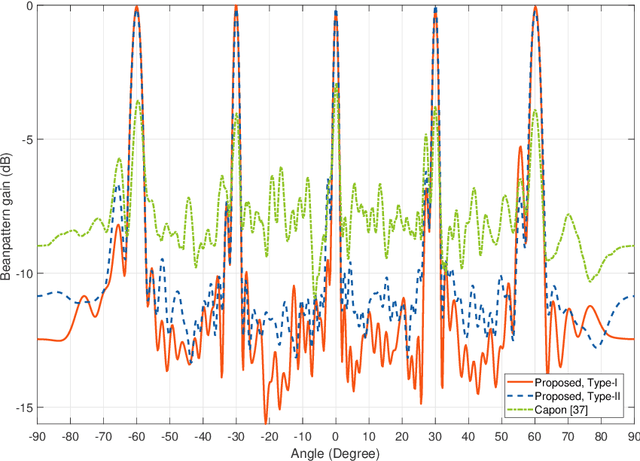
In this paper, we investigate an intelligent reflecting surface (IRS)-assisted integrated sensing and communication (ISAC) system design in a clutter environment. Assisted by an IRS equipped with a uniform linear array (ULA), a multi-antenna base station (BS) is targeted for communicating with multiple communication users (CUs) and sensing multiple targets simultaneously. We consider the IRS-assisted ISAC design in the case with Type-I or Type-II CUs, where each Type-I and Type-II CU can and cannot cancel the interference from sensing signals, respectively. In particular, we aim to maximize the minimum sensing beampattern gain among multiple targets, by jointly optimizing the BS transmit beamforming vectors and the IRS phase shifting matrix, subject to the signal-to-interference-plus-noise ratio (SINR) constraint for each Type-I/Type-II CU, the interference power constraint per clutter, the transmission power constraint at the BS, and the cross-correlation pattern constraint. Due to the coupling of the BS's transmit design variables and the IRS's phase shifting matrix, the formulated max-min IRS-assisted ISAC design problem in the case with Type-I/Type-II CUs is highly non-convex. As such, we propose an efficient algorithm based on the alternating-optimization and semi-definite relaxation (SDR) techniques. In the case with Type-I CUs, we show that the dedicated sensing signal at the BS is always beneficial to improve the sensing performance. By contrast, the dedicated sensing signal at the BS is not required in the case with Type-II CUs. Numerical results are provided to show that the proposed IRS-assisted ISAC design schemes achieve a significant gain over the existing benchmark schemes.

Sequential Offloading for Distributed DNN Computation in Multiuser MEC Systems
Mar 02, 2022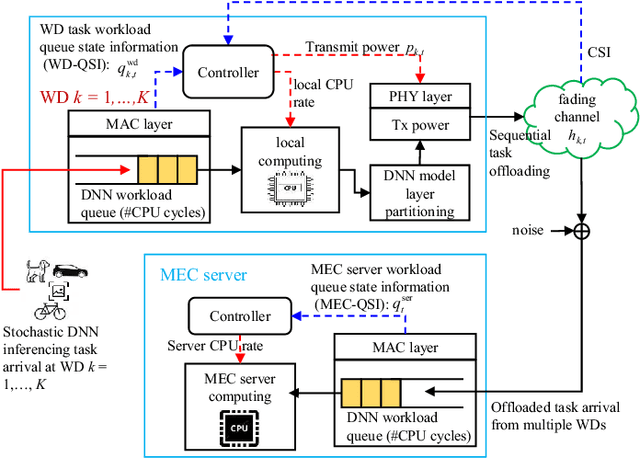
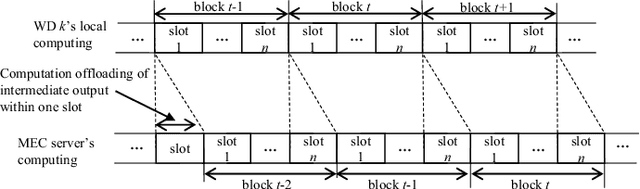
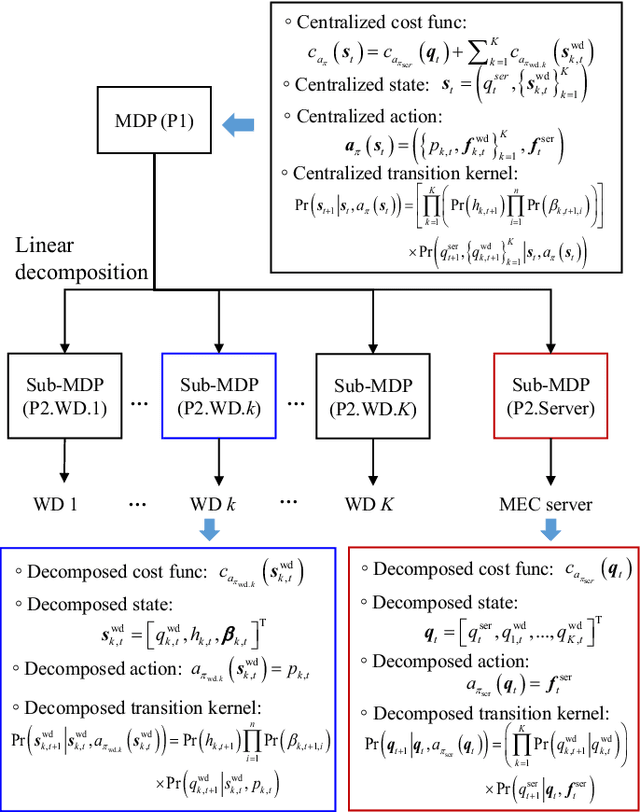
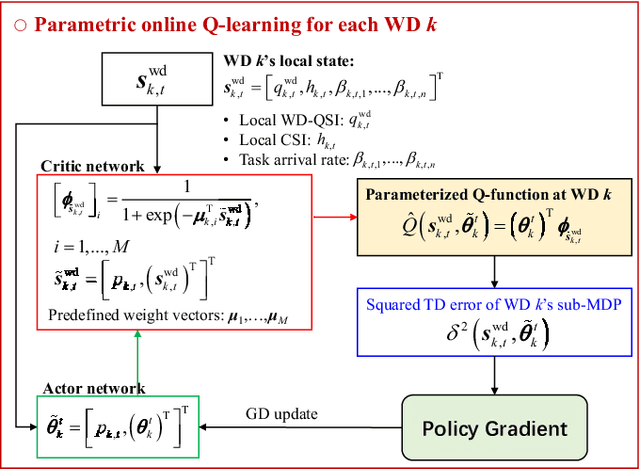
This paper studies a sequential task offloading problem for a multiuser mobile edge computing (MEC) system. We consider a dynamic optimization approach, which embraces wireless channel fluctuations and random deep neural network (DNN) task arrivals over an infinite horizon. Specifically, we introduce a local CPU workload queue (WD-QSI) and an MEC server workload queue (MEC-QSI) to model the dynamic workload of DNN tasks at each WD and the MEC server, respectively. The transmit power and the partitioning of the local DNN task at each WD are dynamically determined based on the instantaneous channel conditions (to capture the transmission opportunities) and the instantaneous WD-QSI and MEC-QSI (to capture the dynamic urgency of the tasks) to minimize the average latency of the DNN tasks. The joint optimization can be formulated as an ergodic Markov decision process (MDP), in which the optimality condition is characterized by a centralized Bellman equation. However, the brute force solution of the MDP is not viable due to the curse of dimensionality as well as the requirement for knowledge of the global state information. To overcome these issues, we first decompose the MDP into multiple lower dimensional sub-MDPs, each of which can be associated with a WD or the MEC server. Next, we further develop a parametric online Q-learning algorithm, so that each sub-MDP is solved locally at its associated WD or the MEC server. The proposed solution is completely decentralized in the sense that the transmit power for sequential offloading and the DNN task partitioning can be determined based on the local channel state information (CSI) and the local WD-QSI at the WD only. Additionally, no prior knowledge of the distribution of the DNN task arrivals or the channel statistics will be needed for the MEC server.
Over-the-Air Aggregation for Federated Learning: Waveform Superposition and Prototype Validation
Oct 27, 2021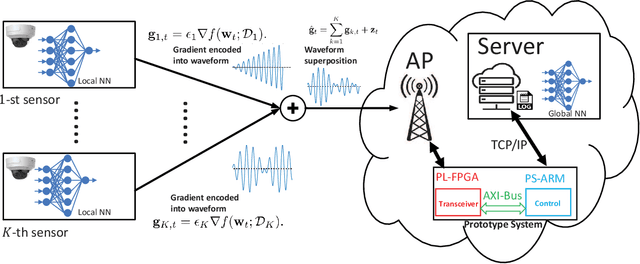
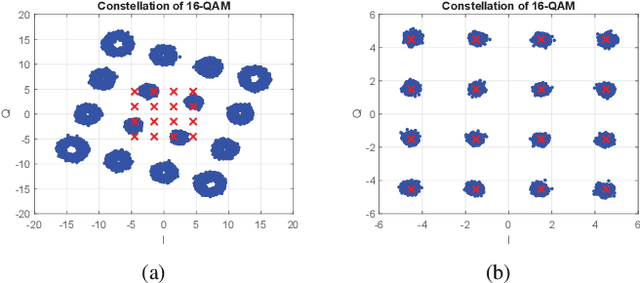
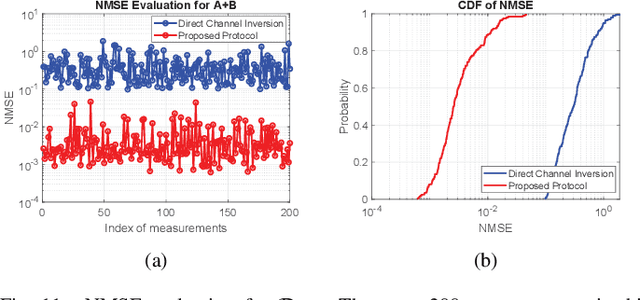
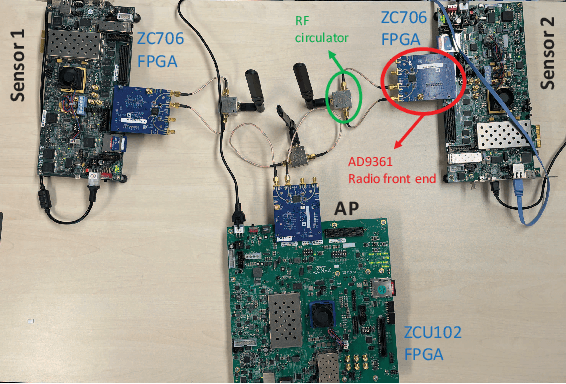
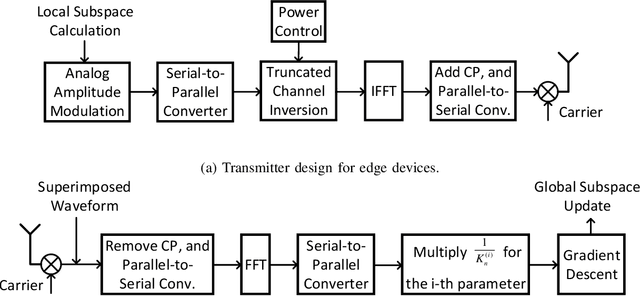
In this paper, we develop an orthogonal-frequency-division-multiplexing (OFDM)-based over-the-air (OTA) aggregation solution for wireless federated learning (FL). In particular, the local gradients in massive IoT devices are modulated by an analog waveform and are then transmitted using the same wireless resources. To this end, achieving perfect waveform superposition is the key challenge, which is difficult due to the existence of frame timing offset (TO) and carrier frequency offset (CFO). In order to address these issues, we propose a two-stage waveform pre-equalization technique with a customized multiple access protocol that can estimate and then mitigate the TO and CFO for the OTA aggregation. Based on the proposed solution, we develop a hardware transceiver and application software to train a real-world FL task, which learns a deep neural network to predict the received signal strength with global positioning system information. Experiments verify that the proposed OTA aggregation solution can achieve comparable performance to offline learning procedures with high prediction accuracy.
Cascaded Channel Estimation for Intelligent Reflecting Surface Assisted Multiuser MISO Systems
Aug 20, 2021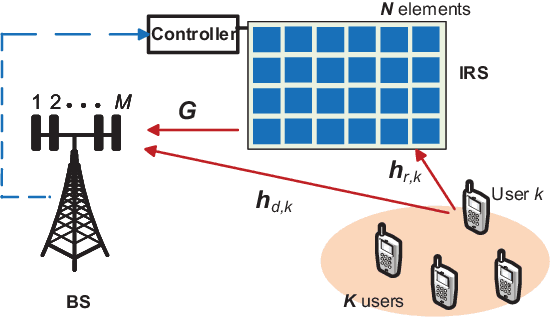
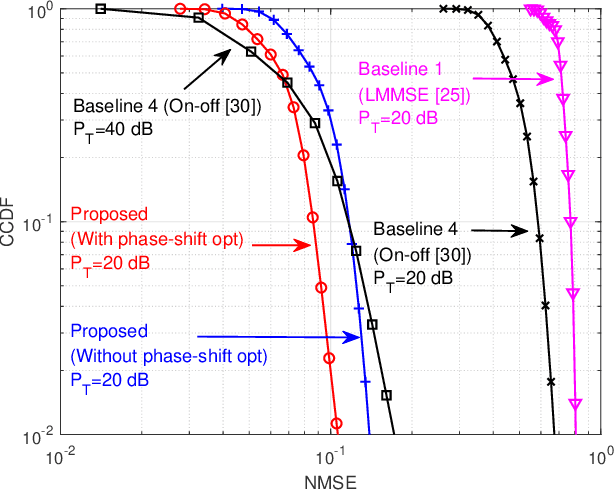
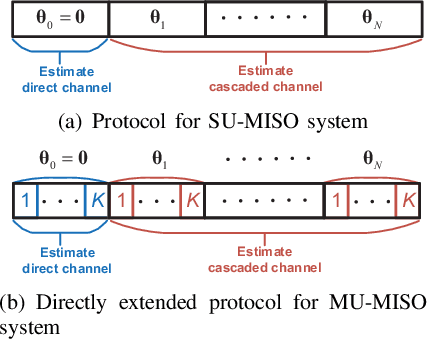
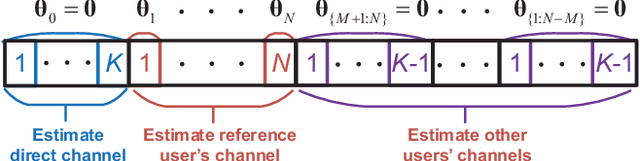
This paper investigates the uplink cascaded channel estimation for intelligent-reflecting-surface (IRS)-assisted multi-user multiple-input-single-output systems. We focus on a sub-6 GHz scenario where the channel propagation is not sparse and the number of IRS elements can be larger than the number of BS antennas. A novel channel estimation protocol without the need of on-off amplitude control to avoid the reflection power loss is proposed. In addition, the pilot overhead is substantially reduced by exploiting the common-link structure to decompose the cascaded channel coefficients by the multiplication of the common-link variables and the user-specific variables. However, these two types of variables are highly coupled, which makes them difficult to estimate. To address this issue, we formulate an optimization-based joint channel estimation problem, which only utilizes the covariance of the cascaded channel. Then, we design a low-complexity alternating optimization algorithm with efficient initialization for the non-convex optimization problem, which achieves a local optimum solution. To further enhance the estimation accuracy, we propose a new formulation to optimize the training phase shifting configuration for the proposed protocol, and then solve it using the successive convex approximation algorithm. Comprehensive simulations verify that the proposed algorithm has supreme performance compared to various state-of-the-art baseline schemes.
Dynamic RAT Selection and Transceiver Optimization for Mobile Edge Computing Over Multi-RAT Heterogeneous Networks
Aug 18, 2021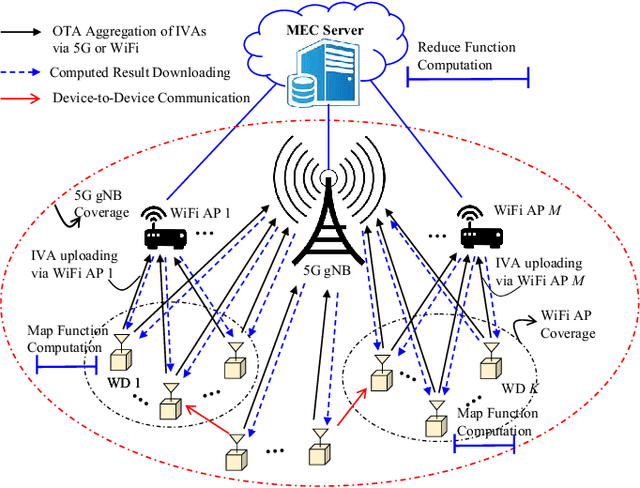

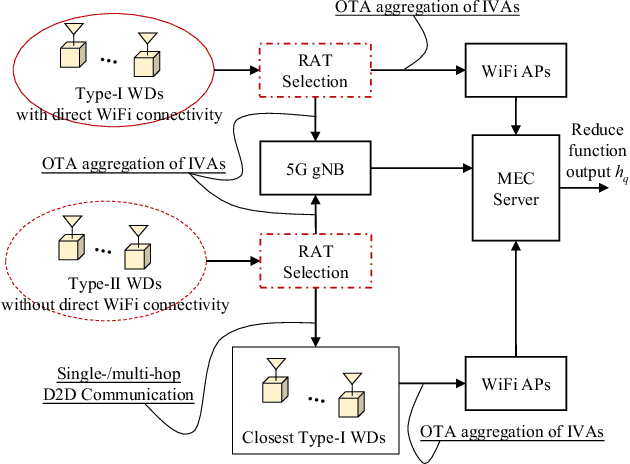
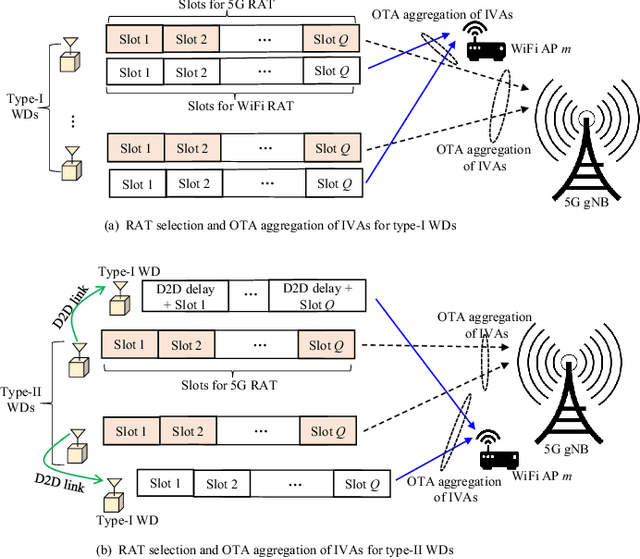
Mobile edge computing (MEC) integrated with multiple radio access technologies (RATs) is a promising technique for satisfying the growing low-latency computation demand of emerging intelligent internet of things (IoT) applications. Under the distributed MapReduce framework, this paper investigates the joint RAT selection and transceiver design for over-the-air (OTA) aggregation of intermediate values (IVAs) in wireless multiuser MEC systems, while taking into account the energy budget constraint for the local computing and IVA transmission per wireless device (WD). We aim to minimize the weighted sum of the computation mean squared error (MSE) of the aggregated IVA at the RAT receivers, the WDs' IVA transmission cost, and the associated transmission time delay, which is a mixed-integer and non-convex problem. Based on the Lagrange duality method and primal decomposition, we develop a low-complexity algorithm by solving the WDs' RAT selection problem, the WDs' transmit coefficients optimization problem, and the aggregation beamforming problem. Extensive numerical results are provided to demonstrate the effectiveness and merit of our proposed algorithm as compared with other existing schemes.
Multi-Level Over-the-Air Aggregation of Mobile Edge Computing over D2D Wireless Networks
May 02, 2021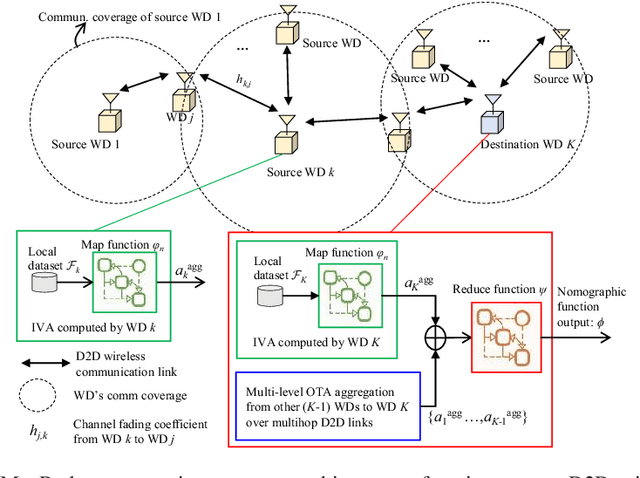
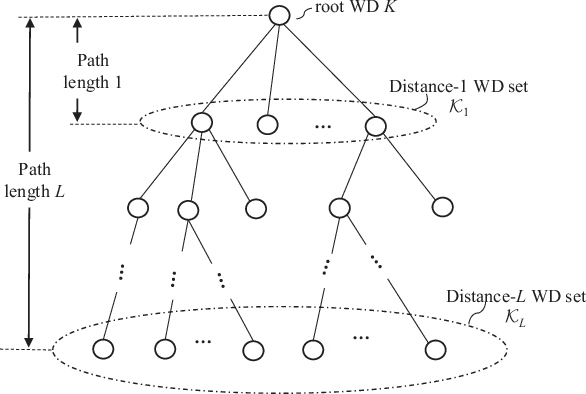
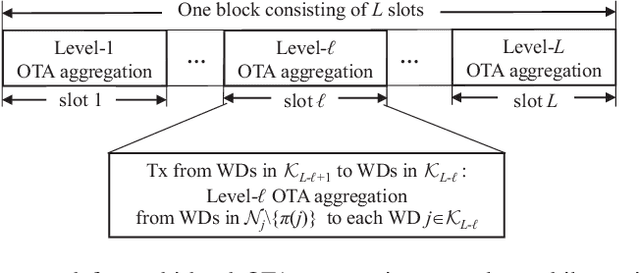
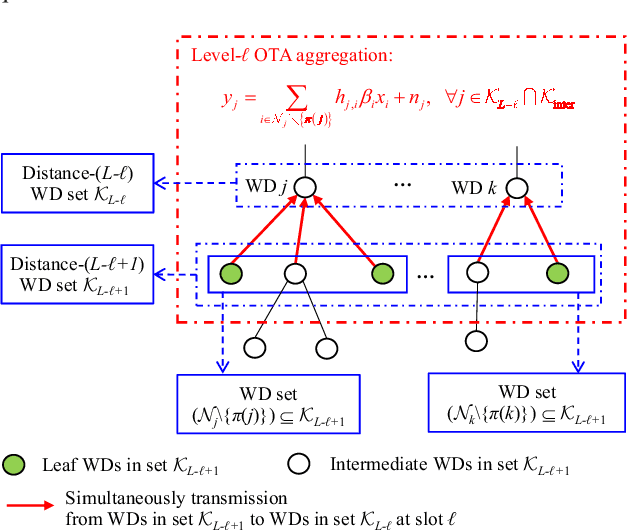
In this paper, we consider a wireless multihop device-to-device (D2D) based mobile edge computing (MEC) system, where the destination wireless device (WD) is scheduled to compute nomographic functions. Under the MapReduce framework and motivated by reducing communication resource overhead, we propose a new multi-level over-the-air (OTA) aggregation scheme for the destination WD to collect the individual partially aggregated intermediate values (IVAs) for reduction from multiple source WDs in the data shuffling phase. For OTA aggregation per level, the source WDs employ a channel inverse structure multiplied by their individual transmit coefficients in transmission over the same time frequency resource blocks, and the destination WD finally uses a receive filtering factor to construct the aggregated IVA. Under this setup, we develop a unified transceiver design framework that minimizes the mean squared error (MSE) of the aggregated IVA at the destination WD subject to the source WDs' individual power constraints, by jointly optimizing the source WDs' individual transmit coefficients and the destination WD's receive filtering factor. First, based on the primal decomposition method, we derive the closed-form solution under the special case of a common transmit coefficient. It shows that all the source WDs' common transmit is determined by the minimal transmit power budget among the source WDs. Next, for the general case, we transform the original problem into a quadratic fractional programming problem, and then develop a low-complexity algorithm to obtain the (near-) optimal solution by leveraging Dinkelbach's algorithm along with the Gaussian randomization method.
Turning Channel Noise into an Accelerator for Over-the-Air Principal Component Analysis
Apr 21, 2021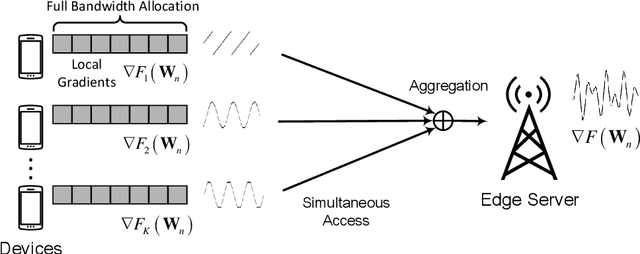
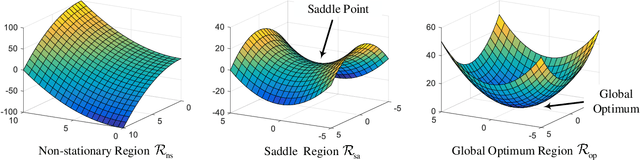
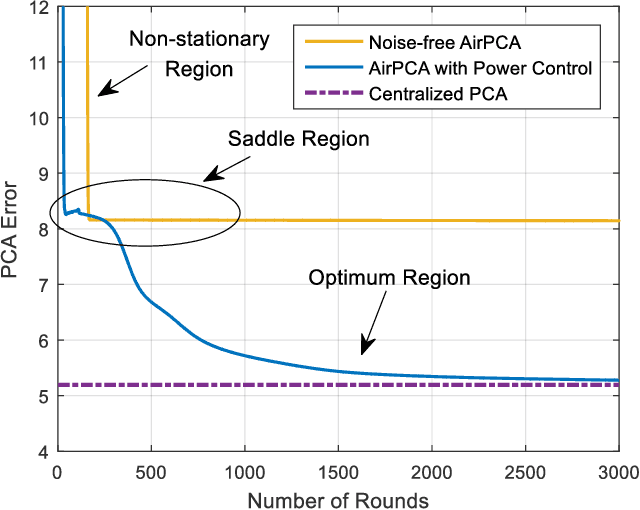
Recently years, the attempts on distilling mobile data into useful knowledge has been led to the deployment of machine learning algorithms at the network edge. Principal component analysis (PCA) is a classic technique for extracting the linear structure of a dataset, which is useful for feature extraction and data compression. In this work, we propose the deployment of distributed PCA over a multi-access channel based on the algorithm of stochastic gradient descent to learn the dominant feature space of a distributed dataset at multiple devices. Over-the-air aggregation is adopted to reduce the multi-access latency, giving the name over-the-air PCA. The novelty of this design lies in exploiting channel noise to accelerate the descent in the region around each saddle point encountered by gradient descent, thereby increasing the convergence speed of over-the-air PCA. The idea is materialized by proposing a power-control scheme which detects the type of descent region and controlling the level of channel noise accordingly. The scheme is proved to achieve a faster convergence rate than in the case without power control.
Queue-Aware Dynamic Clustering and Power Allocation for Network MIMO Systems via Distributive Stochastic Learning
Dec 17, 2010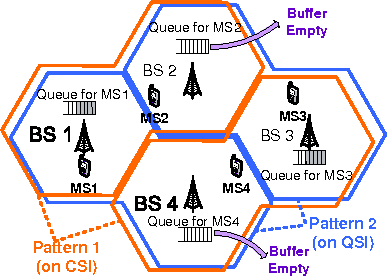
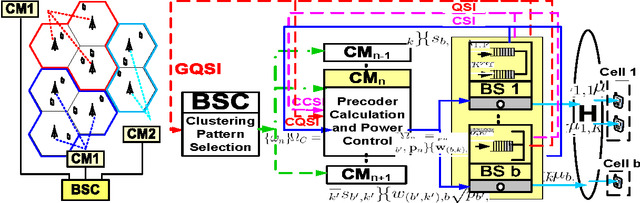
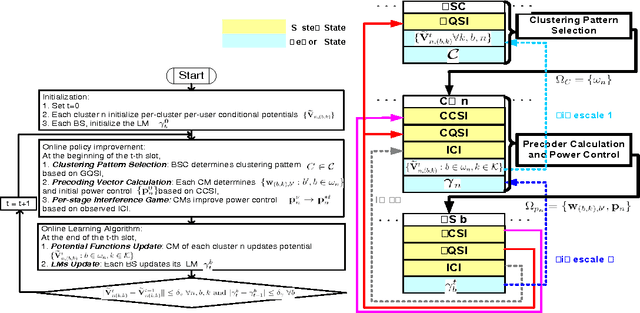
In this paper, we propose a two-timescale delay-optimal dynamic clustering and power allocation design for downlink network MIMO systems. The dynamic clustering control is adaptive to the global queue state information (GQSI) only and computed at the base station controller (BSC) over a longer time scale. On the other hand, the power allocations of all the BSs in one cluster are adaptive to both intra-cluster channel state information (CCSI) and intra-cluster queue state information (CQSI), and computed at the cluster manager (CM) over a shorter time scale. We show that the two-timescale delay-optimal control can be formulated as an infinite-horizon average cost Constrained Partially Observed Markov Decision Process (CPOMDP). By exploiting the special problem structure, we shall derive an equivalent Bellman equation in terms of Pattern Selection Q-factor to solve the CPOMDP. To address the distributive requirement and the issue of exponential memory requirement and computational complexity, we approximate the Pattern Selection Q-factor by the sum of Per-cluster Potential functions and propose a novel distributive online learning algorithm to estimate the Per-cluster Potential functions (at each CM) as well as the Lagrange multipliers (LM) (at each BS). We show that the proposed distributive online learning algorithm converges almost surely (with probability 1). By exploiting the birth-death structure of the queue dynamics, we further decompose the Per-cluster Potential function into sum of Per-cluster Per-user Potential functions and formulate the instantaneous power allocation as a Per-stage QSI-aware Interference Game played among all the CMs. We also propose a QSI-aware Simultaneous Iterative Water-filling Algorithm (QSIWFA) and show that it can achieve the Nash Equilibrium (NE).
Queue-Aware Distributive Resource Control for Delay-Sensitive Two-Hop MIMO Cooperative Systems
Oct 02, 2010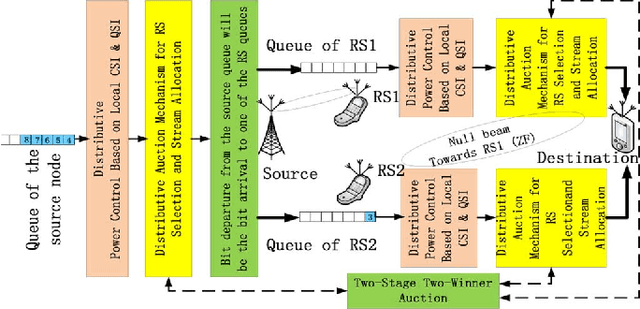
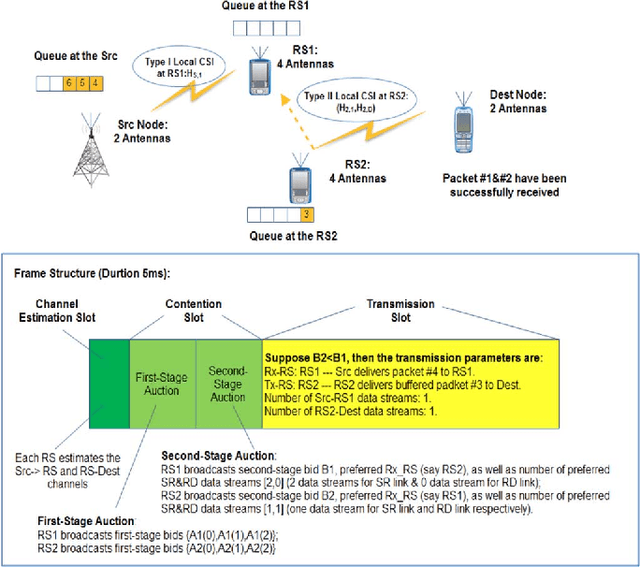
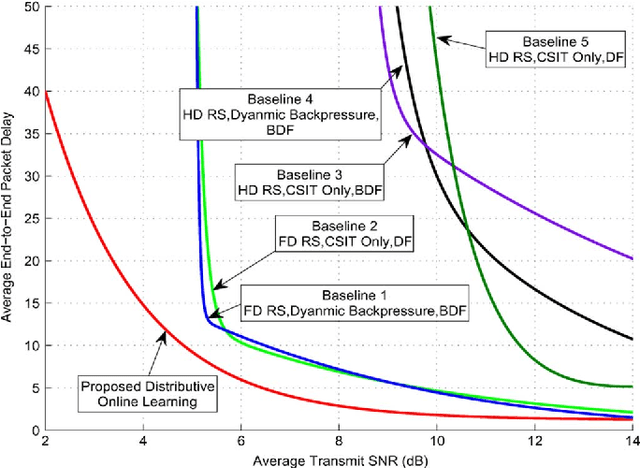
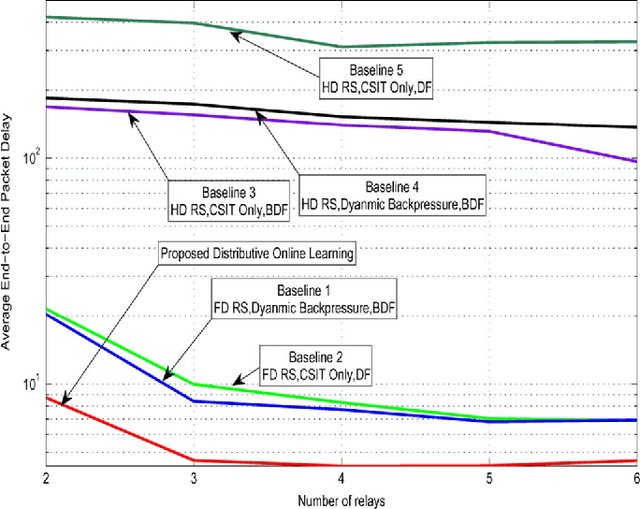
In this paper, we consider a queue-aware distributive resource control algorithm for two-hop MIMO cooperative systems. We shall illustrate that relay buffering is an effective way to reduce the intrinsic half-duplex penalty in cooperative systems. The complex interactions of the queues at the source node and the relays are modeled as an average-cost infinite horizon Markov Decision Process (MDP). The traditional approach solving this MDP problem involves centralized control with huge complexity. To obtain a distributive and low complexity solution, we introduce a linear structure which approximates the value function of the associated Bellman equation by the sum of per-node value functions. We derive a distributive two-stage two-winner auction-based control policy which is a function of the local CSI and local QSI only. Furthermore, to estimate the best fit approximation parameter, we propose a distributive online stochastic learning algorithm using stochastic approximation theory. Finally, we establish technical conditions for almost-sure convergence and show that under heavy traffic, the proposed low complexity distributive control is global optimal.
Distributive Stochastic Learning for Delay-Optimal OFDMA Power and Subband Allocation
May 01, 2010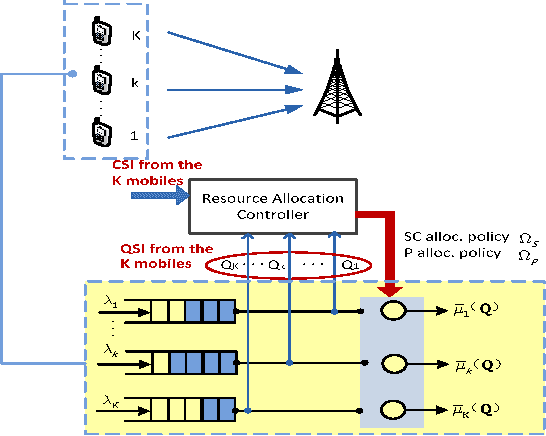
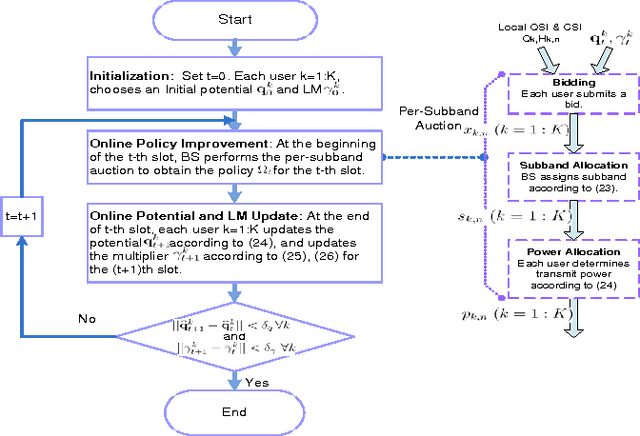
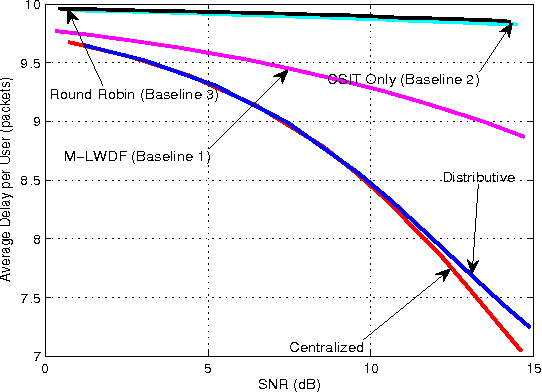
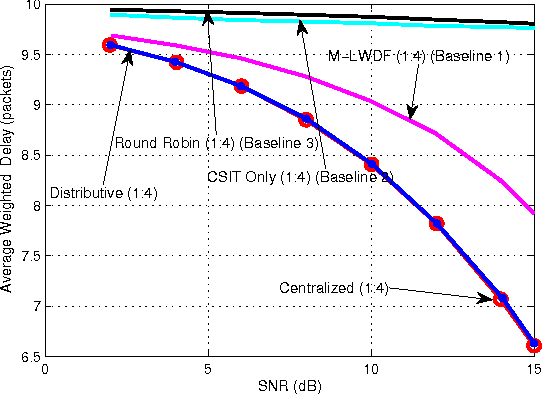
In this paper, we consider the distributive queue-aware power and subband allocation design for a delay-optimal OFDMA uplink system with one base station, $K$ users and $N_F$ independent subbands. Each mobile has an uplink queue with heterogeneous packet arrivals and delay requirements. We model the problem as an infinite horizon average reward Markov Decision Problem (MDP) where the control actions are functions of the instantaneous Channel State Information (CSI) as well as the joint Queue State Information (QSI). To address the distributive requirement and the issue of exponential memory requirement and computational complexity, we approximate the subband allocation Q-factor by the sum of the per-user subband allocation Q-factor and derive a distributive online stochastic learning algorithm to estimate the per-user Q-factor and the Lagrange multipliers (LM) simultaneously and determine the control actions using an auction mechanism. We show that under the proposed auction mechanism, the distributive online learning converges almost surely (with probability 1). For illustration, we apply the proposed distributive stochastic learning framework to an application example with exponential packet size distribution. We show that the delay-optimal power control has the {\em multi-level water-filling} structure where the CSI determines the instantaneous power allocation and the QSI determines the water-level. The proposed algorithm has linear signaling overhead and computational complexity $\mathcal O(KN)$, which is desirable from an implementation perspective.