 Add to Chrome
 Add to Firefox
 Add to Edge
Learning Varying Physical Therapist-Patient Interactions for Robot-mediated Upper Limb Task-Specific Training
Aug 17, 2026
Upper extremity motor function recovery is positively linked to Task-Specific Training (TST) and sufficient therapy dosage. Rehabilitation robots can increase TST dosage via controlled, repetitive treatment and free therapists to simultaneously manage other patients, but it has yet to demonstrate significant benefits over conventional treatment. This is potentially linked to inaccurate robotic representation of personalised physical therapist-patient interaction and lack of practice variability during TST. Hence, we advocate for robotic interventions that preserve the personalised physical therapist-patient interactions when delivering TST for patients across varying practise conditions. We propose a Learning-from-Demonstration framework using Task-Parameterised Gaussian Mixture Models (TPGMM) to learn personalised physical therapist-patient interaction in Task-Specific exercises, mapping patient joint kinematics to therapist-applied torques using few demonstrations. The model is generalised to reconstruct therapist torques in new task variations. The framework was evaluated on physical interactions from 14 mock "therapist-patient" pairs over three tasks of increasing complexity, each with six variations. A benchmark comparison against a Look-Up Table was conducted. The results show both methods reproducing interactions in unseen task variations that deviate slightly from the actual interaction, with TPGMM slightly outperforming LUT. Both methods reproduced interactions that gets increasingly closer to the actual interaction as task complexity increases.

SpasticMyoElbow: Physical Human-Robot Interaction Simulation Framework for Modelling Elbow Spasticity
Dec 06, 2024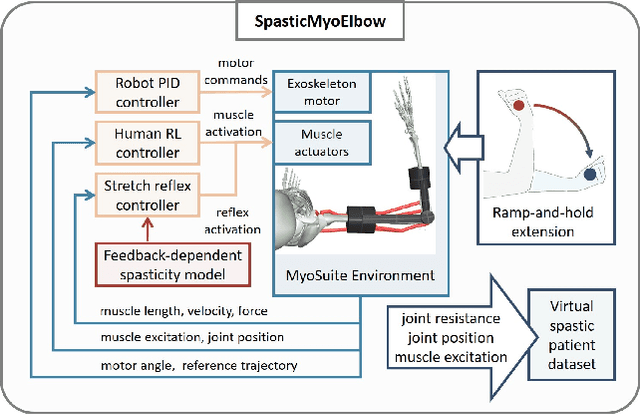
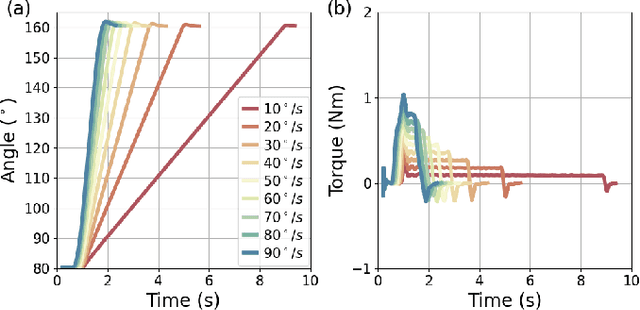
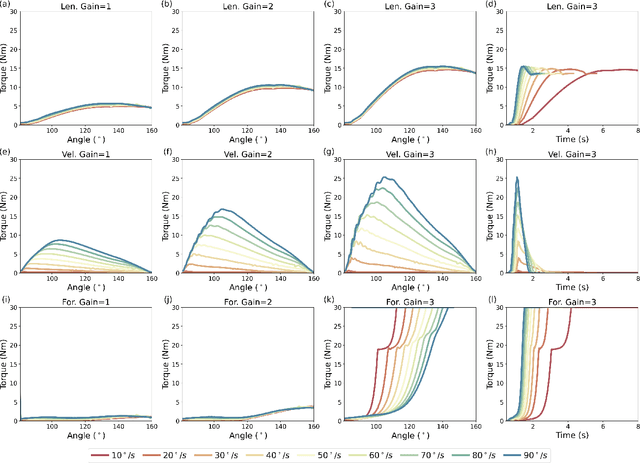
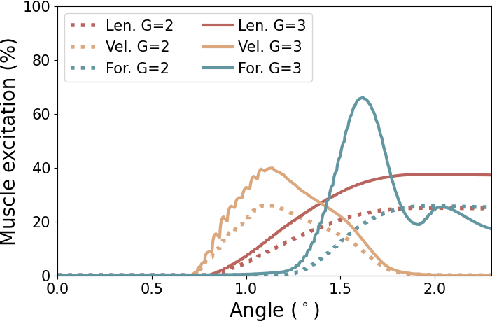
Robotic devices hold great potential for efficient and reliable assessment of neuromotor abnormalities in post-stroke patients. However, spasticity caused by stroke is still assessed manually in clinical settings. The limited and variable nature of data collected from patients has long posed a major barrier to quantitatively modelling spasticity with robotic measurements and fully validating robotic assessment techniques. This paper presents a simulation framework developed to support the design and validation of elbow spasticity models and mitigate data problems. The framework consists of a simulation environment of robot-assisted spasticity assessment, two motion controllers for the robot and human models, and a stretch reflex controller. Our framework allows simulation based on synthetic data without experimental data from human subjects. Using this framework, we replicated the constant-velocity stretch experiment typically used in robot-assisted spasticity assessment and evaluated four types of spasticity models. Our results show that a spasticity reflex model incorporating feedback on both muscle fibre velocity and length more accurately captures joint resistance characteristics during passive elbow stretching in spastic patients than a force-dependent model. When integrated with an appropriate spasticity model, this simulation framework has the potential to generate extensive datasets of virtual patients for future research on spasticity assessment.