 Add to Chrome
 Add to Firefox
 Add to Edge
Learning Varying Physical Therapist-Patient Interactions for Robot-mediated Upper Limb Task-Specific Training
Aug 17, 2026
Upper extremity motor function recovery is positively linked to Task-Specific Training (TST) and sufficient therapy dosage. Rehabilitation robots can increase TST dosage via controlled, repetitive treatment and free therapists to simultaneously manage other patients, but it has yet to demonstrate significant benefits over conventional treatment. This is potentially linked to inaccurate robotic representation of personalised physical therapist-patient interaction and lack of practice variability during TST. Hence, we advocate for robotic interventions that preserve the personalised physical therapist-patient interactions when delivering TST for patients across varying practise conditions. We propose a Learning-from-Demonstration framework using Task-Parameterised Gaussian Mixture Models (TPGMM) to learn personalised physical therapist-patient interaction in Task-Specific exercises, mapping patient joint kinematics to therapist-applied torques using few demonstrations. The model is generalised to reconstruct therapist torques in new task variations. The framework was evaluated on physical interactions from 14 mock "therapist-patient" pairs over three tasks of increasing complexity, each with six variations. A benchmark comparison against a Look-Up Table was conducted. The results show both methods reproducing interactions in unseen task variations that deviate slightly from the actual interaction, with TPGMM slightly outperforming LUT. Both methods reproduced interactions that gets increasingly closer to the actual interaction as task complexity increases.

Cross-Domain Transfer Learning using Attention Latent Features for Multi-Agent Trajectory Prediction
Nov 12, 2024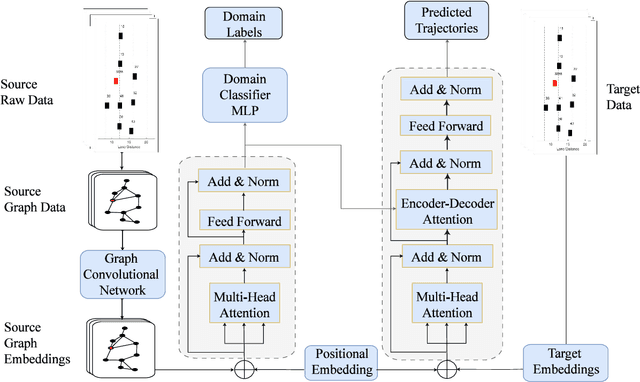
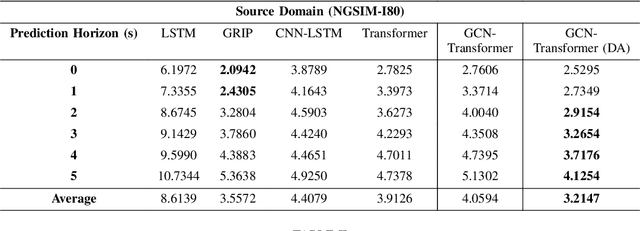
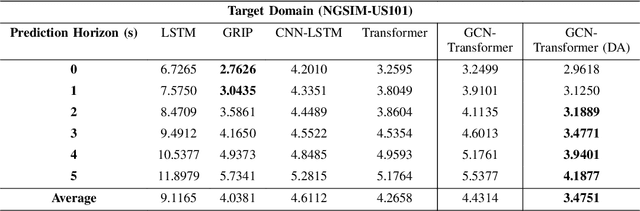
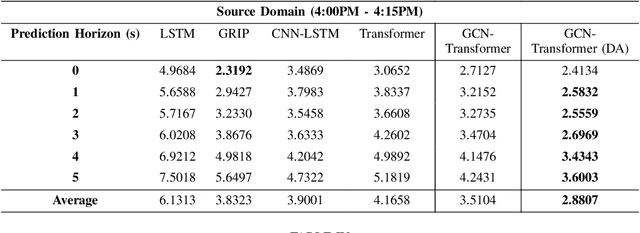
With the advancements of sensor hardware, traffic infrastructure and deep learning architectures, trajectory prediction of vehicles has established a solid foundation in intelligent transportation systems. However, existing solutions are often tailored to specific traffic networks at particular time periods. Consequently, deep learning models trained on one network may struggle to generalize effectively to unseen networks. To address this, we proposed a novel spatial-temporal trajectory prediction framework that performs cross-domain adaption on the attention representation of a Transformer-based model. A graph convolutional network is also integrated to construct dynamic graph feature embeddings that accurately model the complex spatial-temporal interactions between the multi-agent vehicles across multiple traffic domains. The proposed framework is validated on two case studies involving the cross-city and cross-period settings. Experimental results show that our proposed framework achieves superior trajectory prediction and domain adaptation performances over the state-of-the-art models.