 Add to Chrome
 Add to Firefox
 Add to Edge
DQ-Ladder: A Deep Reinforcement Learning-based Bitrate Ladder for Adaptive Video Streaming
Mar 13, 2026
Adaptive streaming of segmented video over HTTP typically relies on a predefined set of bitrate-resolution pairs, known as a bitrate ladder. However, fixed ladders often overlook variations in content and decoding complexities, leading to suboptimal trade-offs between encoding time, decoding efficiency, and video quality. This article introduces DQ-Ladder, a deep reinforcement learning (DRL)-based scheme for constructing time- and quality-aware bitrate ladders for adaptive video streaming applications. DQ-Ladder employs predicted decoding time, quality scores, and bitrate levels per segment as inputs to a Deep Q-Network (DQN) agent, guided by a weighted reward function of decoding time, video quality, and resolution smoothness. We leverage machine learning models to predict decoding time, bitrate level, and objective quality metrics (VMAF, XPSNR), eliminating the need for exhaustive encoding or quality metric computation. We evaluate DQ-Ladder using the Versatile Video Coding (VVC) toolchain (VVenC/VVdeC) on 750 video sequences across six Apple HLS-compliant resolutions and 41 quantization parameters. Experimental results against four baselines show that DQ-Ladder achieves BD-rate reductions of at least 10.3% for XPSNR compared to the HLS ladder, while reducing decoding time by 22%. DQ-Ladder shows significantly lower sensitivity to prediction errors than competing methods, remaining robust even with up to 20% noise.

Content-Driven Frame-Level Bit Prediction for Rate Control in Versatile Video Coding
Feb 05, 2026Rate control allocates bits efficiently across frames to meet a target bitrate while maintaining quality. Conventional two-pass rate control (2pRC) in Versatile Video Coding (VVC) relies on analytical rate-QP models, which often fail to capture nonlinear spatial-temporal variations, causing quality instability and high complexity due to multiple trial encodes. This paper proposes a content-adaptive framework that predicts frame-level bit consumption using lightweight features from the Video Complexity Analyzer (VCA) and quantization parameters within a Random Forest regression. On ultra-high-definition sequences encoded with VVenC, the model achieves strong correlation with ground truth, yielding R2 values of 0.93, 0.88, and 0.77 for I-, P-, and B-frames, respectively. Integrated into a rate-control loop, it achieves comparable coding efficiency to 2pRC while reducing total encoding time by 33.3%. The results show that VCA-driven bit prediction provides a computationally efficient and accurate alternative to conventional rate-QP models.
Decoding Complexity-Rate-Quality Pareto-Front for Adaptive VVC Streaming
Sep 27, 2024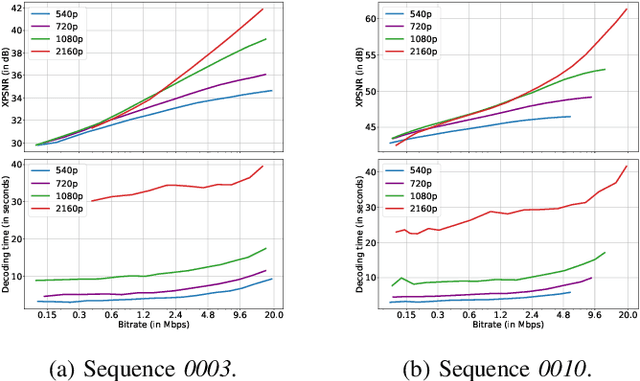
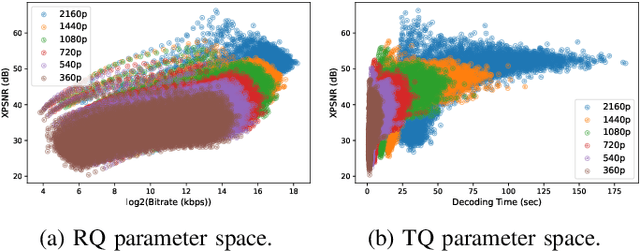
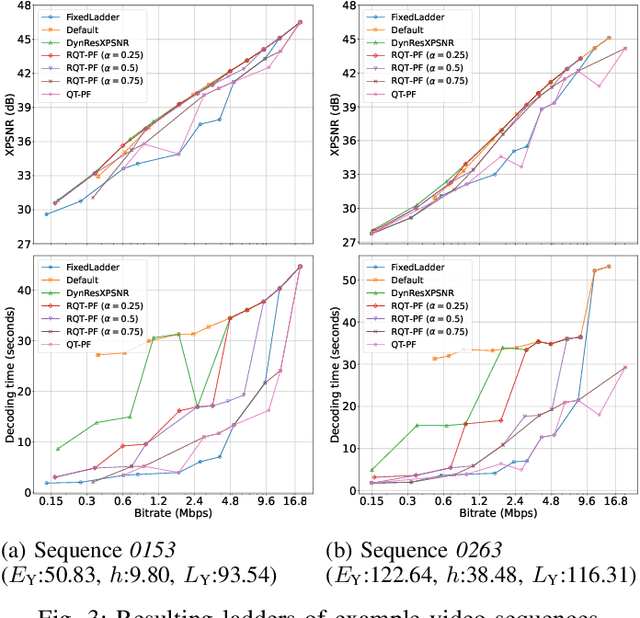
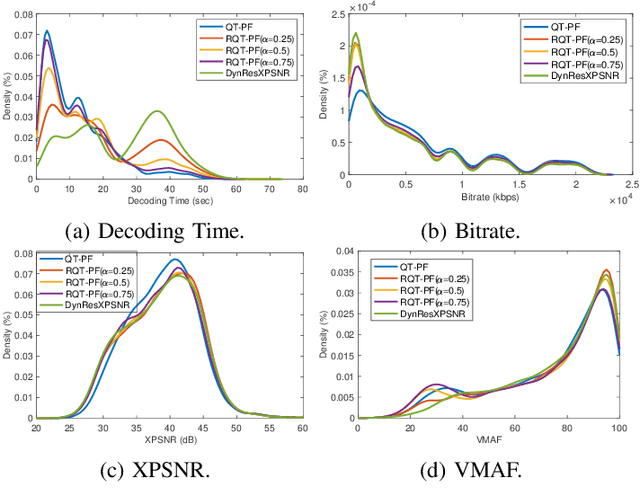
Pareto-front optimization is crucial for addressing the multi-objective challenges in video streaming, enabling the identification of optimal trade-offs between conflicting goals such as bitrate, video quality, and decoding complexity. This paper explores the construction of efficient bitrate ladders for adaptive Versatile Video Coding (VVC) streaming, focusing on optimizing these trade-offs. We investigate various ladder construction methods based on Pareto-front optimization, including exhaustive Rate-Quality and fixed ladder approaches. We propose a joint decoding time-rate-quality Pareto-front, providing a comprehensive framework to balance bitrate, decoding time, and video quality in video streaming. This allows streaming services to tailor their encoding strategies to meet specific requirements, prioritizing low decoding latency, bandwidth efficiency, or a balanced approach, thus enhancing the overall user experience. The experimental results confirm and demonstrate these opportunities for navigating the decoding time-rate-quality space to support various use cases. For example, when prioritizing low decoding latency, the proposed method achieves decoding time reduction of 14.86% while providing Bjontegaard delta rate savings of 4.65% and 0.32dB improvement in the eXtended Peak Signal-to-Noise Ratio (XPSNR)-Rate domain over the traditional fixed ladder solution.
Convex-hull Estimation using XPSNR for Versatile Video Coding
Jun 19, 2024As adaptive streaming becomes crucial for delivering high-quality video content across diverse network conditions, accurate metrics to assess perceptual quality are essential. This paper explores using the eXtended Peak Signal-to-Noise Ratio (XPSNR) metric as an alternative to the popular Video Multimethod Assessment Fusion (VMAF) metric for determining optimized bitrate-resolution pairs in the context of Versatile Video Coding (VVC). Our study is rooted in the observation that XPSNR shows a superior correlation with subjective quality scores for VVC-coded Ultra-High Definition (UHD) content compared to VMAF. We predict the average XPSNR of VVC-coded bitstreams using spatiotemporal complexity features of the video and the target encoding configuration and then determine the convex-hull online. On average, the proposed convex-hull using XPSNR (VEXUS) achieves an overall quality improvement of 5.84 dB PSNR and 0.62 dB XPSNR while maintaining the same bitrate, compared to the default UHD encoding using the VVenC encoder, accompanied by an encoding time reduction of 44.43% and a decoding time reduction of 65.46%. This shift towards XPSNR as a guiding metric shall enhance the effectiveness of adaptive streaming algorithms, ensuring an optimal balance between bitrate efficiency and perceptual fidelity with advanced video coding standards.