 Add to Chrome
 Add to Firefox
 Add to Edge
Fusion: A Framework for Unified Sequential Token AdaptatIon in VisiOn TraNsformers
Jul 01, 2026
Vision Transformers achieve strong image classification accuracy but process all image regions with nearly the same computation, even when many regions are redundant or uninformative. Recent adaptive inference methods reduce this cost by selectively compressing tokens or terminating inference early, but combining these mechanisms often causes unstable intermediate representations and accuracy degradation. We introduce Fusion, a unified adaptive inference framework that coordinates token merging, early exiting, and token pruning through a simple staged design: tokens are merged first, confidence is evaluated next, and pruning is applied only to samples that continue inference. This ordering allows the three mechanisms to operate cooperatively rather than competitively. Fusion further includes lightweight routing modules that adapt compression strength to each input and support inference-time adjustment of the accuracy--latency trade-off without retraining. On ImageNet-1k with DeiT-S, Fusion matches or surpasses state-of-the-art adaptive ViT methods at comparable compute budgets while reducing calibration error by up to $4\times$ and inference energy by $48\%$. Experiments across ImageNet-100, CIFAR-100, and ImageNette with multiple ViT backbones demonstrate consistent transferability without dataset-specific tuning.

Energy-Aware Frame Rate Selection for Video Coding
Mar 18, 2026The main contributions of this paper are twofold: First, we present an in-depth analysis of the impact of frame rate reductions on the visual quality of the video and the encoding as well as decoding energy. Second, we propose a lightweight frame rate selection method for energy- and quality-aware encoding. Concerning the first contribution, this paper performs extensive encoding and decoding measurements, followed by an investigation of the impact of temporal downsampling on the energy demand of encoding and decoding at different frame rates. Furthermore, we determine the objective visual quality of the downsampled videos. As a result of this investigation, we identify content- and quantization-setting-dependent energy-aware frame rates, i.e., the temporal downsampling factors that lead to Pareto-optimality in terms of energy and quality. We demonstrate that significant energy savings are achieved while maintaining constant visual quality. Subsequently, a subjective experiment is conducted to verify this observation regarding perceptual quality using mean opinion scores. As the second contribution, we propose an energy-aware frame rate selection method that extracts spatio-temporal features from the video sequences. Based on these features, the proposed method employs a feature-based supervised machine learning approach to predict energy-aware frame rates for a given quantization parameter and video sequence, aiming to reduce energy consumption during encoding and decoding. The experimental results demonstrate that the proposed method offers significant energy savings, with an average of 17.46% and 17.60% of encoding and decoding energy demand reduction, respectively, alongside 3.38% average bitrate savings at a constant quality.
RESQ: A Unified Framework for REliability- and Security Enhancement of Quantized Deep Neural Networks
Mar 16, 2026This work proposes a unified three-stage framework that produces a quantized DNN with balanced fault and attack robustness. The first stage improves attack resilience via fine-tuning that desensitizes feature representations to small input perturbations. The second stage reinforces fault resilience through fault-aware fine-tuning under simulated bit-flip faults. Finally, a lightweight post-training adjustment integrates quantization to enhance efficiency and further mitigate fault sensitivity without degrading attack resilience. Experiments on ResNet18, VGG16, EfficientNet, and Swin-Tiny in CIFAR-10, CIFAR-100, and GTSRB show consistent gains of up to 10.35% in attack resilience and 12.47% in fault resilience, while maintaining competitive accuracy in quantized networks. The results also highlight an asymmetric interaction in which improvements in fault resilience generally increase resilience to adversarial attacks, whereas enhanced adversarial resilience does not necessarily lead to higher fault resilience.
SPARQ: Spiking Early-Exit Neural Networks for Energy-Efficient Edge AI
Mar 15, 2026Spiking neural networks (SNNs) offer inherent energy efficiency due to their event-driven computation model, making them promising for edge AI deployment. However, their practical adoption is limited by the computational overhead of deep architectures and the absence of input-adaptive control. This work presents SPARQ, a unified framework that integrates spiking computation, quantization-aware training, and reinforcement learning-guided early exits for efficient and adaptive inference. Evaluations across MLP, LeNet, and AlexNet architectures demonstrated that the proposed Quantised Dynamic SNNs (QDSNN) consistently outperform conventional SNNs and QSNNs, achieving up to 5.15% higher accuracy over QSNNs, over 330 times lower system energy compared to baseline SNNs, and over 90 percent fewer synaptic operations across different datasets. These results validate SPARQ as a hardware-friendly, energy-efficient solution for real-time AI at the edge.
HAWX: A Hardware-Aware FrameWork for Fast and Scalable ApproXimation of DNNs
Feb 18, 2026This work presents HAWX, a hardware-aware scalable exploration framework that employs multi-level sensitivity scoring at different DNN abstraction levels (operator, filter, layer, and model) to guide selective integration of heterogeneous AxC blocks. Supported by predictive models for accuracy, power, and area, HAWX accelerates the evaluation of candidate configurations, achieving over 23* speedup in a layer-level search with two candidate approximate blocks and more than (3*106)* speedup at the filter-level search only for LeNet-5, while maintaining accuracy comparable to exhaustive search. Experiments across state-of-the-art DNN benchmarks such as VGG-11, ResNet-18, and EfficientNetLite demonstrate that the efficiency benefits of HAWX scale exponentially with network size. The HAWX hardware-aware search algorithm supports both spatial and temporal accelerator architectures, leveraging either off-the-shelf approximate components or customized designs.
Content-Driven Frame-Level Bit Prediction for Rate Control in Versatile Video Coding
Feb 05, 2026Rate control allocates bits efficiently across frames to meet a target bitrate while maintaining quality. Conventional two-pass rate control (2pRC) in Versatile Video Coding (VVC) relies on analytical rate-QP models, which often fail to capture nonlinear spatial-temporal variations, causing quality instability and high complexity due to multiple trial encodes. This paper proposes a content-adaptive framework that predicts frame-level bit consumption using lightweight features from the Video Complexity Analyzer (VCA) and quantization parameters within a Random Forest regression. On ultra-high-definition sequences encoded with VVenC, the model achieves strong correlation with ground truth, yielding R2 values of 0.93, 0.88, and 0.77 for I-, P-, and B-frames, respectively. Integrated into a rate-control loop, it achieves comparable coding efficiency to 2pRC while reducing total encoding time by 33.3%. The results show that VCA-driven bit prediction provides a computationally efficient and accurate alternative to conventional rate-QP models.
Adaptive Resolution and Chroma Subsampling for Energy-Efficient Video Coding
Feb 05, 2026Conventional video encoders typically employ a fixed chroma subsampling format, such as YUV420, which may not optimally reflect variations in chroma detail across different types of content. This can lead to suboptimal chroma quality and inefficiencies in bitrate allocation. We propose an Adaptive Resolution-Chroma Subsampling (ARCS) framework that jointly optimizes spatial resolution and chroma subsampling to balance perceptual quality and decoding efficiency. ARCS selects an optimal (resolution, chroma format) pair for each bitrate by maximizing a composite quality-complexity objective, while enforcing monotonicity constraints to ensure smooth transitions between representations. Experimental results using x265 show that, compared to a fixed-format encoding (YUV444), on average, ARCS achieves a 13.48 % bitrate savings and a 62.18 % reduction in decoding time, which we use as a proxy for the decoding energy, to yield the same colorVideoVDP score. The proposed framework introduces chroma adaptivity as a new control dimension for energy-efficient video streaming.
Fast Multirate Encoding for 360° Video in OMAF Streaming Workflows
Jan 24, 2026Preparing high-quality 360-degree video for HTTP Adaptive Streaming requires encoding each sequence into multiple representations spanning different resolutions and quantization parameters (QPs). For ultra-high-resolution immersive content such as 8K 360-degree video, this process is computationally intensive due to the large number of representations and the high complexity of modern codecs. This paper investigates fast multirate encoding strategies that reduce encoding time by reusing encoder analysis information across QPs and resolutions. We evaluate two cross-resolution information-reuse pipelines that differ in how reference encodes propagate across resolutions: (i) a strict HD -> 4K -> 8K cascade with scaled analysis reuse, and (ii) a resolution-anchored scheme that initializes each resolution with its own highest-bitrate reference before guiding dependent encodes. In addition to evaluating these pipelines on standard equirectangular projection content, we also apply the same two pipelines to cubemap-projection (CMP) tiling, where each 360-degree frame is partitioned into independently encoded tiles. CMP introduces substantial parallelism, while still benefiting from the proposed multirate analysis-reuse strategies. Experimental results using the SJTU 8K 360-degree dataset show that hierarchical analysis reuse significantly accelerates HEVC encoding with minimal rate-distortion impact across both equirectangular and CMP-tiled content, yielding encoding-time reductions of roughly 33%-59% for ERP and about 51% on average for CMP, with Bjontegaard Delta Encoding Time (BDET) gains approaching -50% and wall-clock speedups of up to 4.2x.
A High-Level Feature Model to Predict the Encoding Energy of a Hardware Video Encoder
Oct 14, 2025In today's society, live video streaming and user generated content streamed from battery powered devices are ubiquitous. Live streaming requires real-time video encoding, and hardware video encoders are well suited for such an encoding task. In this paper, we introduce a high-level feature model using Gaussian process regression that can predict the encoding energy of a hardware video encoder. In an evaluation setup restricted to only P-frames and a single keyframe, the model can predict the encoding energy with a mean absolute percentage error of approximately 9%. Further, we demonstrate with an ablation study that spatial resolution is a key high-level feature for encoding energy prediction of a hardware encoder. A practical application of our model is that it can be used to perform a prior estimation of the energy required to encode a video at various spatial resolutions, with different coding standards and codec presets.
Design Space Exploration at Frame-Level for Joint Decoding Energy and Quality Optimization in VVC
Oct 01, 2024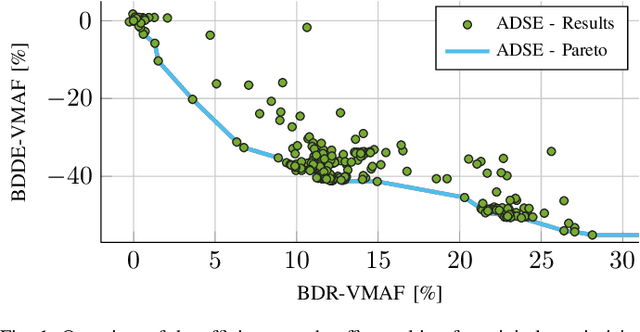
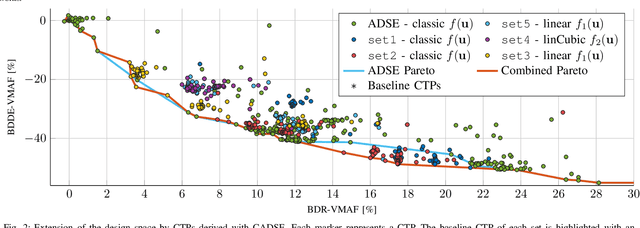
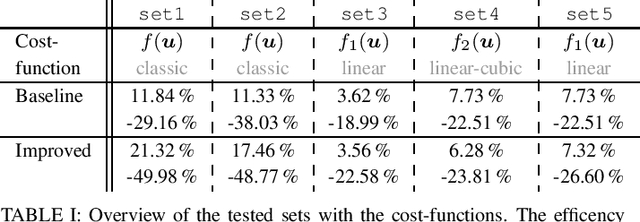
In the pursuit of a reduced energy demand of VVC decoders, it was found that the coding tool configuration has a substantial influence on the bit rate efficiency and the decoding energy demand. The Advanced Design Space Exploration algorithm as proposed in the literature, can derive coding tool configurations that provide optimal trade-offs between rate and energy efficiency. Yet, some trade-off points in the design space cannot be reached with the state-of-the-art methodology, which defines coding tools for an entire bitstream. This work proposes a novel, granular adjustment of the coding tool usage in VVC. Consequently, the optimization algorithm is adjusted to explore coding tool configurations that operate on frame-level. Moreover, new optimization criteria are introduced to focus the search on specific bit rates. As a result, coding tool configurations are obtained which yield so far inaccessible trade-offs between bit rate efficiency and decoding energy demand for VVC-coded sequences. The proposed methodology extends the design space and enhances the continuity of the Pareto front.
* submitted, accepted and published at EuSipCo 2024, Special Session on Frugality for Video Streaming