 Add to Chrome
 Add to Firefox
 Add to Edge
DQ-Ladder: A Deep Reinforcement Learning-based Bitrate Ladder for Adaptive Video Streaming
Mar 13, 2026
Adaptive streaming of segmented video over HTTP typically relies on a predefined set of bitrate-resolution pairs, known as a bitrate ladder. However, fixed ladders often overlook variations in content and decoding complexities, leading to suboptimal trade-offs between encoding time, decoding efficiency, and video quality. This article introduces DQ-Ladder, a deep reinforcement learning (DRL)-based scheme for constructing time- and quality-aware bitrate ladders for adaptive video streaming applications. DQ-Ladder employs predicted decoding time, quality scores, and bitrate levels per segment as inputs to a Deep Q-Network (DQN) agent, guided by a weighted reward function of decoding time, video quality, and resolution smoothness. We leverage machine learning models to predict decoding time, bitrate level, and objective quality metrics (VMAF, XPSNR), eliminating the need for exhaustive encoding or quality metric computation. We evaluate DQ-Ladder using the Versatile Video Coding (VVC) toolchain (VVenC/VVdeC) on 750 video sequences across six Apple HLS-compliant resolutions and 41 quantization parameters. Experimental results against four baselines show that DQ-Ladder achieves BD-rate reductions of at least 10.3% for XPSNR compared to the HLS ladder, while reducing decoding time by 22%. DQ-Ladder shows significantly lower sensitivity to prediction errors than competing methods, remaining robust even with up to 20% noise.

Stream Reasoning-Based Control of Caching Strategies in CCN Routers
Oct 13, 2016
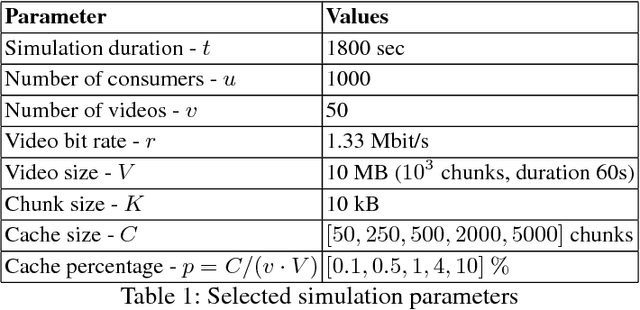
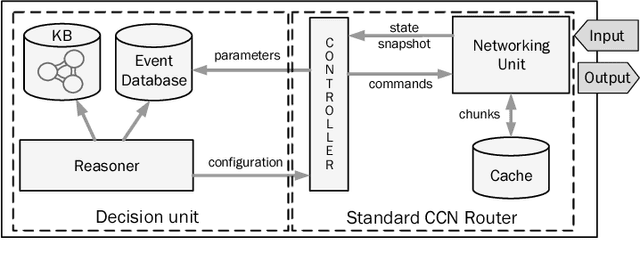
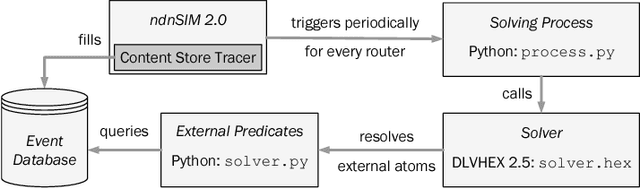
Content-Centric Networking (CCN) research addresses the mismatch between the modern usage of the Internet and its outdated architecture. Importantly, CCN routers may locally cache frequently requested content in order to speed up delivery to end users. Thus, the issue of caching strategies arises, i.e., which content shall be stored and when it should be replaced. In this work, we employ novel techniques towards intelligent administration of CCN routers that autonomously switch between existing strategies in response to changing content request patterns. In particular, we present a router architecture for CCN networks that is controlled by rule-based stream reasoning, following the recent formal framework LARS which extends Answer Set Programming for streams. The obtained possibility for flexible router configuration at runtime allows for faster experimentation and may thus help to advance the further development of CCN. Moreover, the empirical evaluation of our feasibility study shows that the resulting caching agent may give significant performance gains.