 Add to Chrome
 Add to Firefox
 Add to Edge
Hybrid Continual Learning for Low-Resource Australian Aboriginal Language Identification
Jul 11, 2026
Language identification is an important step toward integrating endangered Australian Aboriginal languages (AALs) into speech technologies supporting language revitalisation and digital inclusion. However, extreme data scarcity limits model performance. Transfer learning from high-resource languages shows promise but often suffers from catastrophic forgetting when adapting to new languages. Continual learning (CL) can mitigate this issue, though it remains challenging with very limited data. To address this, we propose two hybrid continual learning methods: Replay Augmented Elastic Weight Consolidation and Constraint Guided Knowledge Distillation to adapt pretrained speech models for AAL identification while preserving previously learned knowledge. Experiments on Warlpiri, Dalabon and Dharawal show that the proposed methods outperform fine-tuning and existing CL baselines, improving adaptation to multiple AALs while maintaining performance on previously learnt high-resource languages.

Which Languages Transfer Best to Warlpiri? A Similarity-Based Study for Low-Resource ASR
Jul 11, 2026This paper investigates how language similarity can improve cross-lingual transfer for automatic speech recognition (ASR) in extremely low-resource settings. Warlpiri, an Australian Aboriginal language, has very limited transcribed speech data, making transfer learning essential. We propose a framework combining acoustic similarity from pre-trained speech models with linguistic similarity based on typology, phoneme inventories, grammatical, and syntactic features to rank high-resource source languages and evaluate their effectiveness for ASR transfer to Warlpiri. Experiments with Whisper show that acoustically and typologically similar languages outperform monolingual and multilingual baselines. Assamese and Hindi achieve substantial reductions in word and character error rates. Correlation analysis further indicates that acoustic similarity is the strongest predictor of fine-tuning performance, while phoneme inventory and typological similarity better explain zero-shot transfer.
BiEAR: A Human Auditory-Inspired Adaptive Binaural Front-end for Multi-Speaker Localisation and Distance Estimation
Jun 05, 2026We present BiEAR, a human auditory-inspired adaptive binaural front-end for multi-speaker localisation and distance estimation. Inspired by medial olivocochlear (MOC) feedback in human hearing, BiEAR uses a neural controller to adaptively adjust the frequency selectivity of a binaural auditory filterbank during inference. This yields time-frequency adaptive representations for ears, enabling the model to respond to changing acoustic conditions. We evaluate BiEAR on multi-speaker localisation and distance estimation in anechoic and real-room environments. Results show that the adaptive front-end improves localisation accuracy and robustness to unseen speakers and rooms compared with commonly used fixed binaural front-ends. Visualisation and analysis of learned filter adaptations show that BiEAR emphasises informative frequency bands over time. These findings suggest that adaptive, biologically inspired binaural front-ends can improve machine hearing robustness in complex acoustic scenes.
Why Can't They Remember? Uncovering Representation and Retrieval Bottlenecks in Multi-Turn Acoustic Memory
May 26, 2026Large audio language models (LALMs) process both speech and environmental acoustic cues, yet struggle to retain non-speech information across multi-turn interactions. The performance gap between semantic (speech) and acoustic (non-speech) understanding remains poorly understood, and the underlying mechanisms of representation and retrieval are still unclear. This work introduces EnvMem, a controlled multi-turn benchmark designed to study this gap and identify the root causes of failures at the representation (i.e., latent embeddings) and retrieval levels (i.e., attention allocation). We further conduct post-hoc interventions to probe representational structure and attention dynamics. Our results reveal representational trajectory drift as the key failure mode, while showing that attention allocation plays a limited role in explaining the observed degradation. Overall, we provide a systematic framework for analyzing and improving non-linguistic memory in long-context LALMs, shedding light on future data and training design for robust acoustic memory modeling.
Beyond Deep Learning: Speech Segmentation and Phone Classification with Neural Assemblies
Mar 11, 2026Deep learning dominates speech processing but relies on massive datasets, global backpropagation-guided weight updates, and produces entangled representations. Assembly Calculus (AC), which models sparse neuronal assemblies via Hebbian plasticity and winner-take-all competition, offers a biologically grounded alternative, yet prior work focused on discrete symbolic inputs. We introduce an AC-based speech processing framework that operates directly on continuous speech by combining three key contributions:(i) neural encoding that converts speech into assembly-compatible spike patterns using probabilistic mel binarisation and population-coded MFCCs; (ii) a multi-area architecture organising assemblies across hierarchical timescales and classes; and (iii) cross-area update schemes for downstream tasks. Applied to two core tasks of boundary detection and segment classification, our framework detects phone (F1=0.69) and word (F1=0.61) boundaries without any weight training, and achieves 47.5% and 45.1% accuracy on phone and command recognition. These results show that AC-based dynamical systems are a viable alternative to deep learning for speech processing.
Should Audio Front-ends be Adaptive? Comparing Learnable and Adaptive Front-ends
Feb 05, 2025Hand-crafted features, such as Mel-filterbanks, have traditionally been the choice for many audio processing applications. Recently, there has been a growing interest in learnable front-ends that extract representations directly from the raw audio waveform. \textcolor{black}{However, both hand-crafted filterbanks and current learnable front-ends lead to fixed computation graphs at inference time, failing to dynamically adapt to varying acoustic environments, a key feature of human auditory systems.} To this end, we explore the question of whether audio front-ends should be adaptive by comparing the Ada-FE front-end (a recently developed adaptive front-end that employs a neural adaptive feedback controller to dynamically adjust the Q-factors of its spectral decomposition filters) to established learnable front-ends. Specifically, we systematically investigate learnable front-ends and Ada-FE across two commonly used back-end backbones and a wide range of audio benchmarks including speech, sound event, and music. The comprehensive results show that our Ada-FE outperforms advanced learnable front-ends, and more importantly, it exhibits impressive stability or robustness on test samples over various training epochs.
Blind Estimation of Sub-band Acoustic Parameters from Ambisonics Recordings using Spectro-Spatial Covariance Features
Nov 05, 2024Estimating frequency-varying acoustic parameters is essential for enhancing immersive perception in realistic spatial audio creation. In this paper, we propose a unified framework that blindly estimates reverberation time (T60), direct-to-reverberant ratio (DRR), and clarity (C50) across 10 frequency bands using first-order Ambisonics (FOA) speech recordings as inputs. The proposed framework utilizes a novel feature named Spectro-Spatial Covariance Vector (SSCV), efficiently representing temporal, spectral as well as spatial information of the FOA signal. Our models significantly outperform existing single-channel methods with only spectral information, reducing estimation errors by more than half for all three acoustic parameters. Additionally, we introduce FOA-Conv3D, a novel back-end network for effectively utilising the SSCV feature with a 3D convolutional encoder. FOA-Conv3D outperforms the convolutional neural network (CNN) and recurrent convolutional neural network (CRNN) backends, achieving lower estimation errors and accounting for a higher proportion of variance (PoV) for all 3 acoustic parameters.
AER-LLM: Ambiguity-aware Emotion Recognition Leveraging Large Language Models
Sep 26, 2024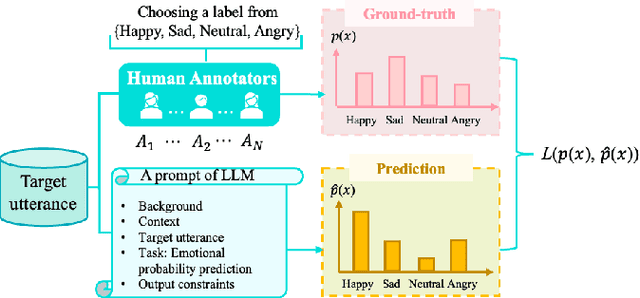
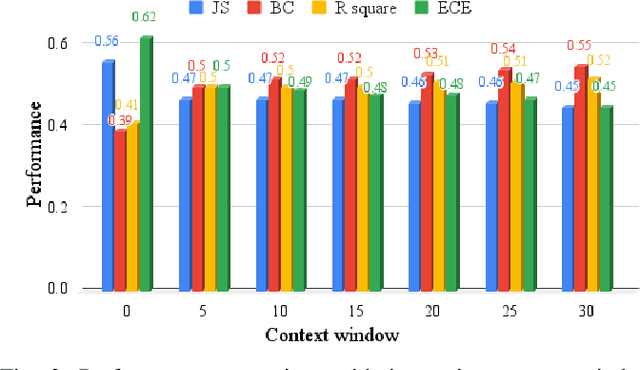
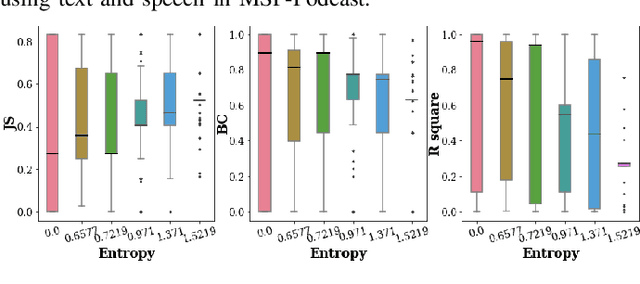
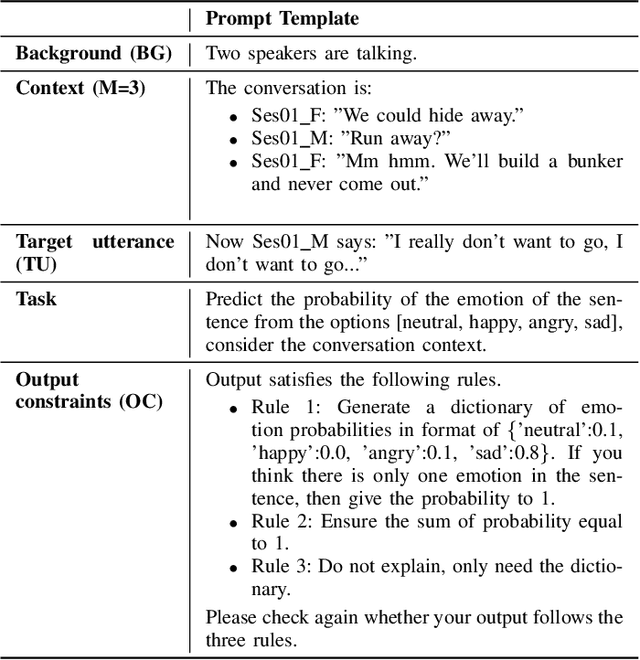
Recent advancements in Large Language Models (LLMs) have demonstrated great success in many Natural Language Processing (NLP) tasks. In addition to their cognitive intelligence, exploring their capabilities in emotional intelligence is also crucial, as it enables more natural and empathetic conversational AI. Recent studies have shown LLMs' capability in recognizing emotions, but they often focus on single emotion labels and overlook the complex and ambiguous nature of human emotions. This study is the first to address this gap by exploring the potential of LLMs in recognizing ambiguous emotions, leveraging their strong generalization capabilities and in-context learning. We design zero-shot and few-shot prompting and incorporate past dialogue as context information for ambiguous emotion recognition. Experiments conducted using three datasets indicate significant potential for LLMs in recognizing ambiguous emotions, and highlight the substantial benefits of including context information. Furthermore, our findings indicate that LLMs demonstrate a high degree of effectiveness in recognizing less ambiguous emotions and exhibit potential for identifying more ambiguous emotions, paralleling human perceptual capabilities.
Dual-Constrained Dynamical Neural ODEs for Ambiguity-aware Continuous Emotion Prediction
Jul 31, 2024There has been a significant focus on modelling emotion ambiguity in recent years, with advancements made in representing emotions as distributions to capture ambiguity. However, there has been comparatively less effort devoted to the consideration of temporal dependencies in emotion distributions which encodes ambiguity in perceived emotions that evolve smoothly over time. Recognizing the benefits of using constrained dynamical neural ordinary differential equations (CD-NODE) to model time series as dynamic processes, we propose an ambiguity-aware dual-constrained Neural ODE approach to model the dynamics of emotion distributions on arousal and valence. In our approach, we utilize ODEs parameterised by neural networks to estimate the distribution parameters, and we integrate additional constraints to restrict the range of the system outputs to ensure the validity of predicted distributions. We evaluated our proposed system on the publicly available RECOLA dataset and observed very promising performance across a range of evaluation metrics.
Binaural Selective Attention Model for Target Speaker Extraction
Jun 18, 2024
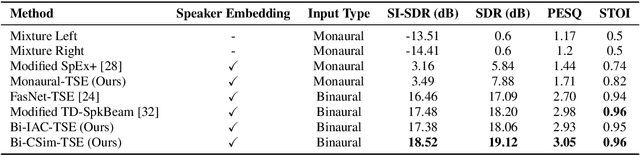
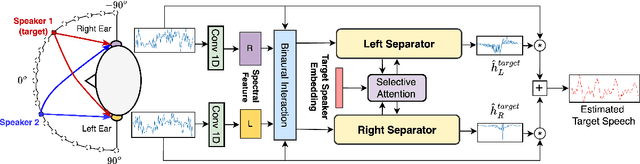
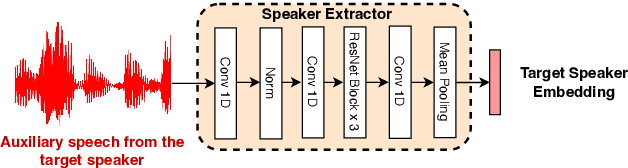
The remarkable ability of humans to selectively focus on a target speaker in cocktail party scenarios is facilitated by binaural audio processing. In this paper, we present a binaural time-domain Target Speaker Extraction model based on the Filter-and-Sum Network (FaSNet). Inspired by human selective hearing, our proposed model introduces target speaker embedding into separators using a multi-head attention-based selective attention block. We also compared two binaural interaction approaches -- the cosine similarity of time-domain signals and inter-channel correlation in learned spectral representations. Our experimental results show that our proposed model outperforms monaural configurations and state-of-the-art multi-channel target speaker extraction models, achieving best-in-class performance with 18.52 dB SI-SDR, 19.12 dB SDR, and 3.05 PESQ scores under anechoic two-speaker test configurations.