 Add to Chrome
 Add to Firefox
 Add to Edge
Nemotron 3 Ultra: Open, Efficient Mixture-of-Experts Hybrid Mamba-Transformer Model for Agentic Reasoning
Jun 12, 2026
We introduce Nemotron 3 Ultra, a 550 billion total and 55 billion active parameter Mixture-of-Experts Hybrid Mamba-Attention language model. We pre-trained Nemotron 3 Ultra on 20 trillion text tokens, then extended the context length to 1M tokens, and post-trained using Supervised Fine Tuning (SFT), Reinforcement Learning (RL), and Multi-teacher On-Policy Distillation (MOPD). Nemotron 3 Ultra is our most capable model yet, employing multiple key technologies - LatentMoE, Multi Token Prediction (MTP), NVFP4 pre-training, multi-environment RLVR, MOPD, and reasoning budget control. Nemotron 3 Ultra achieves up to ~6x higher inference throughput as compared to state-of-the-art publicly available LLMs while attaining on-par accuracy. The state-of-the-art accuracy, high inference throughput, and 1M token context length make Nemotron 3 Ultra ideal for long-running autonomous agentic tasks. We open-source the base, post-trained, and quantized checkpoints, along with the training data and recipe on HuggingFace.

Nemotron 3 Super: Open, Efficient Mixture-of-Experts Hybrid Mamba-Transformer Model for Agentic Reasoning
Apr 14, 2026We describe the pre-training, post-training, and quantization of Nemotron 3 Super, a 120 billion (active 12 billion) parameter hybrid Mamba-Attention Mixture-of-Experts model. Nemotron 3 Super is the first model in the Nemotron 3 family to 1) be pre-trained in NVFP4, 2) leverage LatentMoE, a new Mixture-of-Experts architecture that optimizes for both accuracy per FLOP and accuracy per parameter, and 3) include MTP layers for inference acceleration through native speculative decoding. We pre-trained Nemotron 3 Super on 25 trillion tokens followed by post-training using supervised fine tuning (SFT) and reinforcement learning (RL). The final model supports up to 1M context length and achieves comparable accuracy on common benchmarks, while also achieving up to 2.2x and 7.5x higher inference throughput compared to GPT-OSS-120B and Qwen3.5-122B, respectively. Nemotron 3 Super datasets, along with the base, post-trained, and quantized checkpoints, are open-sourced on HuggingFace.
LatentMoE: Toward Optimal Accuracy per FLOP and Parameter in Mixture of Experts
Jan 26, 2026Mixture of Experts (MoEs) have become a central component of many state-of-the-art open-source and proprietary large language models. Despite their widespread adoption, it remains unclear how close existing MoE architectures are to optimal with respect to inference cost, as measured by accuracy per floating-point operation and per parameter. In this work, we revisit MoE design from a hardware-software co-design perspective, grounded in empirical and theoretical considerations. We characterize key performance bottlenecks across diverse deployment regimes, spanning offline high-throughput execution and online, latency-critical inference. Guided by these insights, we introduce LatentMoE, a new model architecture resulting from systematic design exploration and optimized for maximal accuracy per unit of compute. Empirical design space exploration at scales of up to 95B parameters and over a 1T-token training horizon, together with supporting theoretical analysis, shows that LatentMoE consistently outperforms standard MoE architectures in terms of accuracy per FLOP and per parameter. Given its strong performance, the LatentMoE architecture has been adopted by the flagship Nemotron-3 Super and Ultra models and scaled to substantially larger regimes, including longer token horizons and larger model sizes, as reported in Nvidia et al. (arXiv:2512.20856).
NVIDIA Nemotron 3: Efficient and Open Intelligence
Dec 24, 2025We introduce the Nemotron 3 family of models - Nano, Super, and Ultra. These models deliver strong agentic, reasoning, and conversational capabilities. The Nemotron 3 family uses a Mixture-of-Experts hybrid Mamba-Transformer architecture to provide best-in-class throughput and context lengths of up to 1M tokens. Super and Ultra models are trained with NVFP4 and incorporate LatentMoE, a novel approach that improves model quality. The two larger models also include MTP layers for faster text generation. All Nemotron 3 models are post-trained using multi-environment reinforcement learning enabling reasoning, multi-step tool use, and support granular reasoning budget control. Nano, the smallest model, outperforms comparable models in accuracy while remaining extremely cost-efficient for inference. Super is optimized for collaborative agents and high-volume workloads such as IT ticket automation. Ultra, the largest model, provides state-of-the-art accuracy and reasoning performance. Nano is released together with its technical report and this white paper, while Super and Ultra will follow in the coming months. We will openly release the model weights, pre- and post-training software, recipes, and all data for which we hold redistribution rights.
Nemotron 3 Nano: Open, Efficient Mixture-of-Experts Hybrid Mamba-Transformer Model for Agentic Reasoning
Dec 23, 2025We present Nemotron 3 Nano 30B-A3B, a Mixture-of-Experts hybrid Mamba-Transformer language model. Nemotron 3 Nano was pretrained on 25 trillion text tokens, including more than 3 trillion new unique tokens over Nemotron 2, followed by supervised fine tuning and large-scale RL on diverse environments. Nemotron 3 Nano achieves better accuracy than our previous generation Nemotron 2 Nano while activating less than half of the parameters per forward pass. It achieves up to 3.3x higher inference throughput than similarly-sized open models like GPT-OSS-20B and Qwen3-30B-A3B-Thinking-2507, while also being more accurate on popular benchmarks. Nemotron 3 Nano demonstrates enhanced agentic, reasoning, and chat abilities and supports context lengths up to 1M tokens. We release both our pretrained Nemotron 3 Nano 30B-A3B Base and post-trained Nemotron 3 Nano 30B-A3B checkpoints on Hugging Face.
ATTENTION2D: Communication Efficient Distributed Self-Attention Mechanism
Mar 20, 2025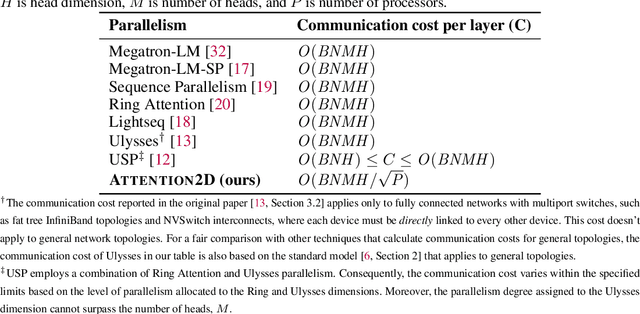
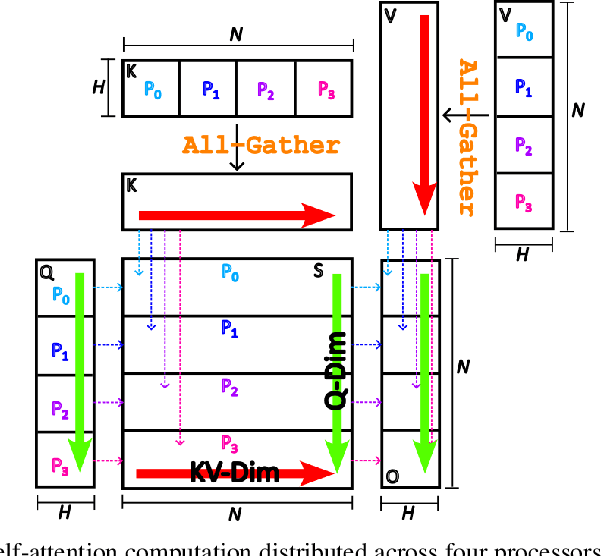

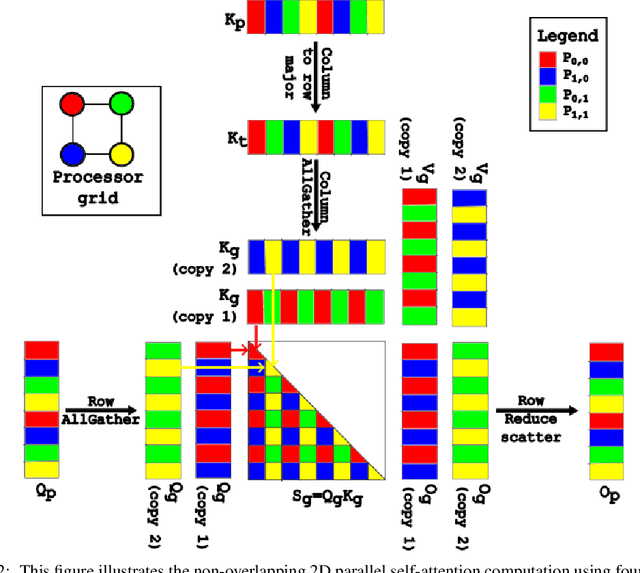
Transformer-based models have emerged as a leading architecture for natural language processing, natural language generation, and image generation tasks. A fundamental element of the transformer architecture is self-attention, which allows the model to capture intricate dependencies within the data. However, the self-attention mechanism also incurs significant computational and memory costs, particularly for long sequences. In this paper, we introduce ATTENTION2D, a novel approach that exploits parallelism along two dimensions - query and key/value - of the self-attention operation. This method enables efficient distribution and parallelization of computations across multiple devices. Our approach facilitates asymptotically faster training and inference phases compared to previous methods, without relying on approximations or incurring additional computational or memory overheads. Furthermore, unlike existing techniques that struggle to scale with an increasing number of processing units, our approach effectively scales with additional processing units. Our experimental results confirm the effectiveness of our method in improving communication efficiency and scalability. Compared to Ring Attention, our approach demonstrated up to a 5x performance boost on a GPT-3-like model using 64 NVIDIA A100 GPUs across 16 nodes, and up to a 9.4x performance boost on 64 NVIDIA H100 GPUs across 64 nodes.
PaSE: Parallelization Strategies for Efficient DNN Training
Jul 04, 2024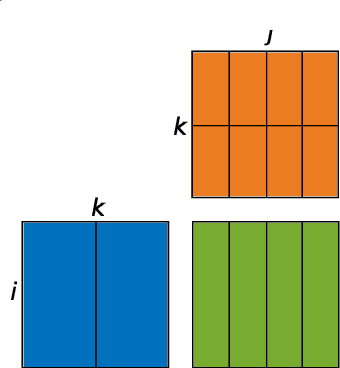
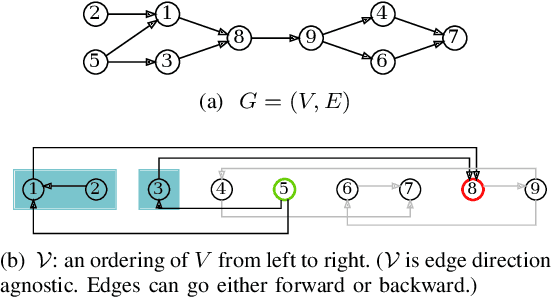
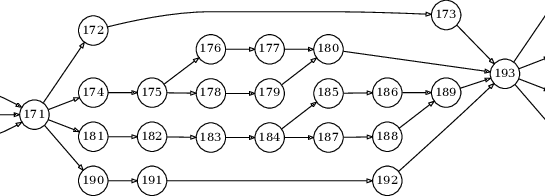
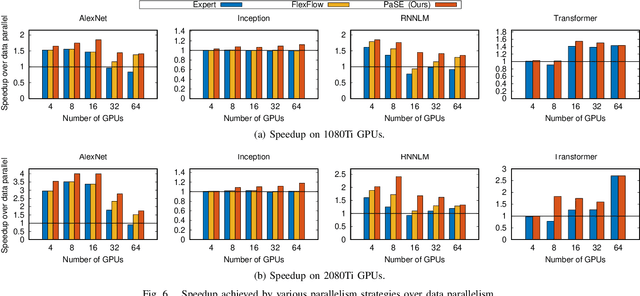
Training a deep neural network (DNN) requires substantial computational and memory requirements. It is common to use multiple devices to train a DNN to reduce the overall training time. There are several choices to parallelize each layer in a DNN. Exhaustively searching this list to find an optimal parallelization strategy is prohibitively time consuming and impractical. The standard practice is to use data parallelism because of its simplicity. However, data parallelism is often sub-optimal, and suffers from poor performance and high memory requirement. Expert-designed strategies have been proposed on a case-by-case basis using domain specific knowledge. These expert-designed strategies do not generalize well to DNNs other than the ones for which they were designed, and are not always necessarily the best choice. In this paper, we propose an approach to automatically find efficient parallelization strategies for DNNs from their computation graphs. We present an efficient algorithm to compute these strategies within a reasonable time in practice. We evaluate the effectiveness of our approach on various DNNs. We also compare the performance of the strategies identified by our approach against data parallelism, expert-designed strategies, and the state-of-the-art approaches. Our results show that the strategies found using our approach outperform the baseline data parallelism strategy in all the cases. In addition, our strategies achieve better performance than the expert-designed strategies and the state-of-the-art approaches.
* Published as conference paper at IPDPS 2021
Microscaling Data Formats for Deep Learning
Oct 19, 2023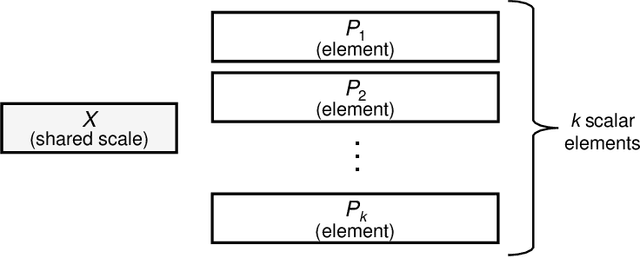
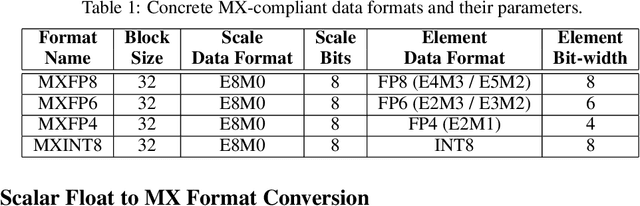
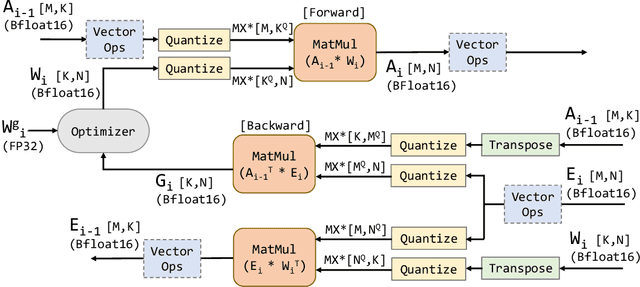

Narrow bit-width data formats are key to reducing the computational and storage costs of modern deep learning applications. This paper evaluates Microscaling (MX) data formats that combine a per-block scaling factor with narrow floating-point and integer types for individual elements. MX formats balance the competing needs of hardware efficiency, model accuracy, and user friction. Empirical results on over two dozen benchmarks demonstrate practicality of MX data formats as a drop-in replacement for baseline FP32 for AI inference and training with low user friction. We also show the first instance of training generative language models at sub-8-bit weights, activations, and gradients with minimal accuracy loss and no modifications to the training recipe.
Shared Microexponents: A Little Shifting Goes a Long Way
Feb 16, 2023

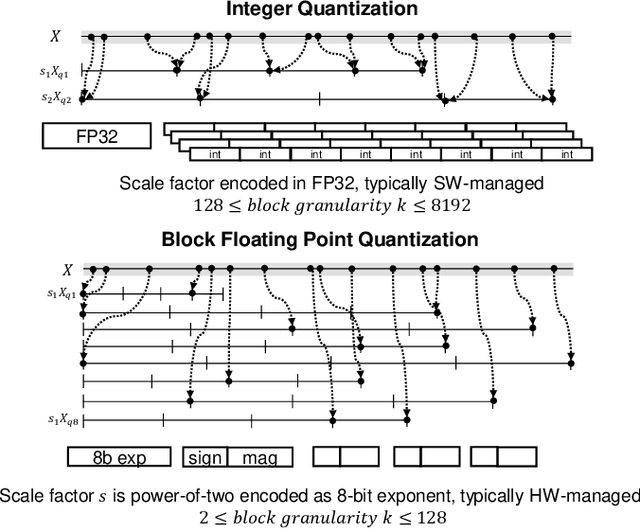
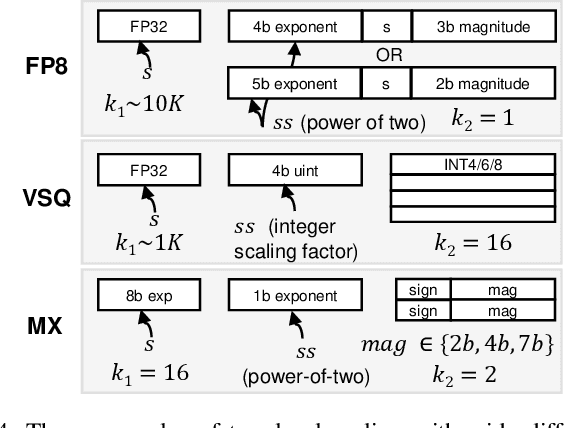
This paper introduces Block Data Representations (BDR), a framework for exploring and evaluating a wide spectrum of narrow-precision formats for deep learning. It enables comparison of popular quantization standards, and through BDR, new formats based on shared microexponents (MX) are identified, which outperform other state-of-the-art quantization approaches, including narrow-precision floating-point and block floating-point. MX utilizes multiple levels of quantization scaling with ultra-fine scaling factors based on shared microexponents in the hardware. The effectiveness of MX is demonstrated on real-world models including large-scale generative pretraining and inferencing, and production-scale recommendation systems.