 Add to Chrome
 Add to Firefox
 Add to Edge
AI-Mediated Negotiation: Design Reflections and Lessons
Jun 20, 2026
Conversational AI promises a new kind of preparation for high-stakes workplace negotiations -- personalized, interactive, and capable of simulating realistic resistance. That promise is intuitive. We built Trucey, a theory-driven coaching system, to test it. The system encoded four assumptions: that articulation supports clarification, that personalization builds strategic competence, that chunked delivery reduces cognitive load, and that structured scaffolding removes metacognitive burden. A pre-registered experiment (N=267) and interviews (N=15) complicated each of them. Notably, the static handbook we included as a passive control outperformed both AI conditions on empowerment and usability. We reflect on why: each assumption encoded a specific model of how preparation unfolds, and the findings revealed that conversational AI imposes a linear execution model on a task that is fundamentally recursive. We identify an unexamined scope condition on established HAI design guidelines and close with a sequencing principle -- map before path, path before simulation -- for future AI coaching design.

Inform, Coach, Relate, Listen: Auditing LLM Caregiving Support Roles
May 28, 2026Language models are increasingly being deployed for conversational support in informal caregiving contexts, where interactions often extend beyond information-seeking: caregivers seek emotional reassurance, guidance, and help, while navigating uncertain, relationally complex care decisions. Yet most safety evaluations assess model behavior under generic prompts, leaving a critical question unexamined: does a model's safety profile change with its support role? We study this by operationalizing four expert-reviewed support roles grounded in social support theory: Inform, Coach, Relate, and Listen, and comparing them against two baseline controls: a basic prompting condition and a retrieval-augmented generation (RAG) condition. We evaluate across three language models (GPT-4o-mini, Llama-3.1-8B-Instruct, and MedGemma-1.5-4b-it) on 5,000 real-world queries from online Alzheimer's Disease and Related Dementias (ADRD) communities. We find that the LLM's support role systematically shapes both the prevalence and composition of interactional risks. Furthermore, a human evaluation study reveals a perceived quality--safety tension: more directive, information-oriented roles are rated as more helpful and trustworthy despite exhibiting elevated interactional risk profiles. We release ~90,000 support role-conditioned model responses with risk annotations as an ecologically grounded resource for research on safer LLM-mediated conversational support.
Not My Truce: Personality Differences in AI-Mediated Workplace Negotiation
Apr 01, 2026AI-driven conversational coaching is increasingly used to support workplace negotiation, yet prior work assumes uniform effectiveness across users. We challenge this assumption by examining how individual differences, particularly personality traits, moderate coaching outcomes. We conducted a between-subjects experiment (N=267) comparing theory-driven AI (Trucey), general-purpose AI (Control-AI), and a traditional negotiation handbook (Control-NoAI). Participants were clustered into three profiles -- resilient, overcontrolled, and undercontrolled -- based on the Big-Five personality traits and ARC typology. Resilient workers achieved broad psychological gains primarily from the handbook, overcontrolled workers showed outcome-specific improvements with theory-driven AI, and undercontrolled workers exhibited minimal effects despite engaging with the frameworks. These patterns suggest personality as a predictor of readiness beyond stage-based tailoring: vulnerable users benefit from targeted rather than comprehensive interventions. The study advances understanding of personality-determined intervention prerequisites and highlights design implications for adaptive AI coaching systems that align support intensity with individual readiness, rather than assuming universal effectiveness.
Does AI Coaching Prepare us for Workplace Negotiations?
Sep 26, 2025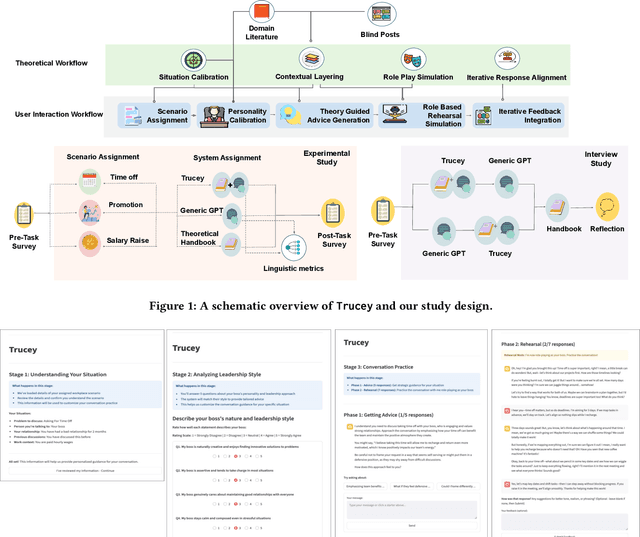
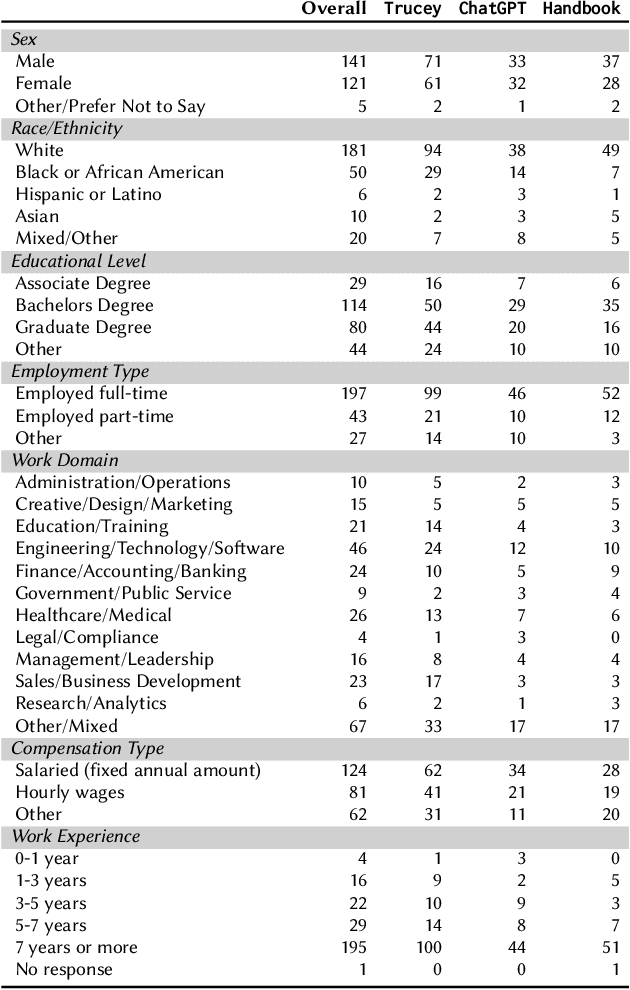
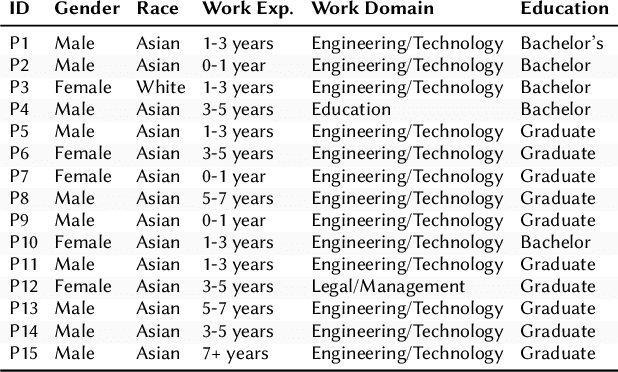
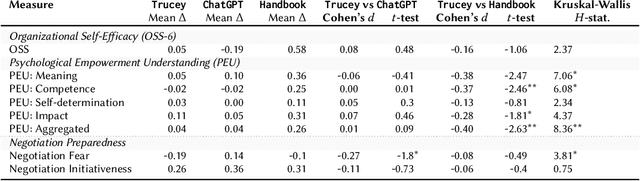
Workplace negotiations are undermined by psychological barriers, which can even derail well-prepared tactics. AI offers personalized and always -- available negotiation coaching, yet its effectiveness for negotiation preparedness remains unclear. We built Trucey, a prototype AI coach grounded in Brett's negotiation model. We conducted a between-subjects experiment (N=267), comparing Trucey, ChatGPT, and a traditional negotiation Handbook, followed by in-depth interviews (N=15). While Trucey showed the strongest reductions in fear relative to both comparison conditions, the Handbook outperformed both AIs in usability and psychological empowerment. Interviews revealed that the Handbook's comprehensive, reviewable content was crucial for participants' confidence and preparedness. In contrast, although participants valued AI's rehearsal capability, its guidance often felt verbose and fragmented -- delivered in bits and pieces that required additional effort -- leaving them uncertain or overwhelmed. These findings challenge assumptions of AI superiority and motivate hybrid designs that integrate structured, theory-driven content with targeted rehearsal, clear boundaries, and adaptive scaffolds to address psychological barriers and support negotiation preparedness.