 Add to Chrome
 Add to Firefox
 Add to Edge
AI-Mediated Negotiation: Design Reflections and Lessons
Jun 20, 2026
Conversational AI promises a new kind of preparation for high-stakes workplace negotiations -- personalized, interactive, and capable of simulating realistic resistance. That promise is intuitive. We built Trucey, a theory-driven coaching system, to test it. The system encoded four assumptions: that articulation supports clarification, that personalization builds strategic competence, that chunked delivery reduces cognitive load, and that structured scaffolding removes metacognitive burden. A pre-registered experiment (N=267) and interviews (N=15) complicated each of them. Notably, the static handbook we included as a passive control outperformed both AI conditions on empowerment and usability. We reflect on why: each assumption encoded a specific model of how preparation unfolds, and the findings revealed that conversational AI imposes a linear execution model on a task that is fundamentally recursive. We identify an unexamined scope condition on established HAI design guidelines and close with a sequencing principle -- map before path, path before simulation -- for future AI coaching design.

TUX: Measuring Human--AI Tacit Understanding
May 29, 2026As large language models (LLMs) increasingly act as collaborative partners, human--AI alignment is often evaluated through explicit task success, accuracy, or reward optimization. Yet many collaborative settings depend on tacit understanding: whether an agent can align with a human's evaluative stance or representational priors without clear objectives, communication, or feedback. To study this capacity, we develop a spectrum-placement task inspired by the social party game Wavelength, in which humans and agents independently place concepts along subjective spectra. We operationalize the Tacit Understanding Index (TUX) as a pairwise measure of similarity between human and agent judgments, and evaluate it with 241 human participants and 200 profile-conditioned LLM agents across four models. We find that nearest human--agent pairs in trait space achieve significantly higher TUX, suggesting that tacit alignment is structured by person-level characteristics rather than random similarity. Regression analyses show that TUX becomes more explainable as predictor sets become richer, with individual traits, decision-making styles, and confidence improving over aggregate trait-distance baselines. These findings suggest that tacit understanding between humans and LLMs is measurable, while revealing the limits of profile-based conditioning for capturing deeper representational alignment.
Not My Truce: Personality Differences in AI-Mediated Workplace Negotiation
Apr 01, 2026AI-driven conversational coaching is increasingly used to support workplace negotiation, yet prior work assumes uniform effectiveness across users. We challenge this assumption by examining how individual differences, particularly personality traits, moderate coaching outcomes. We conducted a between-subjects experiment (N=267) comparing theory-driven AI (Trucey), general-purpose AI (Control-AI), and a traditional negotiation handbook (Control-NoAI). Participants were clustered into three profiles -- resilient, overcontrolled, and undercontrolled -- based on the Big-Five personality traits and ARC typology. Resilient workers achieved broad psychological gains primarily from the handbook, overcontrolled workers showed outcome-specific improvements with theory-driven AI, and undercontrolled workers exhibited minimal effects despite engaging with the frameworks. These patterns suggest personality as a predictor of readiness beyond stage-based tailoring: vulnerable users benefit from targeted rather than comprehensive interventions. The study advances understanding of personality-determined intervention prerequisites and highlights design implications for adaptive AI coaching systems that align support intensity with individual readiness, rather than assuming universal effectiveness.
Does AI Coaching Prepare us for Workplace Negotiations?
Sep 26, 2025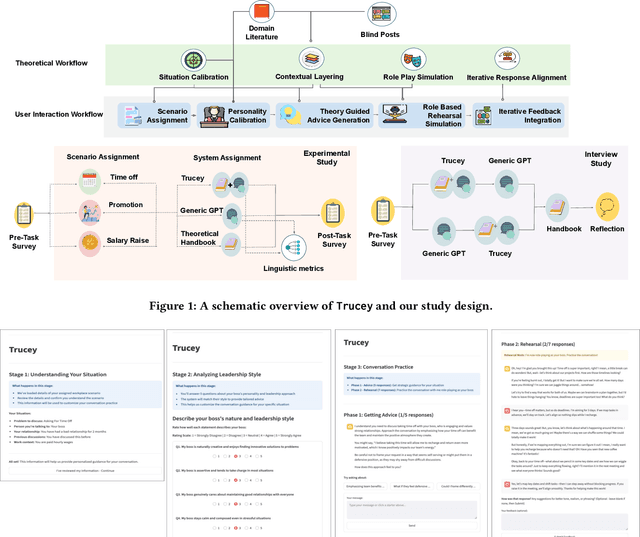
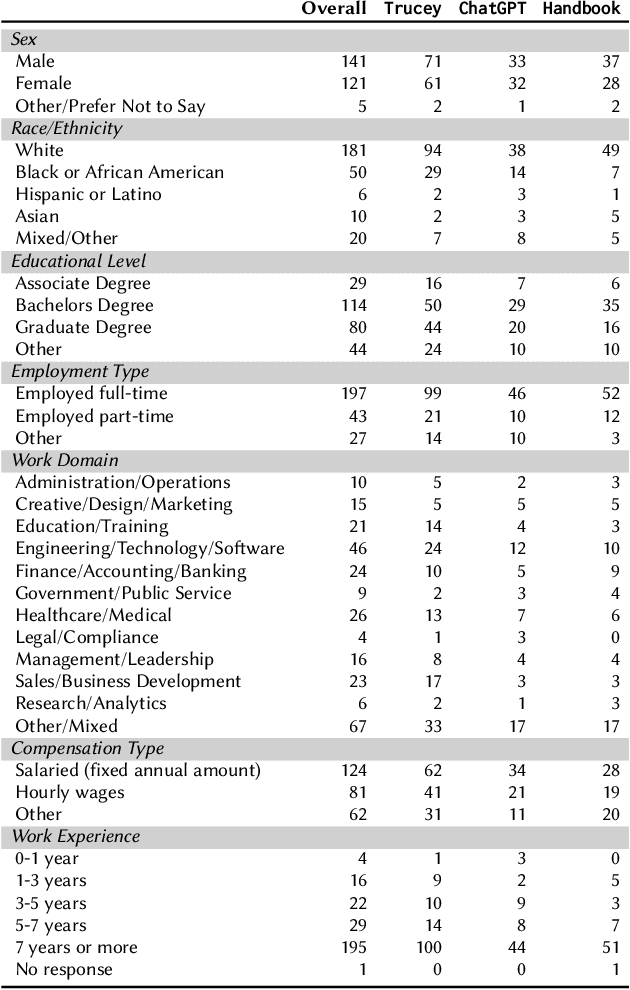
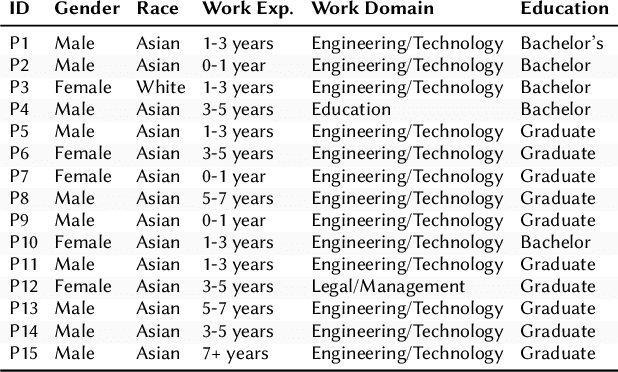
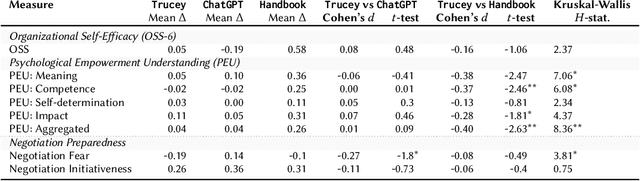
Workplace negotiations are undermined by psychological barriers, which can even derail well-prepared tactics. AI offers personalized and always -- available negotiation coaching, yet its effectiveness for negotiation preparedness remains unclear. We built Trucey, a prototype AI coach grounded in Brett's negotiation model. We conducted a between-subjects experiment (N=267), comparing Trucey, ChatGPT, and a traditional negotiation Handbook, followed by in-depth interviews (N=15). While Trucey showed the strongest reductions in fear relative to both comparison conditions, the Handbook outperformed both AIs in usability and psychological empowerment. Interviews revealed that the Handbook's comprehensive, reviewable content was crucial for participants' confidence and preparedness. In contrast, although participants valued AI's rehearsal capability, its guidance often felt verbose and fragmented -- delivered in bits and pieces that required additional effort -- leaving them uncertain or overwhelmed. These findings challenge assumptions of AI superiority and motivate hybrid designs that integrate structured, theory-driven content with targeted rehearsal, clear boundaries, and adaptive scaffolds to address psychological barriers and support negotiation preparedness.