 Add to Chrome
 Add to Firefox
 Add to Edge
Finite-Step Invariant Sets for Hybrid Systems with Probabilistic Guarantees
Apr 06, 2026
Poincare return maps are a fundamental tool for analyzing periodic orbits in hybrid dynamical systems, including legged locomotion, power electronics, and other cyber-physical systems with switching behavior. The Poincare return map captures the evolution of the hybrid system on a guard surface, reducing the stability analysis of a periodic orbit to that of a discrete-time system. While linearization provides local stability information, assessing robustness to disturbances requires identifying invariant sets of the state space under the return dynamics. However, computing such invariant sets is computationally difficult, especially when system dynamics are only available through forward simulation. In this work, we propose an algorithmic framework leveraging sampling-based optimization to compute a finite-step invariant ellipsoid around a nominal periodic orbit using sampled evaluations of the return map. The resulting solution is accompanied by probabilistic guarantees on finite-step invariance satisfying a user-defined accuracy threshold. We demonstrate the approach on two low-dimensional systems and a compass-gait walking model.

Differentiable Invariant Sets for Hybrid Limit Cycles with Application to Legged Robots
Apr 06, 2026For hybrid systems exhibiting periodic behavior, analyzing the invariant set containing the limit cycle is a natural way to study the robustness of the closed-loop system. However, computing these sets can be computationally expensive, especially when applied to contact-rich cyber-physical systems such as legged robots. In this work, we extend existing methods for overapproximating reachable sets of continuous systems using parametric embeddings to compute a forward-invariant set around the nominal trajectory of a simplified model of a bipedal robot. Our three-step approach (i) computes an overapproximating reachable set around the nominal continuous flow, (ii) catalogs intersections with the guard surface, and (iii) passes these intersections through the reset map. If the overapproximated reachable set after one step is a strict subset of the initial set, we formally verify a forward invariant set for this hybrid periodic orbit. We verify this condition on the bipedal walker model numerically using immrax, a JAX-based library for parametric reachable set computation, and use it within a bi-level optimization framework to design a tracking controller that maximizes the size of the invariant set.
Kinodynamic Motion Retargeting for Humanoid Locomotion via Multi-Contact Whole-Body Trajectory Optimization
Mar 10, 2026We present the KinoDynamic Motion Retargeting (KDMR) framework, a novel approach for humanoid locomotion that models the retargeting process as a multi-contact, whole-body trajectory optimization problem. Conventional kinematics-based retargeting methods rely solely on spatial motion capture (MoCap) data, inevitably introducing physically inconsistent artifacts, such as foot sliding and ground penetration, that severely degrade the performance of downstream imitation learning policies. To bridge this gap, KDMR extends beyond pure kinematics by explicitly enforcing rigid-body dynamics and contact complementarity constraints. Further, by integrating ground reaction force (GRF) measurements alongside MoCap data, our method automatically detects heel-toe contact events to accurately replicate complex human-like contact patterns. We evaluate KDMR against the state-of-the-art baseline, GMR, across three key dimensions: 1) the dynamic feasibility and smoothness of the retargeted motions, 2) the accuracy of GRF tracking compared to raw source data, and 3) the training efficiency and final performance of downstream control policies trained via the BeyondMimic framework. Experimental results demonstrate that KDMR significantly outperforms purely kinematic methods, yielding dynamically viable reference trajectories that accelerate policy convergence and enhance overall locomotion stability. Our end-to-end pipeline will be open-sourced upon publication.
Dense Fixed-Wing Swarming using Receding-Horizon NMPC
Feb 06, 2025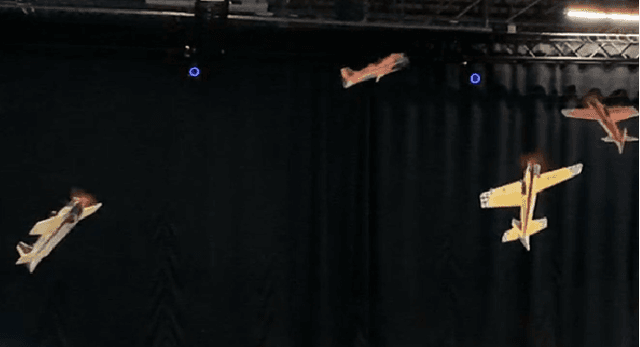
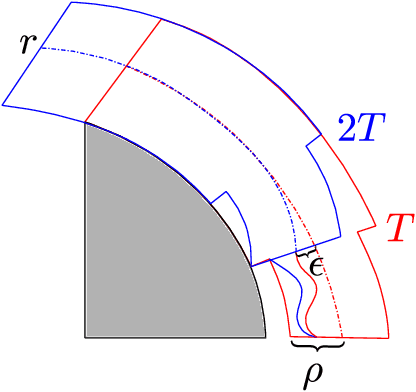
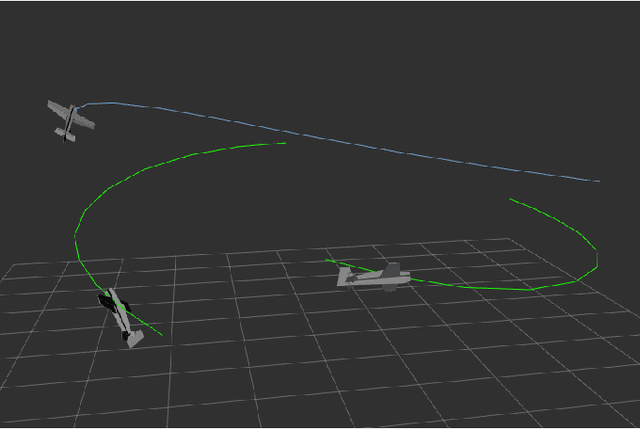
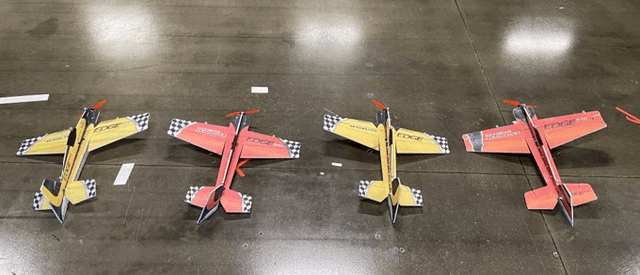
In this paper, we present an approach for controlling a team of agile fixed-wing aerial vehicles in close proximity to one another. Our approach relies on receding-horizon nonlinear model predictive control (NMPC) to plan maneuvers across an expanded flight envelope to enable inter-agent collision avoidance. To facilitate robust collision avoidance and characterize the likelihood of inter-agent collisions, we compute a statistical bound on the probability of the system leaving a tube around the planned nominal trajectory. Finally, we propose a metric for evaluating highly dynamic swarms and use this metric to evaluate our approach. We successfully demonstrated our approach through both simulation and hardware experiments, and to our knowledge, this the first time close-quarters swarming has been achieved with physical aerobatic fixed-wing vehicles.
Rapid Co-design of Task-Specialized Whegged Robots for Ad-Hoc Needs
May 08, 2024In this work, we investigate the use of co-design methods to iterate upon robot designs in the field, performing time sensitive, ad-hoc tasks. Our method optimizes the morphology and wheg trajectory for a MiniRHex robot, producing 3D printable structures and leg trajectory parameters. Tested in four terrains, we show that robots optimized in simulation exhibit strong sim-to-real transfer and are nearly twice as efficient as the nominal platform when tested in hardware.