 Add to Chrome
 Add to Firefox
 Add to Edge
Staying on Spec: Real-Time Monitoring under Uncertainty with a Maritime Case Study
Aug 03, 2026
Robotic systems must operate under uncertainty while satisfying complex task and safety specifications. Monitoring such specifications under uncertainty remains challenging, as existing formulations typically require extensive data or explicit uncertainty distributions. In this paper, we propose a real-time monitoring framework that reduces data requirements by leveraging data-driven reachable sets for specification evaluation. We instantiate the framework for maritime navigation, where complex specifications arise from traffic rules. We develop a data-efficient pipeline for constructing reachable sets and derive a monitoring formulation suitable for real-time deployment. Simulation and hardware experiments demonstrate robust monitoring under realistic disturbances, achieving improved risk detection compared to state-of-the-art metrics.

Learning-enabled Parameter Synthesis for Nonlinear Systems from Signal Temporal Logic
Jul 09, 2026Signal Temporal Logic (STL) is increasingly used to describe interpretable objectives and constraints for optimal control and learning methods, especially when no target time series data is available. In this work, we propose to synthesize parameters for nonlinear systems that robustly satisfy continuous-time STL specifications for uncertain initial conditions. To this end, we use gradient-based optimization along with set-based reachability verification to efficiently learn in high-dimensional parameter spaces while providing provable satisfaction guarantees for the optimized parameters. We demonstrate the effectiveness and scalability of our method on three systems with up to 18 parameter dimensions.
Any-Body Guard: Universal Safeguarding for Manipulation Policies via Action Masking
Jun 21, 2026Ensuring safety of learning-enabled robotic manipulation across diverse embodiments and tasks still requires significant manual engineering. Existing approaches typically rely on heuristically designed fallback controllers or complex forward invariance assessments. These methods are often too conservative for task success, too computationally expensive for real-time execution, too heuristic to provide useful safety guarantees, or too engineering-heavy to transfer between setups. In this paper, we propose a universal safeguarding approach, X-Safe, which reasons directly in the robot's configuration space to provide formal probabilistic guarantees for collision avoidance. By operating in the configuration space, our method transfers across embodiments while relying solely on an object-based, quasi-static scene representation and a forward kinematics model of the robotic manipulator. Thus, X-Safe provides useful formal safety guarantees without requiring additional data, or engineering effort for different embodiments or scenes. We demonstrate X-Safe for diverse embodiments and policies, both in simulation and on hardware. We observe less degradation in task performance compared to state-of-the-art safeguarding, no collisions on hardware experiments, and empirically corroborate our formal guarantees.
Finite-Step Invariant Sets for Hybrid Systems with Probabilistic Guarantees
Apr 06, 2026Poincare return maps are a fundamental tool for analyzing periodic orbits in hybrid dynamical systems, including legged locomotion, power electronics, and other cyber-physical systems with switching behavior. The Poincare return map captures the evolution of the hybrid system on a guard surface, reducing the stability analysis of a periodic orbit to that of a discrete-time system. While linearization provides local stability information, assessing robustness to disturbances requires identifying invariant sets of the state space under the return dynamics. However, computing such invariant sets is computationally difficult, especially when system dynamics are only available through forward simulation. In this work, we propose an algorithmic framework leveraging sampling-based optimization to compute a finite-step invariant ellipsoid around a nominal periodic orbit using sampled evaluations of the return map. The resulting solution is accompanied by probabilistic guarantees on finite-step invariance satisfying a user-defined accuracy threshold. We demonstrate the approach on two low-dimensional systems and a compass-gait walking model.
Falsification-Driven Reinforcement Learning for Maritime Motion Planning
Oct 08, 2025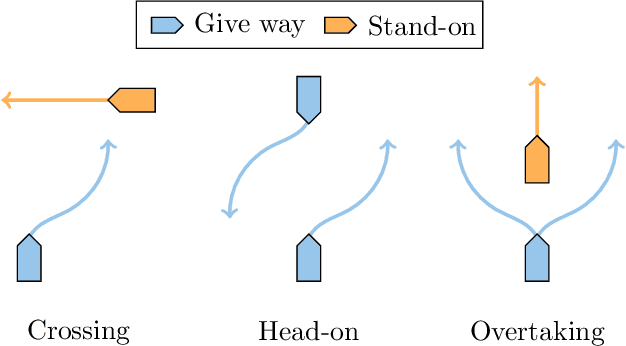
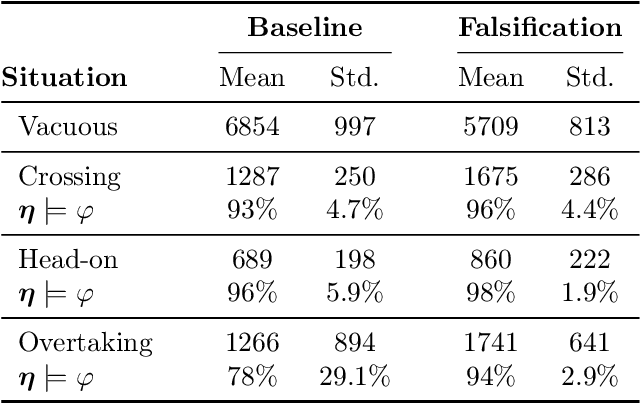
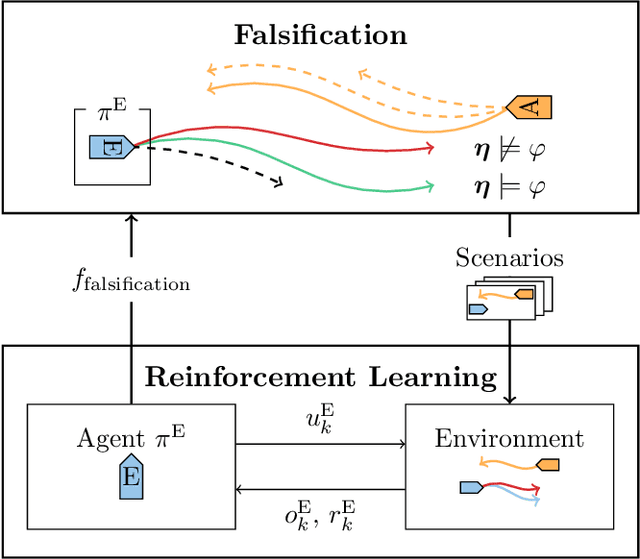
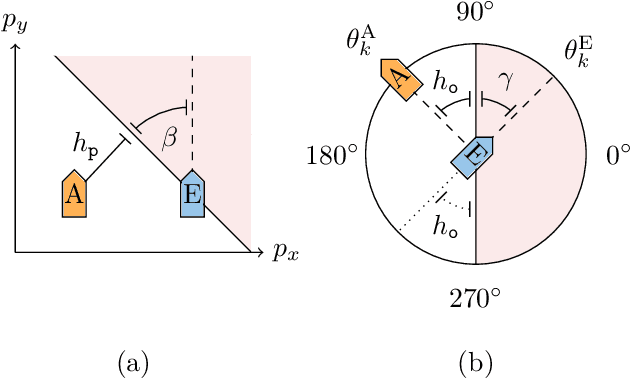
Compliance with maritime traffic rules is essential for the safe operation of autonomous vessels, yet training reinforcement learning (RL) agents to adhere to them is challenging. The behavior of RL agents is shaped by the training scenarios they encounter, but creating scenarios that capture the complexity of maritime navigation is non-trivial, and real-world data alone is insufficient. To address this, we propose a falsification-driven RL approach that generates adversarial training scenarios in which the vessel under test violates maritime traffic rules, which are expressed as signal temporal logic specifications. Our experiments on open-sea navigation with two vessels demonstrate that the proposed approach provides more relevant training scenarios and achieves more consistent rule compliance.
Safe Reinforcement Learning using Action Projection: Safeguard the Policy or the Environment?
Sep 16, 2025Projection-based safety filters, which modify unsafe actions by mapping them to the closest safe alternative, are widely used to enforce safety constraints in reinforcement learning (RL). Two integration strategies are commonly considered: Safe environment RL (SE-RL), where the safeguard is treated as part of the environment, and safe policy RL (SP-RL), where it is embedded within the policy through differentiable optimization layers. Despite their practical relevance in safety-critical settings, a formal understanding of their differences is lacking. In this work, we present a theoretical comparison of SE-RL and SP-RL. We identify a key distinction in how each approach is affected by action aliasing, a phenomenon in which multiple unsafe actions are projected to the same safe action, causing information loss in the policy gradients. In SE-RL, this effect is implicitly approximated by the critic, while in SP-RL, it manifests directly as rank-deficient Jacobians during backpropagation through the safeguard. Our contributions are threefold: (i) a unified formalization of SE-RL and SP-RL in the context of actor-critic algorithms, (ii) a theoretical analysis of their respective policy gradient estimates, highlighting the role of action aliasing, and (iii) a comparative study of mitigation strategies, including a novel penalty-based improvement for SP-RL that aligns with established SE-RL practices. Empirical results support our theoretical predictions, showing that action aliasing is more detrimental for SP-RL than for SE-RL. However, with appropriate improvement strategies, SP-RL can match or outperform improved SE-RL across a range of environments. These findings provide actionable insights for choosing and refining projection-based safe RL methods based on task characteristics.
Learning to Drive by Imitating Surrounding Vehicles
Mar 08, 2025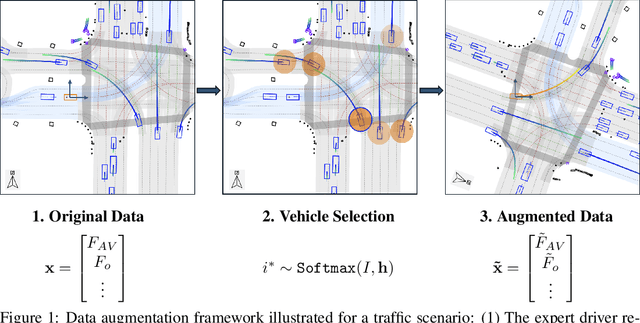
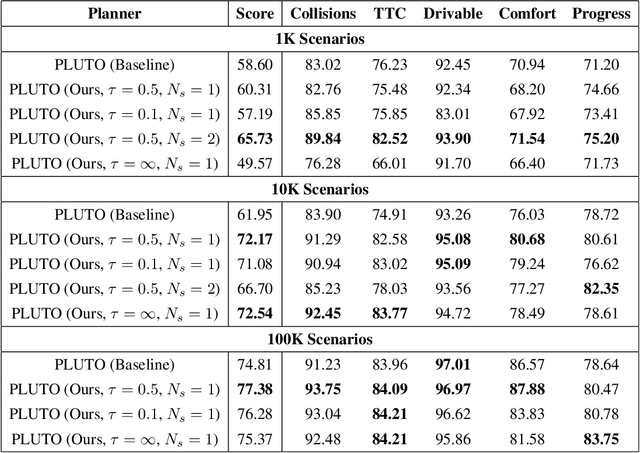
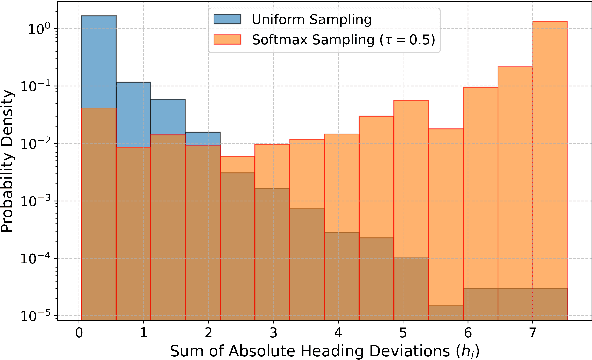
Imitation learning is a promising approach for training autonomous vehicles (AV) to navigate complex traffic environments by mimicking expert driver behaviors. However, a major challenge in this paradigm lies in effectively utilizing available driving data, as collecting new data is resource-intensive and often limited in its ability to cover diverse driving scenarios. While existing imitation learning frameworks focus on leveraging expert demonstrations, they often overlook the potential of additional complex driving data from surrounding traffic participants. In this paper, we propose a data augmentation strategy that enhances imitation learning by leveraging the observed trajectories of nearby vehicles, captured through the AV's sensors, as additional expert demonstrations. We introduce a vehicle selection sampling strategy that prioritizes informative and diverse driving behaviors, contributing to a richer and more diverse dataset for training. We evaluate our approach using the state-of-the-art learning-based planning method PLUTO on the nuPlan dataset and demonstrate that our augmentation method leads to improved performance in complex driving scenarios. Specifically, our method reduces collision rates and improves safety metrics compared to the baseline. Notably, even when using only 10% of the original dataset, our method achieves performance comparable to that of the full dataset, with improved collision rates. Our findings highlight the importance of leveraging diverse real-world trajectory data in imitation learning and provide insights into data augmentation strategies for autonomous driving.
Intelligent Sailing Model for Open Sea Navigation
Jan 09, 2025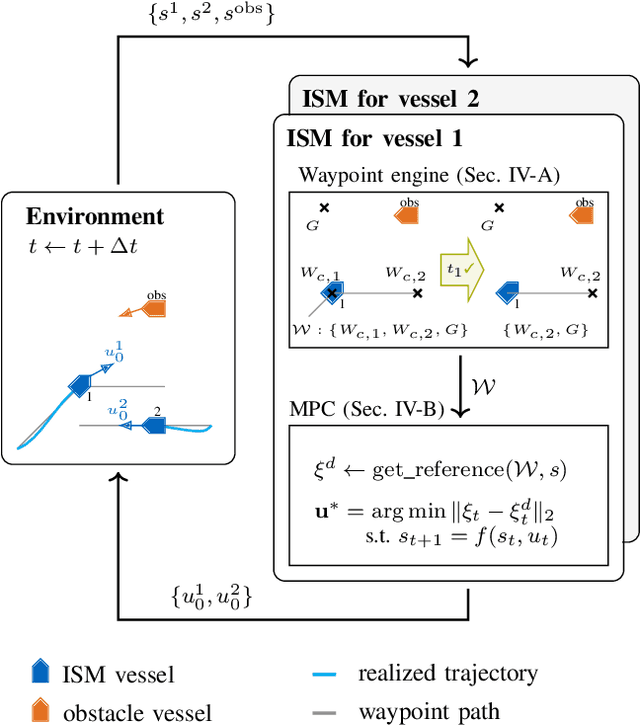
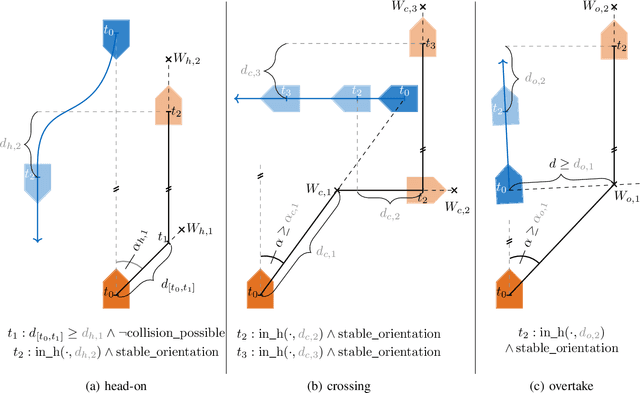
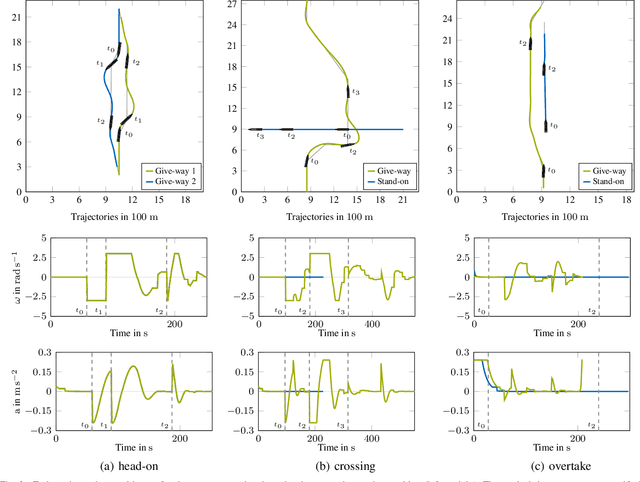
Autonomous vessels potentially enhance safety and reliability of seaborne trade. To facilitate the development of autonomous vessels, high-fidelity simulations are required to model realistic interactions with other vessels. However, modeling realistic interactive maritime traffic is challenging due to the unstructured environment, coarsely specified traffic rules, and largely varying vessel types. Currently, there is no standard for simulating interactive maritime environments in order to rigorously benchmark autonomous vessel algorithms. In this paper, we introduce the first intelligent sailing model (ISM), which simulates rule-compliant vessels for navigation on the open sea. An ISM vessel reacts to other traffic participants according to maritime traffic rules while at the same time solving a motion planning task characterized by waypoints. In particular, the ISM monitors the applicable rules, generates rule-compliant waypoints accordingly, and utilizes a model predictive control for tracking the waypoints. We evaluate the ISM in two environments: interactive traffic with only ISM vessels and mixed traffic where some vessel trajectories are from recorded real-world maritime traffic data or handcrafted for criticality. Our results show that simulations with many ISM vessels of different vessel types are rule-compliant and scalable. We tested 4,049 critical traffic scenarios. For interactive traffic with ISM vessels, no collisions occurred while goal-reaching rates of about 97 percent were achieved. We believe that our ISM can serve as a standard for challenging and realistic maritime traffic simulation to accelerate autonomous vessel development.
Excluding the Irrelevant: Focusing Reinforcement Learning through Continuous Action Masking
Jun 06, 2024

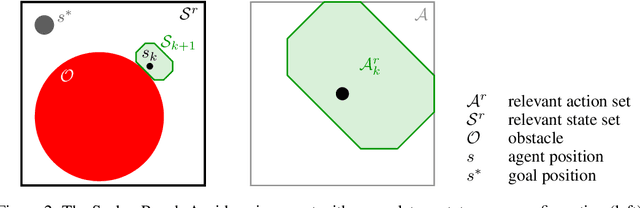
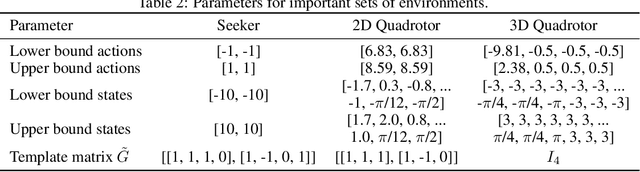
Continuous action spaces in reinforcement learning (RL) are commonly defined as interval sets. While intervals usually reflect the action boundaries for tasks well, they can be challenging for learning because the typically large global action space leads to frequent exploration of irrelevant actions. Yet, little task knowledge can be sufficient to identify significantly smaller state-specific sets of relevant actions. Focusing learning on these relevant actions can significantly improve training efficiency and effectiveness. In this paper, we propose to focus learning on the set of relevant actions and introduce three continuous action masking methods for exactly mapping the action space to the state-dependent set of relevant actions. Thus, our methods ensure that only relevant actions are executed, enhancing the predictability of the RL agent and enabling its use in safety-critical applications. We further derive the implications of the proposed methods on the policy gradient. Using Proximal Policy Optimization (PPO), we evaluate our methods on three control tasks, where the relevant action set is computed based on the system dynamics and a relevant state set. Our experiments show that the three action masking methods achieve higher final rewards and converge faster than the baseline without action masking.
Provable Traffic Rule Compliance in Safe Reinforcement Learning on the Open Sea
Feb 13, 2024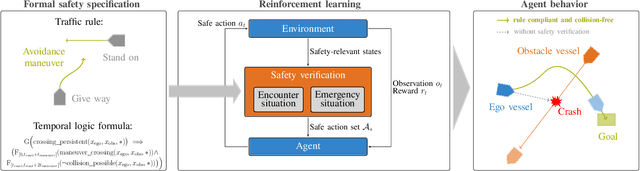
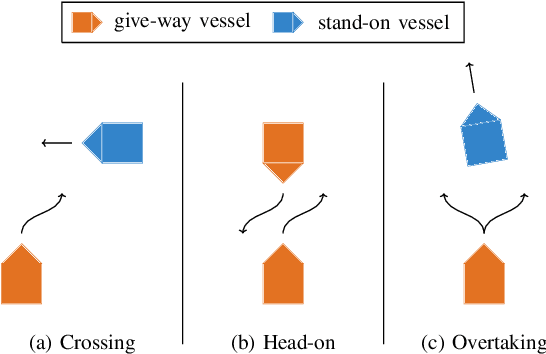
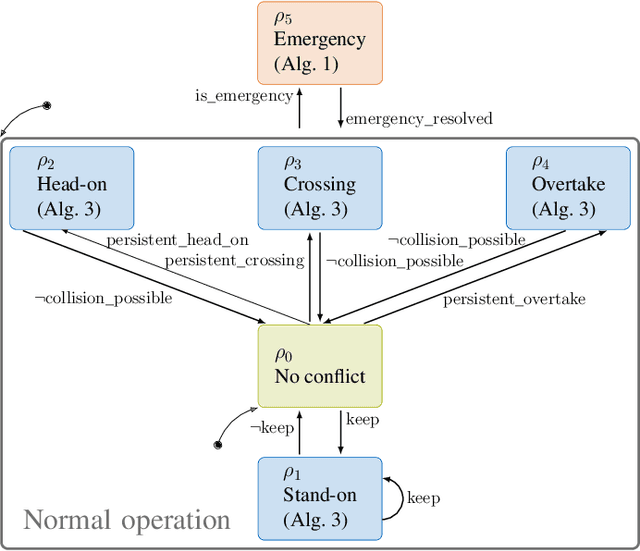
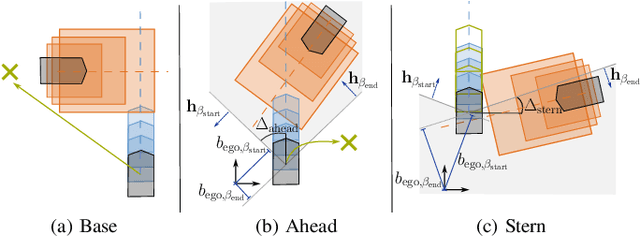
Autonomous vehicles have to obey traffic rules. These rules are often formalized using temporal logic, resulting in constraints that are hard to solve using optimization-based motion planners. Reinforcement Learning (RL) is a promising method to find motion plans adhering to temporal logic specifications. However, vanilla RL algorithms are based on random exploration, which is inherently unsafe. To address this issue, we propose a provably safe RL approach that always complies with traffic rules. As a specific application area, we consider vessels on the open sea, which must adhere to the Convention on the International Regulations for Preventing Collisions at Sea (COLREGS). We introduce an efficient verification approach that determines the compliance of actions with respect to the COLREGS formalized using temporal logic. Our action verification is integrated into the RL process so that the agent only selects verified actions. In contrast to agents that only integrate the traffic rule information in the reward function, our provably safe agent always complies with the formalized rules in critical maritime traffic situations and, thus, never causes a collision.