 Add to Chrome
 Add to Firefox
 Add to Edge
Robostral Navigate
Jul 24, 2026
Deploying navigation systems at scale requires a recipe that minimizes sensor assumptions, generalizes across robot embodiments, and trains efficiently. Yet, today's best systems depend on depth sensors, multi-camera rigs, or pre-built maps, limiting the hardware they support and increasing deployment cost. We introduce Robostral Navigate, an 8B vision-language model built around this scalability objective. The model consumes only a stream of monocular RGB images - the most ubiquitous sensor across robotic platforms and predicts waypoints by pointing to the next target location in the current camera view. Operating purely in image space, rather than robot-specific coordinates, makes the policy naturally robust to changes in camera intrinsics and scene scale, enabling deployment across wheeled, legged, and aerial robots without recalibration. We generate 2.4 million trajectories across 350k simulated scenes to reduce the reliance on real-world data collection and scale easily. We further introduce a prefix-caching training recipe that packs entire episodes into single training sequences, reducing training tokens by 22x and cutting training time from months to days. A tree-based attention mask prevents conditioning on previous ground-truth actions, encouraging visually grounded action prediction, and reinforcement learning is used to further improve exploration and recovery capabilities. On the Room-to-Room and Room-Across-Room in Continuous Environments (R2R-CE and RxR-CE) benchmarks, Robostral Navigate sets a new state of the art. On R2R-CE, it achieves a 77.4% success rate, surpassing the best monocular method by 10.5 points and the strongest depth- or multi-camera system by 5.3 points despite using only a single RGB camera. On RxR-CE, it reaches 75.1% success rate, outperforming all monocular baselines.

On Pretraining Data Diversity for Self-Supervised Learning
Mar 20, 2024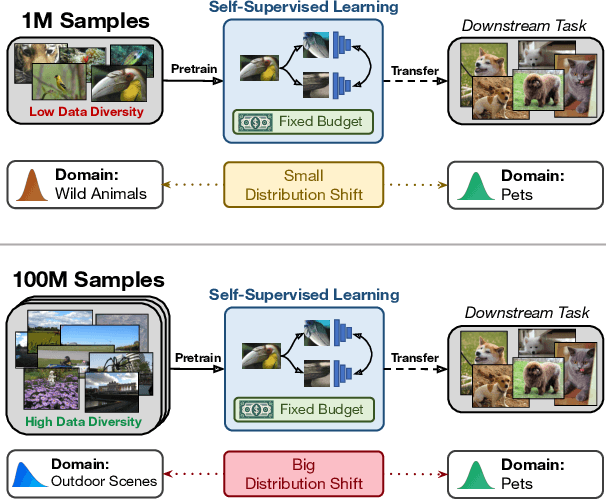


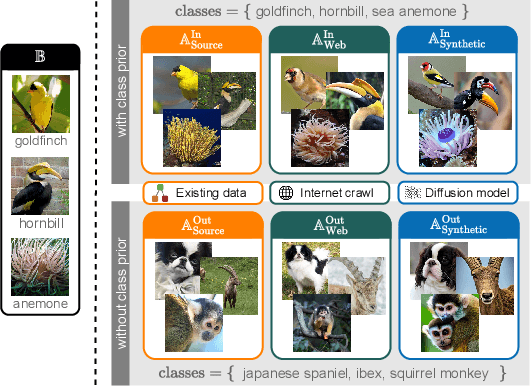
We explore the impact of training with more diverse datasets, characterized by the number of unique samples, on the performance of self-supervised learning (SSL) under a fixed computational budget. Our findings consistently demonstrate that increasing pretraining data diversity enhances SSL performance, albeit only when the distribution distance to the downstream data is minimal. Notably, even with an exceptionally large pretraining data diversity achieved through methods like web crawling or diffusion-generated data, among other ways, the distribution shift remains a challenge. Our experiments are comprehensive with seven SSL methods using large-scale datasets such as ImageNet and YFCC100M amounting to over 200 GPU days. Code and trained models will be available at https://github.com/hammoudhasan/DiversitySSL .
Regulations Aware Motion Planning for Autonomous Surface Vessels in Urban Canals
Feb 24, 2022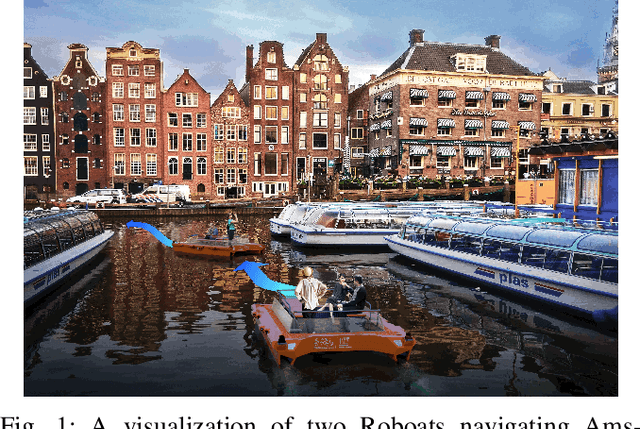
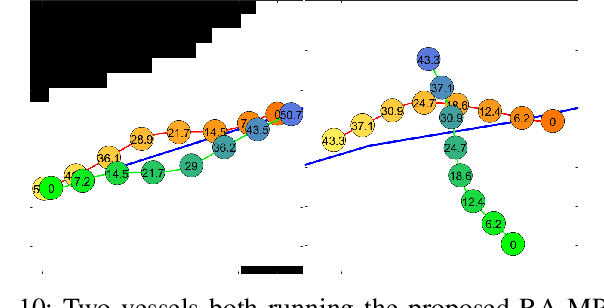
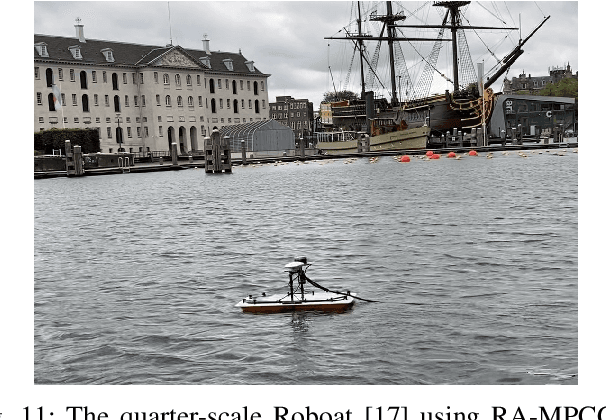
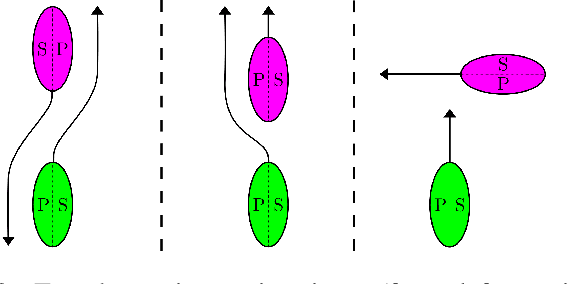
In unstructured urban canals, regulation-aware interactions with other vessels are essential for collision avoidance and social compliance. In this paper, we propose a regulations aware motion planning framework for Autonomous Surface Vessels (ASVs) that accounts for dynamic and static obstacles. Our method builds upon local model predictive contouring control (LMPCC) to generate motion plans satisfying kino-dynamic and collision constraints in real-time while including regulation awareness. To incorporate regulations in the planning stage, we propose a cost function encouraging compliance with rules describing interactions with other vessels similar to COLlision avoidance REGulations at sea (COLREGs). These regulations are essential to make an ASV behave in a predictable and socially compliant manner with regard to other vessels. We compare the framework against baseline methods and show more effective regulation-compliance avoidance of moving obstacles with our motion planner. Additionally, we present experimental results in an outdoor environment
Domain Adaptation for Rare Classes Augmented with Synthetic Samples
Oct 23, 2021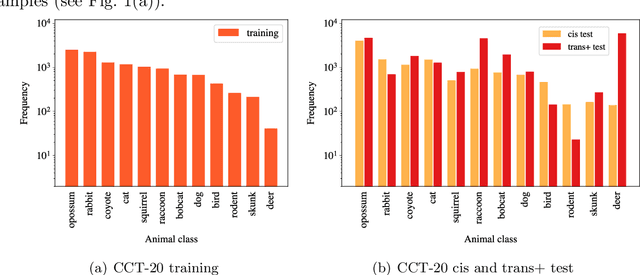
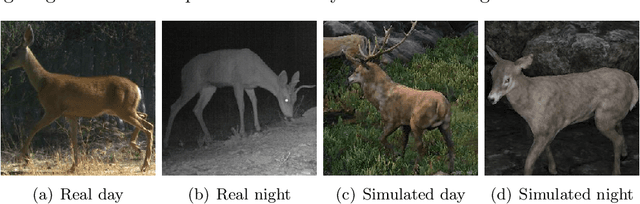
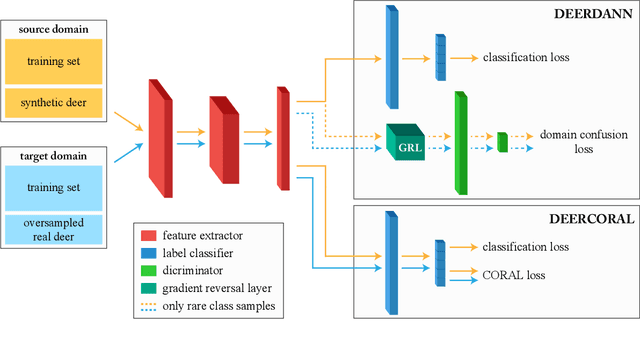
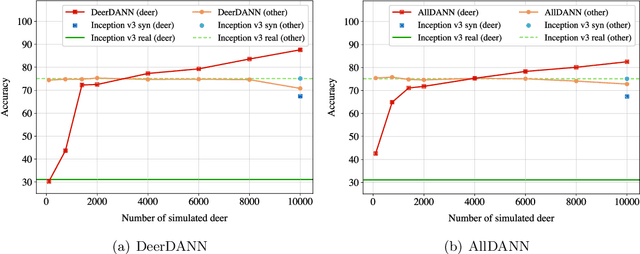
To alleviate lower classification performance on rare classes in imbalanced datasets, a possible solution is to augment the underrepresented classes with synthetic samples. Domain adaptation can be incorporated in a classifier to decrease the domain discrepancy between real and synthetic samples. While domain adaptation is generally applied on completely synthetic source domains and real target domains, we explore how domain adaptation can be applied when only a single rare class is augmented with simulated samples. As a testbed, we use a camera trap animal dataset with a rare deer class, which is augmented with synthetic deer samples. We adapt existing domain adaptation methods to two new methods for the single rare class setting: DeerDANN, based on the Domain-Adversarial Neural Network (DANN), and DeerCORAL, based on deep correlation alignment (Deep CORAL) architectures. Experiments show that DeerDANN has the highest improvement in deer classification accuracy of 24.0% versus 22.4% improvement of DeerCORAL when compared to the baseline. Further, both methods require fewer than 10k synthetic samples, as used by the baseline, to achieve these higher accuracies. DeerCORAL requires the least number of synthetic samples (2k deer), followed by DeerDANN (8k deer).