 Add to Chrome
 Add to Firefox
 Add to Edge
Simplex Relaxation for Discrete Diffusion
Aug 11, 2026
Discrete diffusion models for categorical generation are defined by a corruption kernel, which determines the intermediate state space and the associated reverse prediction problem. We study uniform discrete diffusion and ask whether its training objective and reverse transitions can be enriched without changing the underlying categorical corruption process. We introduce Simplax, an exact Dirichlet--categorical augmentation that couples each corrupted categorical state with an auxiliary simplex-valued variable while preserving the original uniform diffusion process as its categorical marginal. This augmentation yields a tractable Rao--Blackwellized reverse-bridge objective and a corresponding stochastic reverse sampler, while retaining the corrupted categorical state as the denoiser input. Empirically, Simplax improves the generative perplexity--entropy tradeoff on unconditional OpenWebText generation. On Sudoku, a model trained exclusively on $30$-clue puzzles achieves the highest accuracy among the compared methods across all evaluated clue densities, including the minimum uniquely solvable $17$-clue regime, and also achieves the highest validity in unconditional generation.

Understanding and Accelerating the Training of Masked Diffusion Language Models
May 13, 2026Masked diffusion models (MDMs) have emerged as a promising alternative to autoregressive models (ARMs) for language modeling. However, MDMs are known to learn substantially more slowly than ARMs, which may become problematic when scaling MDMs to larger models. Therefore, we ask the following question: how can we accelerate standard MDM training while maintaining its final performance? To this end, we first provide a detailed analysis of why MDM training is slow. We find that the main factor is the locality bias of language: the predictive information for a token is concentrated in nearby positions. We further investigate how this bias slows learning and suggest a simple yet effective remedy: bell-shaped time sampling as a training strategy. Notably, MDMs trained with our training recipe reach the same validation negative log-likelihood (NLL) up to $\sim4\times$ faster than standard training on One Billion Word Benchmark (LM1B). We also show faster improvements in generative perplexity, zero-shot perplexity, and downstream task performance on various benchmarks.
Convex-Geometric Error Bounds for Positive-Weight Kernel Quadrature
May 07, 2026Kernel quadrature can exploit RKHS spectral structure and outperform Monte Carlo on smooth integrands, but optimized quadrature weights are generally signed and may be numerically unstable. We study whether spectral acceleration remains possible when the weights are constrained to be positive, i.e., simplex weights. In the exact-target fixed-pool setting, an evaluated i.i.d. candidate pool of size $N$ is already available and the task is to reweight it so as to approximate the kernel mean embedding. We show that this positive reweighting problem is governed not by the equal-weight empirical average, but by the random convex hull generated by the pool. Our main geometric result shows that the mean of a bounded $d$-dimensional random vector can be approximated by a convex combination of $N$ i.i.d. samples at accuracy $O(d/N)$ with high probability, sharper than equal-weight averaging in the fixed-dimensional regime. We transfer this $d$-dimensional convex-hull approximation to full RKHS worst-case error through an augmented Mercer-truncation argument. The resulting positive-weight KQ bounds consist of a spectral tail term and a finite-sample convex-hull term, yielding Monte-Carlo-beating rates in favorable spectral regimes, including near-$O(1/N)$ rates up to logarithmic factors under exponential spectral decay. We also provide a constructive Frank--Wolfe algorithm that operates directly on the pool atoms, maintains simplex weights, and admits an explicit optimization-error bound.
Demystifying MaskGIT Sampler and Beyond: Adaptive Order Selection in Masked Diffusion
Oct 06, 2025Masked diffusion models have shown promising performance in generating high-quality samples in a wide range of domains, but accelerating their sampling process remains relatively underexplored. To investigate efficient samplers for masked diffusion, this paper theoretically analyzes the MaskGIT sampler for image modeling, revealing its implicit temperature sampling mechanism. Through this analysis, we introduce the "moment sampler," an asymptotically equivalent but more tractable and interpretable alternative to MaskGIT, which employs a "choose-then-sample" approach by selecting unmasking positions before sampling tokens. In addition, we improve the efficiency of choose-then-sample algorithms through two key innovations: a partial caching technique for transformers that approximates longer sampling trajectories without proportional computational cost, and a hybrid approach formalizing the exploration-exploitation trade-off in adaptive unmasking. Experiments in image and text domains demonstrate our theory as well as the efficiency of our proposed methods, advancing both theoretical understanding and practical implementation of masked diffusion samplers.
SONA: Learning Conditional, Unconditional, and Mismatching-Aware Discriminator
Oct 06, 2025Deep generative models have made significant advances in generating complex content, yet conditional generation remains a fundamental challenge. Existing conditional generative adversarial networks often struggle to balance the dual objectives of assessing authenticity and conditional alignment of input samples within their conditional discriminators. To address this, we propose a novel discriminator design that integrates three key capabilities: unconditional discrimination, matching-aware supervision to enhance alignment sensitivity, and adaptive weighting to dynamically balance all objectives. Specifically, we introduce Sum of Naturalness and Alignment (SONA), which employs separate projections for naturalness (authenticity) and alignment in the final layer with an inductive bias, supported by dedicated objective functions and an adaptive weighting mechanism. Extensive experiments on class-conditional generation tasks show that \ours achieves superior sample quality and conditional alignment compared to state-of-the-art methods. Furthermore, we demonstrate its effectiveness in text-to-image generation, confirming the versatility and robustness of our approach.
Concept-TRAK: Understanding how diffusion models learn concepts through concept-level attribution
Jul 09, 2025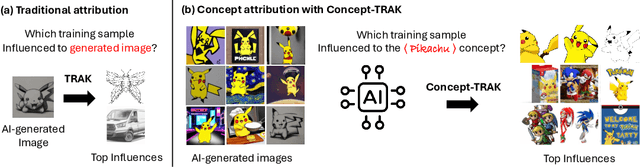
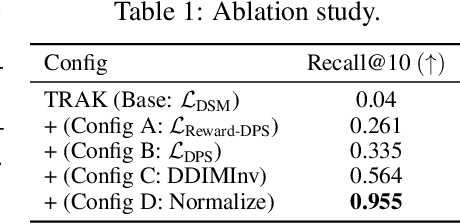
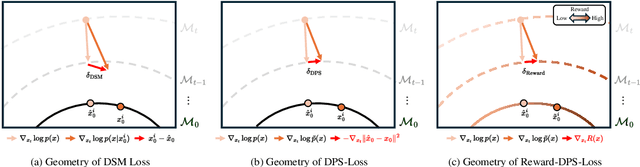
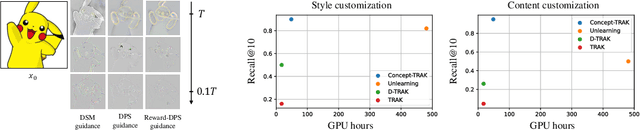
While diffusion models excel at image generation, their growing adoption raises critical concerns around copyright issues and model transparency. Existing attribution methods identify training examples influencing an entire image, but fall short in isolating contributions to specific elements, such as styles or objects, that matter most to stakeholders. To bridge this gap, we introduce \emph{concept-level attribution} via a novel method called \emph{Concept-TRAK}. Concept-TRAK extends influence functions with two key innovations: (1) a reformulated diffusion training loss based on diffusion posterior sampling, enabling robust, sample-specific attribution; and (2) a concept-aware reward function that emphasizes semantic relevance. We evaluate Concept-TRAK on the AbC benchmark, showing substantial improvements over prior methods. Through diverse case studies--ranging from identifying IP-protected and unsafe content to analyzing prompt engineering and compositional learning--we demonstrate how concept-level attribution yields actionable insights for responsible generative AI development and governance.
Distillation of Discrete Diffusion through Dimensional Correlations
Oct 11, 2024

Diffusion models have demonstrated exceptional performances in various fields of generative modeling. While they often outperform competitors including VAEs and GANs in sample quality and diversity, they suffer from slow sampling speed due to their iterative nature. Recently, distillation techniques and consistency models are mitigating this issue in continuous domains, but discrete diffusion models have some specific challenges towards faster generation. Most notably, in the current literature, correlations between different dimensions (pixels, locations) are ignored, both by its modeling and loss functions, due to computational limitations. In this paper, we propose "mixture" models in discrete diffusion that are capable of treating dimensional correlations while remaining scalable, and we provide a set of loss functions for distilling the iterations of existing models. Two primary theoretical insights underpin our approach: first, that dimensionally independent models can well approximate the data distribution if they are allowed to conduct many sampling steps, and second, that our loss functions enables mixture models to distill such many-step conventional models into just a few steps by learning the dimensional correlations. We empirically demonstrate that our proposed method for discrete diffusions work in practice, by distilling a continuous-time discrete diffusion model pretrained on the CIFAR-10 dataset.
$\textit{Jump Your Steps}$: Optimizing Sampling Schedule of Discrete Diffusion Models
Oct 10, 2024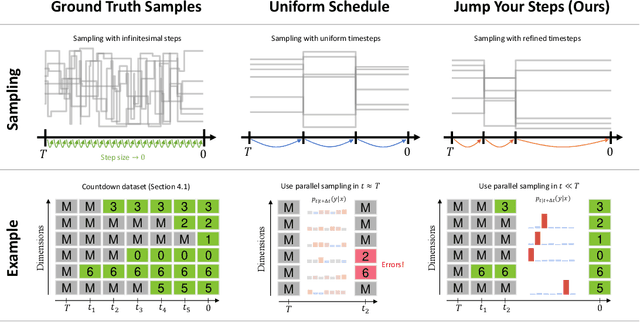
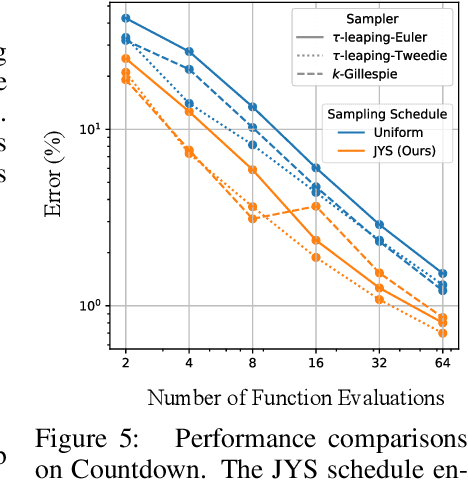
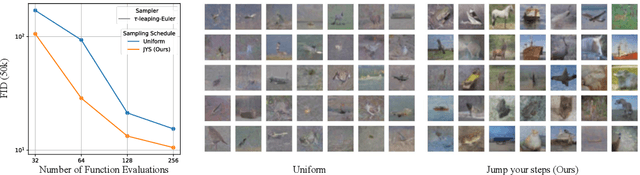

Diffusion models have seen notable success in continuous domains, leading to the development of discrete diffusion models (DDMs) for discrete variables. Despite recent advances, DDMs face the challenge of slow sampling speeds. While parallel sampling methods like $\tau$-leaping accelerate this process, they introduce $\textit{Compounding Decoding Error}$ (CDE), where discrepancies arise between the true distribution and the approximation from parallel token generation, leading to degraded sample quality. In this work, we present $\textit{Jump Your Steps}$ (JYS), a novel approach that optimizes the allocation of discrete sampling timesteps by minimizing CDE without extra computational cost. More precisely, we derive a practical upper bound on CDE and propose an efficient algorithm for searching for the optimal sampling schedule. Extensive experiments across image, music, and text generation show that JYS significantly improves sampling quality, establishing it as a versatile framework for enhancing DDM performance for fast sampling.
A Quadrature Approach for General-Purpose Batch Bayesian Optimization via Probabilistic Lifting
Apr 19, 2024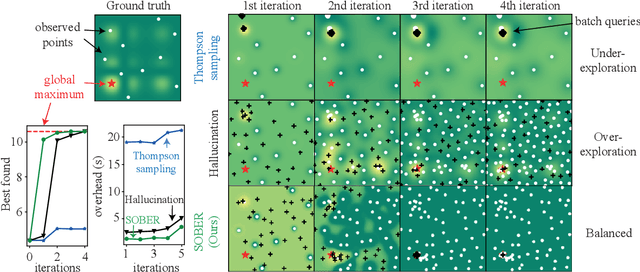
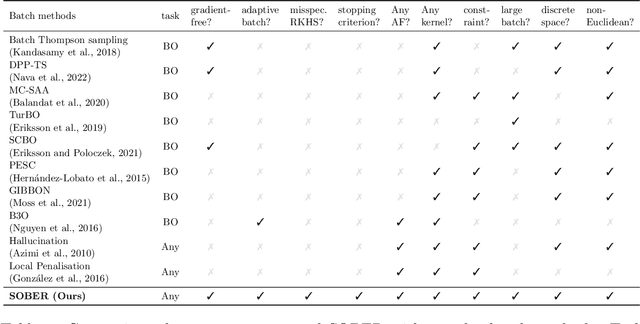
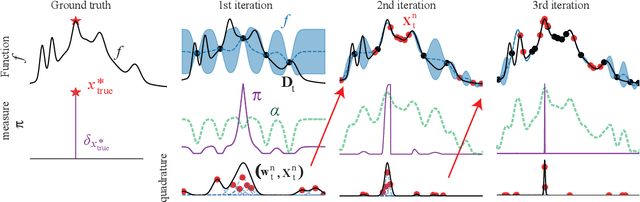
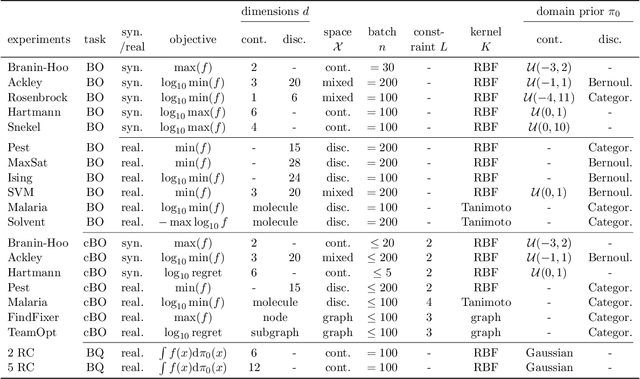
Parallelisation in Bayesian optimisation is a common strategy but faces several challenges: the need for flexibility in acquisition functions and kernel choices, flexibility dealing with discrete and continuous variables simultaneously, model misspecification, and lastly fast massive parallelisation. To address these challenges, we introduce a versatile and modular framework for batch Bayesian optimisation via probabilistic lifting with kernel quadrature, called SOBER, which we present as a Python library based on GPyTorch/BoTorch. Our framework offers the following unique benefits: (1) Versatility in downstream tasks under a unified approach. (2) A gradient-free sampler, which does not require the gradient of acquisition functions, offering domain-agnostic sampling (e.g., discrete and mixed variables, non-Euclidean space). (3) Flexibility in domain prior distribution. (4) Adaptive batch size (autonomous determination of the optimal batch size). (5) Robustness against a misspecified reproducing kernel Hilbert space. (6) Natural stopping criterion.
Policy Gradient with Kernel Quadrature
Oct 23, 2023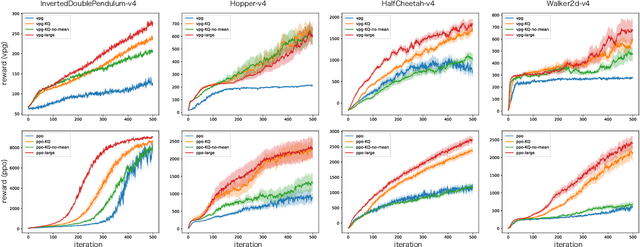

Reward evaluation of episodes becomes a bottleneck in a broad range of reinforcement learning tasks. Our aim in this paper is to select a small but representative subset of a large batch of episodes, only on which we actually compute rewards for more efficient policy gradient iterations. We build a Gaussian process modeling of discounted returns or rewards to derive a positive definite kernel on the space of episodes, run an "episodic" kernel quadrature method to compress the information of sample episodes, and pass the reduced episodes to the policy network for gradient updates. We present the theoretical background of this procedure as well as its numerical illustrations in MuJoCo and causal discovery tasks.