 Add to Chrome
 Add to Firefox
 Add to Edge
A Deployable Embodied Vision-Language Navigation System with Hierarchical Cognition and Context-Aware Exploration
Apr 23, 2026
Bridging the gap between embodied intelligence and embedded deployment remains a key challenge in intelligent robotic systems, where perception, reasoning, and planning must operate under strict constraints on computation, memory, energy, and real-time execution. In vision-language navigation (VLN), existing approaches often face a fundamental trade-off between strong reasoning capabilities and efficient deployment on real-world platforms. In this paper, we present a deployable embodied VLN system that achieves both high efficiency and robust high-level reasoning on real-world robotic platforms. To achieve this, we decouple the system into three asynchronous modules: a real-time perception module for continuous environment sensing, a memory integration module for spatial-semantic aggregation, and a reasoning module for high-level decision making. We incrementally construct a cognitive memory graph to encode scene information, which is further decomposed into subgraphs to enable reasoning with a vision-language model (VLM). To further improve navigation efficiency and accuracy, we also leverage the cognitive memory graph to formulate the exploration problem as a context-aware Weighted Traveling Repairman Problem (WTRP), which minimizes the weighted waiting time of viewpoints. Extensive experiments in both simulation and real-world robotic platforms demonstrate improved navigation success and efficiency over existing VLN approaches, while maintaining real-time performance on resource-constrained hardware.

Learning Dynamic Weight Adjustment for Spatial-Temporal Trajectory Planning in Crowd Navigation
Nov 30, 2024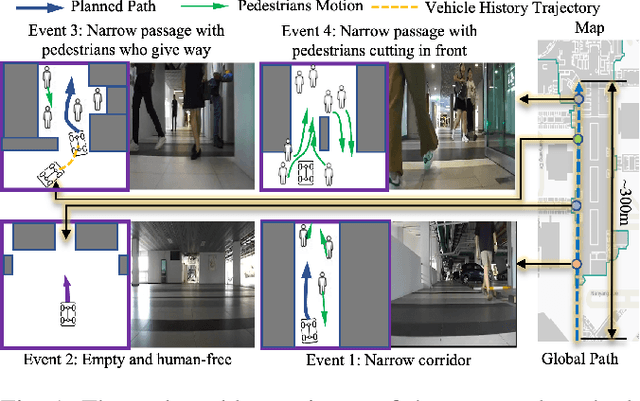
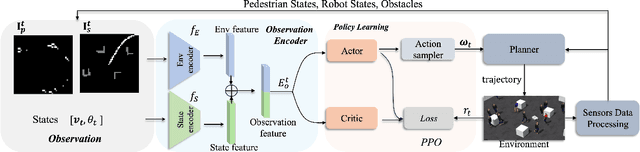
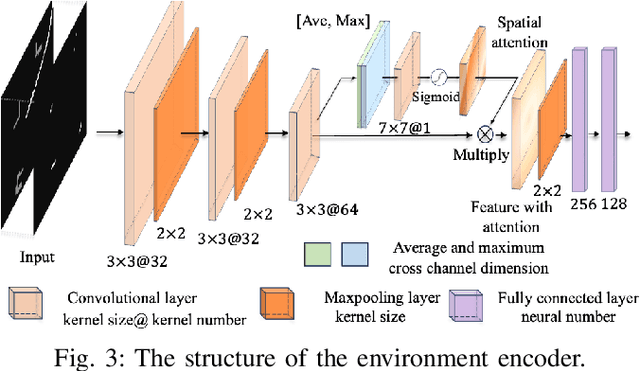
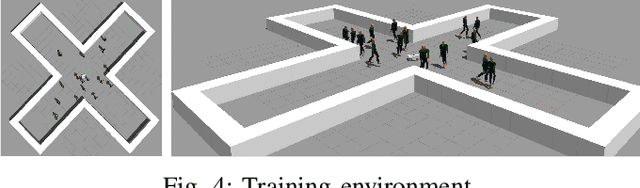
Robot navigation in dense human crowds poses a significant challenge due to the complexity of human behavior in dynamic and obstacle-rich environments. In this work, we propose a dynamic weight adjustment scheme using a neural network to predict the optimal weights of objectives in an optimization-based motion planner. We adopt a spatial-temporal trajectory planner and incorporate diverse objectives to achieve a balance among safety, efficiency, and goal achievement in complex and dynamic environments. We design the network structure, observation encoding, and reward function to effectively train the policy network using reinforcement learning, allowing the robot to adapt its behavior in real time based on environmental and pedestrian information. Simulation results show improved safety compared to the fixed-weight planner and the state-of-the-art learning-based methods, and verify the ability of the learned policy to adaptively adjust the weights based on the observed situations. The approach's feasibility is demonstrated in a navigation task using an autonomous delivery robot across a crowded corridor over a 300 m distance.
Robust Loop Closure by Textual Cues in Challenging Environments
Oct 21, 2024
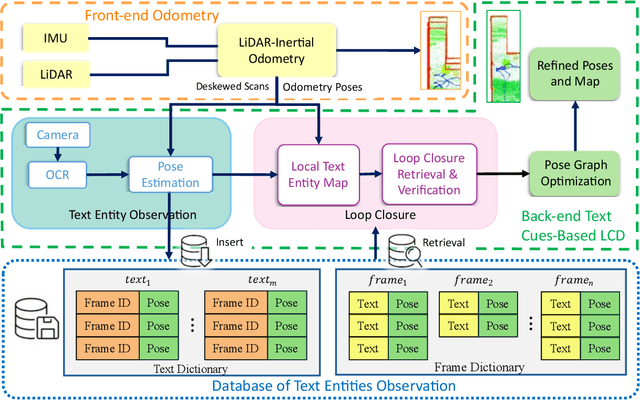

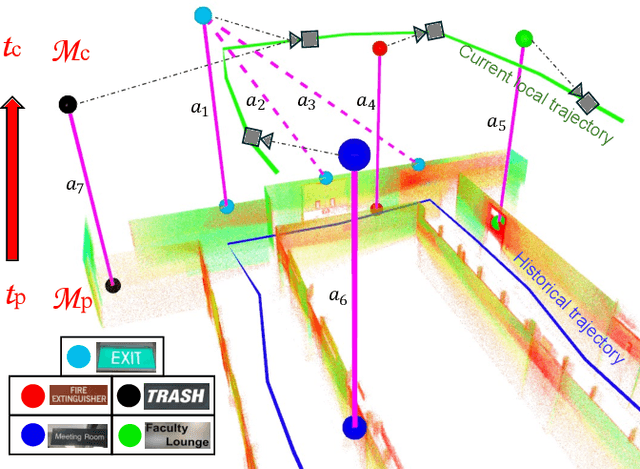
Loop closure is an important task in robot navigation. However, existing methods mostly rely on some implicit or heuristic features of the environment, which can still fail to work in common environments such as corridors, tunnels, and warehouses. Indeed, navigating in such featureless, degenerative, and repetitive (FDR) environments would also pose a significant challenge even for humans, but explicit text cues in the surroundings often provide the best assistance. This inspires us to propose a multi-modal loop closure method based on explicit human-readable textual cues in FDR environments. Specifically, our approach first extracts scene text entities based on Optical Character Recognition (OCR), then creates a local map of text cues based on accurate LiDAR odometry and finally identifies loop closure events by a graph-theoretic scheme. Experiment results demonstrate that this approach has superior performance over existing methods that rely solely on visual and LiDAR sensors. To benefit the community, we release the source code and datasets at \url{https://github.com/TongxingJin/TXTLCD}.
Eigen Is All You Need: Efficient Lidar-Inertial Continuous-Time Odometry with Internal Association
Feb 04, 2024


In this paper, we propose a continuous-time lidar-inertial odometry (CT-LIO) system named SLICT2, which promotes two main insights. One, contrary to conventional wisdom, CT-LIO algorithm can be optimized by linear solvers in only a few iterations, which is more efficient than commonly used nonlinear solvers. Two, CT-LIO benefits more from the correct association than the number of iterations. Based on these ideas, we implement our method with a customized solver where the feature association process is performed immediately after each incremental step, and the solution can converge within a few iterations. Our implementation can achieve real-time performance with a high density of control points while yielding competitive performance in highly dynamical motion scenarios. We demonstrate the advantages of our method by comparing with other existing state-of-the-art CT-LIO methods. The source code will be released for the benefit of the community.