 Add to Chrome
 Add to Firefox
 Add to Edge
Separate First, Then Associate: A Two-Stage Approach for Real-World Audio-Visual Speech Enhancement
Aug 14, 2026
Audio-visual speech enhancement (AVSE) aims at extracting target speech from multi-speaker mixtures by exploiting visual cues. Although recent studies have reported strong performance on simulated datasets, the performance, however, often drops dramatically when they are applied to real-world audio-visual recordings. To bridge this gap, the Real-World AVSE Challenge held in the ISCSLP 2026 conference calls for participants to design a practical solution for AVSE under real-world conditions, where speaker overlap, acoustic interferences, room reverberation and visual degradations naturally co-exist. In our submission to the challenge, we propose a decoupled separation-then-association approach. It consists of two stages: a separation stage in which a trained, audio-only model (i.e., not using visual cues) is used to separate input multi-speaker mixture to individual speaker signals, followed by an association stage, where an audio-visual CLIP model is used to identify the separated speech signal with the highest similarity with the target speaker's facial video via cross-modal similarity matching. Evaluation results on the challenge dataset show the effectiveness of our proposed approach.

A Small and Fast BERT for Chinese Medical Punctuation Restoration
Aug 24, 2023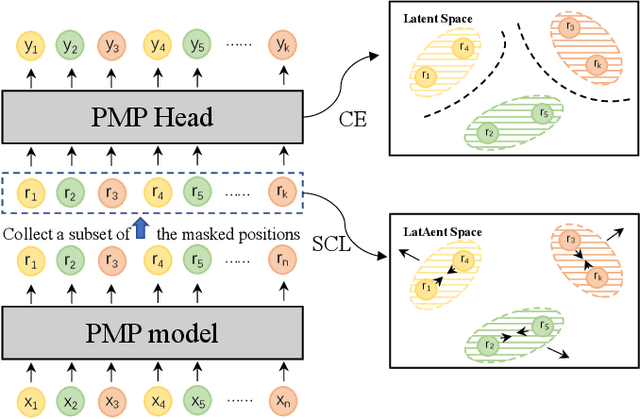
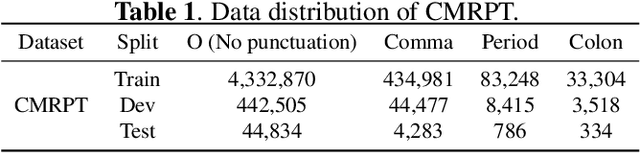
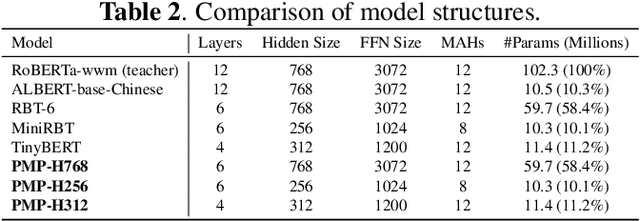
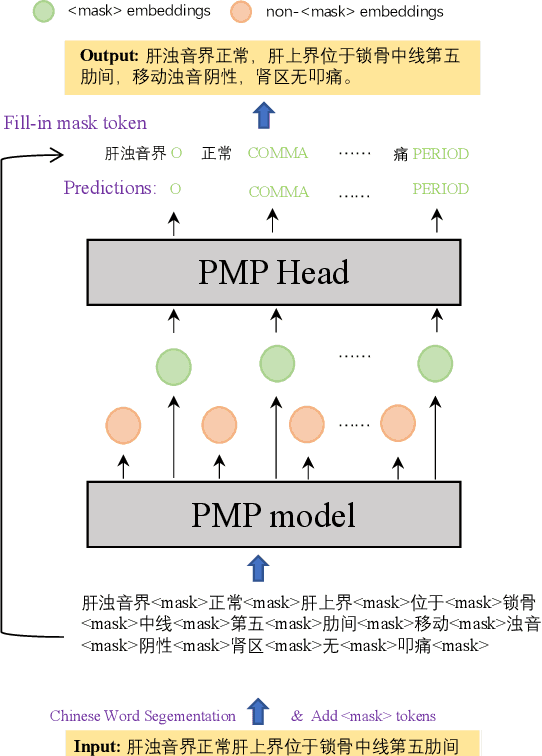
In clinical dictation, utterances after automatic speech recognition (ASR) without explicit punctuation marks may lead to the misunderstanding of dictated reports. To give a precise and understandable clinical report with ASR, automatic punctuation restoration is required. Considering a practical scenario, we propose a fast and light pre-trained model for Chinese medical punctuation restoration based on 'pretraining and fine-tuning' paradigm. In this work, we distill pre-trained models by incorporating supervised contrastive learning and a novel auxiliary pre-training task (Punctuation Mark Prediction) to make it well-suited for punctuation restoration. Our experiments on various distilled models reveal that our model can achieve 95% performance while 10% model size relative to state-of-the-art Chinese RoBERTa.
Sentence-level Event Detection without Triggers via Prompt Learning and Machine Reading Comprehension
Jun 25, 2023The traditional way of sentence-level event detection involves two important subtasks: trigger identification and trigger classifications, where the identified event trigger words are used to classify event types from sentences. However, trigger classification highly depends on abundant annotated trigger words and the accuracy of trigger identification. In a real scenario, annotating trigger words is time-consuming and laborious. For this reason, we propose a trigger-free event detection model, which transforms event detection into a two-tower model based on machine reading comprehension and prompt learning. Compared to existing trigger-based and trigger-free methods, experimental studies on two event detection benchmark datasets (ACE2005 and MAVEN) have shown that the proposed approach can achieve competitive performance.
Evolutionary Verbalizer Search for Prompt-based Few Shot Text Classification
Jun 18, 2023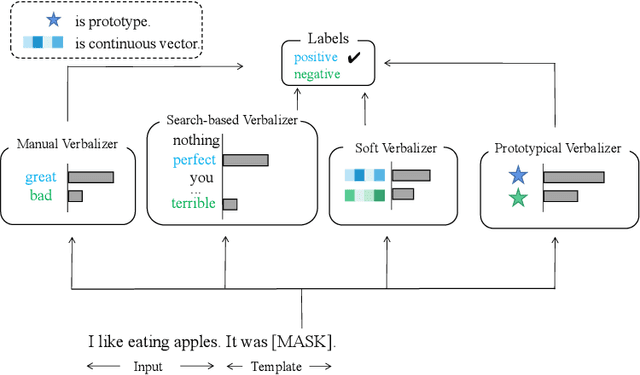
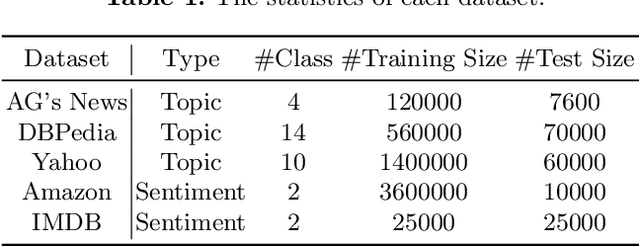
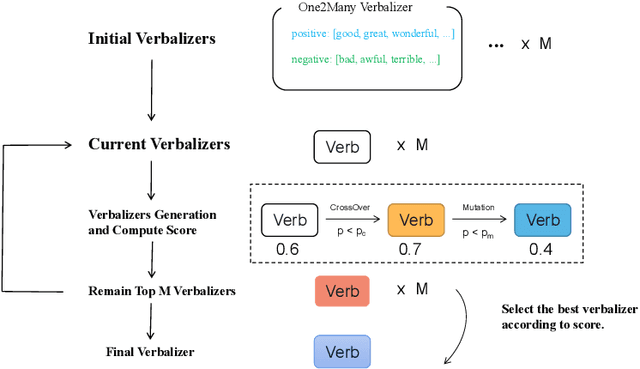
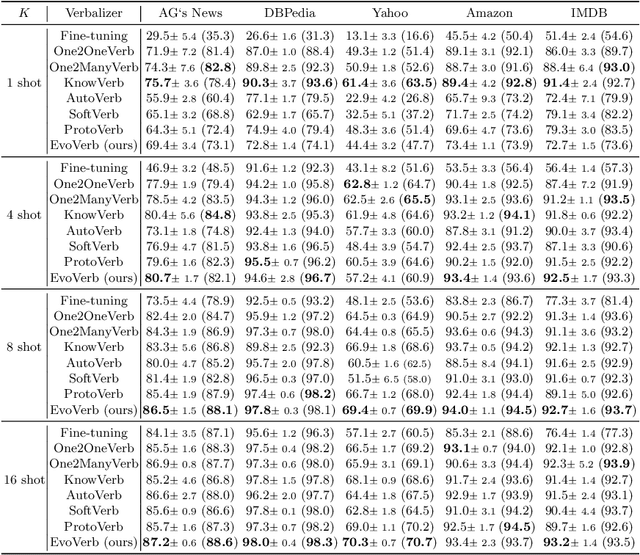
Recent advances for few-shot text classification aim to wrap textual inputs with task-specific prompts to cloze questions. By processing them with a masked language model to predict the masked tokens and using a verbalizer that constructs the mapping between predicted words and target labels. This approach of using pre-trained language models is called prompt-based tuning, which could remarkably outperform conventional fine-tuning approach in the low-data scenario. As the core of prompt-based tuning, the verbalizer is usually handcrafted with human efforts or suboptimally searched by gradient descent. In this paper, we focus on automatically constructing the optimal verbalizer and propose a novel evolutionary verbalizer search (EVS) algorithm, to improve prompt-based tuning with the high-performance verbalizer. Specifically, inspired by evolutionary algorithm (EA), we utilize it to automatically evolve various verbalizers during the evolutionary procedure and select the best one after several iterations. Extensive few-shot experiments on five text classification datasets show the effectiveness of our method.