 Add to Chrome
 Add to Firefox
 Add to Edge
SpecAHD: Localize to Specialize for Automated Heuristic Design in Large-Scale Routing Problems
Jul 26, 2026
LLM-based automated heuristic design (AHD) typically scores executable programs on complete instances or within fixed solver components. In large-scale routing problems, localized reconstruction reduces the size of each optimization task, but repair regions within the same incumbent can exhibit substantially different structures. One construction rule must therefore compromise across them. In this paper, we propose SpecAHD, a coupled bilevel framework for within-instance specialization. An upper-level search learns where to expose bounded repair regions, while a lower-level search evolves a complementary repertoire of executable heuristics for the induced repair tasks. The upper-level program determines the repair tasks seen by the lower level, while checked repair outcomes determine how upper-level programs are evaluated. The lower-level objective favors heuristics that perform well on average or solve tasks that the current repertoire handles poorly. For the repair tasks induced by a fixed upper-level program and a fixed lower-level candidate pool, this objective is monotone submodular, allowing greedy repertoire selection with a (1-1/e) approximation guarantee. Across four routing problems and multiple LLM backbones, SpecAHD reduces held-out objective cost by up to 57.7% against the strongest competing AHD baseline and outperforms the per-instance baseline envelope on most public instances.

CoAction: Cross-task Correlation-aware Pareto Set Learning
May 03, 2026Pareto set learning (PSL) is an emerging paradigm in multi-objective optimization that trains neural networks to map preference vectors to Pareto optimal solutions. However, existing PSL methods primarily focus on solving a single multi-objective optimization problem at a time. This limitation not only increases computational costs in multi-objective multitask optimization scenarios by requiring a separate model for each task, but also fails to exploit the inter-task correlations across tasks. To address this, we propose a Cross-tAsk correlation-aware Pareto Set Learning (CoAction) framework, which leverages task-aware transformer to handle multiple tasks simultaneously. Specifically, by assigning task-specific embedding vectors to individual tasks, the model effectively distinguishes between tasks while facilitating knowledge sharing among them. We utilize a Transformer encoder as the backbone architecture to leverage its self-attention mechanism for capturing complex task dependencies. The proposed approach is evaluated on comprehensive multitask test suites covering both benchmark problems and real-world applications, demonstrating effectiveness and competitive performance in Hypervolume, Range, and Sparsity.
Beyond the Node: Clade-level Selection for Efficient MCTS in Automatic Heuristic Design
Jan 31, 2026While Monte Carlo Tree Search (MCTS) shows promise in Large Language Model (LLM) based Automatic Heuristic Design (AHD), it suffers from a critical over-exploitation tendency under the limited computational budgets required for heuristic evaluation. To address this limitation, we propose Clade-AHD, an efficient framework that replaces node-level point estimates with clade-level Bayesian beliefs. By aggregating descendant evaluations into Beta distributions and performing Thompson Sampling over these beliefs, Clade-AHD explicitly models uncertainty to guide exploration, enabling more reliable decision-making under sparse and noisy evaluations. Extensive experiments on complex combinatorial optimization problems demonstrate that Clade-AHD consistently outperforms state-of-the-art methods while significantly reducing computational cost. The source code is publicly available at: https://github.com/Mriya0306/Clade-AHD.
Sentence-level Event Detection without Triggers via Prompt Learning and Machine Reading Comprehension
Jun 25, 2023The traditional way of sentence-level event detection involves two important subtasks: trigger identification and trigger classifications, where the identified event trigger words are used to classify event types from sentences. However, trigger classification highly depends on abundant annotated trigger words and the accuracy of trigger identification. In a real scenario, annotating trigger words is time-consuming and laborious. For this reason, we propose a trigger-free event detection model, which transforms event detection into a two-tower model based on machine reading comprehension and prompt learning. Compared to existing trigger-based and trigger-free methods, experimental studies on two event detection benchmark datasets (ACE2005 and MAVEN) have shown that the proposed approach can achieve competitive performance.
Evolutionary Verbalizer Search for Prompt-based Few Shot Text Classification
Jun 18, 2023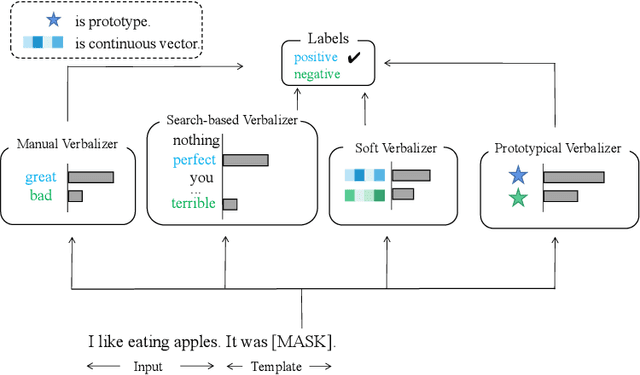
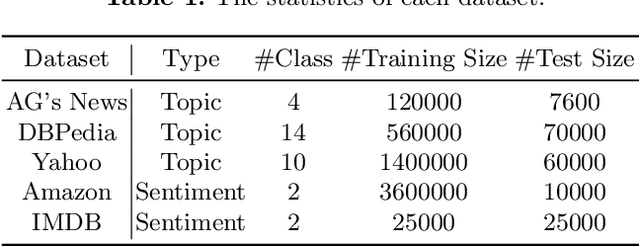
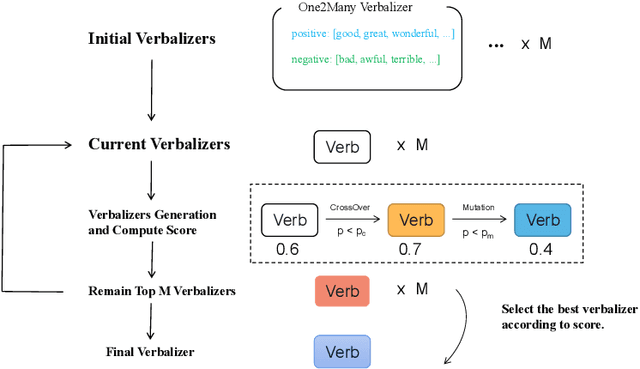
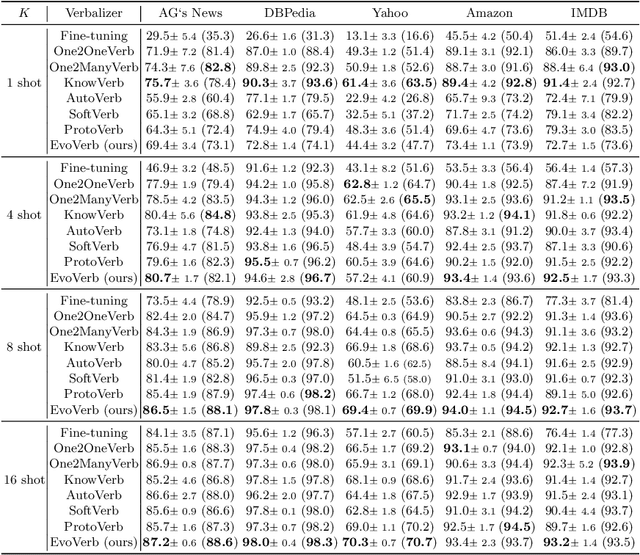
Recent advances for few-shot text classification aim to wrap textual inputs with task-specific prompts to cloze questions. By processing them with a masked language model to predict the masked tokens and using a verbalizer that constructs the mapping between predicted words and target labels. This approach of using pre-trained language models is called prompt-based tuning, which could remarkably outperform conventional fine-tuning approach in the low-data scenario. As the core of prompt-based tuning, the verbalizer is usually handcrafted with human efforts or suboptimally searched by gradient descent. In this paper, we focus on automatically constructing the optimal verbalizer and propose a novel evolutionary verbalizer search (EVS) algorithm, to improve prompt-based tuning with the high-performance verbalizer. Specifically, inspired by evolutionary algorithm (EA), we utilize it to automatically evolve various verbalizers during the evolutionary procedure and select the best one after several iterations. Extensive few-shot experiments on five text classification datasets show the effectiveness of our method.