 Add to Chrome
 Add to Firefox
 Add to Edge
On Purely Private Covariance Estimation
Oct 30, 2025
We present a simple perturbation mechanism for the release of $d$-dimensional covariance matrices $\Sigma$ under pure differential privacy. For large datasets with at least $n\geq d^2/\varepsilon$ elements, our mechanism recovers the provably optimal Frobenius norm error guarantees of \cite{nikolov2023private}, while simultaneously achieving best known error for all other $p$-Schatten norms, with $p\in [1,\infty]$. Our error is information-theoretically optimal for all $p\ge 2$, in particular, our mechanism is the first purely private covariance estimator that achieves optimal error in spectral norm. For small datasets $n< d^2/\varepsilon$, we further show that by projecting the output onto the nuclear norm ball of appropriate radius, our algorithm achieves the optimal Frobenius norm error $O(\sqrt{d\;\text{Tr}(\Sigma) /n})$, improving over the known bounds of $O(\sqrt{d/n})$ of \cite{nikolov2023private} and ${O}\big(d^{3/4}\sqrt{\text{Tr}(\Sigma)/n}\big)$ of \cite{dong2022differentially}.

Tight Differentially Private PCA via Matrix Coherence
Oct 30, 2025We revisit the task of computing the span of the top $r$ singular vectors $u_1, \ldots, u_r$ of a matrix under differential privacy. We show that a simple and efficient algorithm -- based on singular value decomposition and standard perturbation mechanisms -- returns a private rank-$r$ approximation whose error depends only on the \emph{rank-$r$ coherence} of $u_1, \ldots, u_r$ and the spectral gap $\sigma_r - \sigma_{r+1}$. This resolves a question posed by Hardt and Roth~\cite{hardt2013beyond}. Our estimator outperforms the state of the art -- significantly so in some regimes. In particular, we show that in the dense setting, it achieves the same guarantees for single-spike PCA in the Wishart model as those attained by optimal non-private algorithms, whereas prior private algorithms failed to do so. In addition, we prove that (rank-$r$) coherence does not increase under Gaussian perturbations. This implies that any estimator based on the Gaussian mechanism -- including ours -- preserves the coherence of the input. We conjecture that similar behavior holds for other structured models, including planted problems in graphs. We also explore applications of coherence to graph problems. In particular, we present a differentially private algorithm for Max-Cut and other constraint satisfaction problems under low coherence assumptions.
A Near-Linear Time Approximation Algorithm for Beyond-Worst-Case Graph Clustering
Jun 07, 2024We consider the semi-random graph model of [Makarychev, Makarychev and Vijayaraghavan, STOC'12], where, given a random bipartite graph with $\alpha$ edges and an unknown bipartition $(A, B)$ of the vertex set, an adversary can add arbitrary edges inside each community and remove arbitrary edges from the cut $(A, B)$ (i.e. all adversarial changes are \textit{monotone} with respect to the bipartition). For this model, a polynomial time algorithm is known to approximate the Balanced Cut problem up to value $O(\alpha)$ [MMV'12] as long as the cut $(A, B)$ has size $\Omega(\alpha)$. However, it consists of slow subroutines requiring optimal solutions for logarithmically many semidefinite programs. We study the fine-grained complexity of the problem and present the first near-linear time algorithm that achieves similar performances to that of [MMV'12]. Our algorithm runs in time $O(|V(G)|^{1+o(1)} + |E(G)|^{1+o(1)})$ and finds a balanced cut of value $O(\alpha)$. Our approach appears easily extendible to related problem, such as Sparsest Cut, and also yields an near-linear time $O(1)$-approximation to Dagupta's objective function for hierarchical clustering [Dasgupta, STOC'16] for the semi-random hierarchical stochastic block model inputs of [Cohen-Addad, Kanade, Mallmann-Trenn, Mathieu, JACM'19].
Perturb-and-Project: Differentially Private Similarities and Marginals
Jun 07, 2024We revisit the input perturbations framework for differential privacy where noise is added to the input $A\in \mathcal{S}$ and the result is then projected back to the space of admissible datasets $\mathcal{S}$. Through this framework, we first design novel efficient algorithms to privately release pair-wise cosine similarities. Second, we derive a novel algorithm to compute $k$-way marginal queries over $n$ features. Prior work could achieve comparable guarantees only for $k$ even. Furthermore, we extend our results to $t$-sparse datasets, where our efficient algorithms yields novel, stronger guarantees whenever $t\le n^{5/6}/\log n\,.$ Finally, we provide a theoretical perspective on why \textit{fast} input perturbation algorithms works well in practice. The key technical ingredients behind our results are tight sum-of-squares certificates upper bounding the Gaussian complexity of sets of solutions.
Multi-View Stochastic Block Models
Jun 07, 2024Graph clustering is a central topic in unsupervised learning with a multitude of practical applications. In recent years, multi-view graph clustering has gained a lot of attention for its applicability to real-world instances where one has access to multiple data sources. In this paper we formalize a new family of models, called \textit{multi-view stochastic block models} that captures this setting. For this model, we first study efficient algorithms that naively work on the union of multiple graphs. Then, we introduce a new efficient algorithm that provably outperforms previous approaches by analyzing the structure of each graph separately. Furthermore, we complement our results with an information-theoretic lower bound studying the limits of what can be done in this model. Finally, we corroborate our results with experimental evaluations.
Private graphon estimation via sum-of-squares
Mar 18, 2024We develop the first pure node-differentially-private algorithms for learning stochastic block models and for graphon estimation with polynomial running time for any constant number of blocks. The statistical utility guarantees match those of the previous best information-theoretic (exponential-time) node-private mechanisms for these problems. The algorithm is based on an exponential mechanism for a score function defined in terms of a sum-of-squares relaxation whose level depends on the number of blocks. The key ingredients of our results are (1) a characterization of the distance between the block graphons in terms of a quadratic optimization over the polytope of doubly stochastic matrices, (2) a general sum-of-squares convergence result for polynomial optimization over arbitrary polytopes, and (3) a general approach to perform Lipschitz extensions of score functions as part of the sum-of-squares algorithmic paradigm.
Reaching Kesten-Stigum Threshold in the Stochastic Block Model under Node Corruptions
May 17, 2023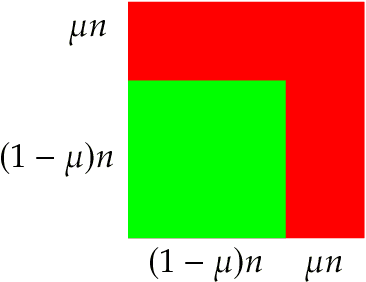
We study robust community detection in the context of node-corrupted stochastic block model, where an adversary can arbitrarily modify all the edges incident to a fraction of the $n$ vertices. We present the first polynomial-time algorithm that achieves weak recovery at the Kesten-Stigum threshold even in the presence of a small constant fraction of corrupted nodes. Prior to this work, even state-of-the-art robust algorithms were known to break under such node corruption adversaries, when close to the Kesten-Stigum threshold. We further extend our techniques to the $Z_2$ synchronization problem, where our algorithm reaches the optimal recovery threshold in the presence of similar strong adversarial perturbations. The key ingredient of our algorithm is a novel identifiability proof that leverages the push-out effect of the Grothendieck norm of principal submatrices.
Private estimation algorithms for stochastic block models and mixture models
Jan 11, 2023We introduce general tools for designing efficient private estimation algorithms, in the high-dimensional settings, whose statistical guarantees almost match those of the best known non-private algorithms. To illustrate our techniques, we consider two problems: recovery of stochastic block models and learning mixtures of spherical Gaussians. For the former, we present the first efficient $(\epsilon, \delta)$-differentially private algorithm for both weak recovery and exact recovery. Previously known algorithms achieving comparable guarantees required quasi-polynomial time. For the latter, we design an $(\epsilon, \delta)$-differentially private algorithm that recovers the centers of the $k$-mixture when the minimum separation is at least $ O(k^{1/t}\sqrt{t})$. For all choices of $t$, this algorithm requires sample complexity $n\geq k^{O(1)}d^{O(t)}$ and time complexity $(nd)^{O(t)}$. Prior work required minimum separation at least $O(\sqrt{k})$ as well as an explicit upper bound on the Euclidean norm of the centers.
Higher degree sum-of-squares relaxations robust against oblivious outliers
Nov 14, 2022We consider estimation models of the form $Y=X^*+N$, where $X^*$ is some $m$-dimensional signal we wish to recover, and $N$ is symmetrically distributed noise that may be unbounded in all but a small $\alpha$ fraction of the entries. We introduce a family of algorithms that under mild assumptions recover the signal $X^*$ in all estimation problems for which there exists a sum-of-squares algorithm that succeeds in recovering the signal $X^*$ when the noise $N$ is Gaussian. This essentially shows that it is enough to design a sum-of-squares algorithm for an estimation problem with Gaussian noise in order to get the algorithm that works with the symmetric noise model. Our framework extends far beyond previous results on symmetric noise models and is even robust to adversarial perturbations. As concrete examples, we investigate two problems for which no efficient algorithms were known to work for heavy-tailed noise: tensor PCA and sparse PCA. For the former, our algorithm recovers the principal component in polynomial time when the signal-to-noise ratio is at least $\tilde{O}(n^{p/4}/\alpha)$, that matches (up to logarithmic factors) current best known algorithmic guarantees for Gaussian noise. For the latter, our algorithm runs in quasipolynomial time and matches the state-of-the-art guarantees for quasipolynomial time algorithms in the case of Gaussian noise. Using a reduction from the planted clique problem, we provide evidence that the quasipolynomial time is likely to be necessary for sparse PCA with symmetric noise. In our proofs we use bounds on the covering numbers of sets of pseudo-expectations, which we obtain by certifying in sum-of-squares upper bounds on the Gaussian complexities of sets of solutions. This approach for bounding the covering numbers of sets of pseudo-expectations may be interesting in its own right and may find other application in future works.
On the well-spread property and its relation to linear regression
Jun 16, 2022We consider the robust linear regression model $\boldsymbol{y} = X\beta^* + \boldsymbol{\eta}$, where an adversary oblivious to the design $X \in \mathbb{R}^{n \times d}$ may choose $\boldsymbol{\eta}$ to corrupt all but a (possibly vanishing) fraction of the observations $\boldsymbol{y}$ in an arbitrary way. Recent work [dLN+21, dNS21] has introduced efficient algorithms for consistent recovery of the parameter vector. These algorithms crucially rely on the design matrix being well-spread (a matrix is well-spread if its column span is far from any sparse vector). In this paper, we show that there exists a family of design matrices lacking well-spreadness such that consistent recovery of the parameter vector in the above robust linear regression model is information-theoretically impossible. We further investigate the average-case time complexity of certifying well-spreadness of random matrices. We show that it is possible to efficiently certify whether a given $n$-by-$d$ Gaussian matrix is well-spread if the number of observations is quadratic in the ambient dimension. We complement this result by showing rigorous evidence -- in the form of a lower bound against low-degree polynomials -- of the computational hardness of this same certification problem when the number of observations is $o(d^2)$.