 Add to Chrome
 Add to Firefox
 Add to Edge
LatentGym: A Testbed For Cross-Task Experiential Learning With Controllable Latent Structure
Jun 13, 2026
We envision continually learning agentic systems that become more useful over time: as they encounter sequences of related tasks, they should infer the hidden structure shared across those tasks and use it to improve future decisions. This cross-task experiential learning capability is pivotal in domains such as personalization and interactive assistance, but existing training/evaluation frameworks do not provide shared, controllable latent structures and cannot measure whether or why agents improve. We introduce LatentGym: a controllable suite in which each environment is organized around a ground-truth latent variable governing the structure across tasks. Our construction yields metrics that separate exploration (whether the agent's actions gather information about the latent) from exploitation (whether the agent uses what it has gathered). We demonstrate our suite on empirical studies addressing three questions: how and why frontier models fail to adapt across related tasks; whether post-training on related task sequences improves general cross-task adaptation, and where those gains come from; and how design choices such as inter-task feedback shape training dynamics and generalization. Together, these results establish a controlled foundation for studying how LLM agents learn from experience across tasks, and for designing agents that adapt more reliably in sequential, personalized, and interactive settings.

SynthTools: A Framework for Scaling Synthetic Tools for Agent Development
Nov 11, 2025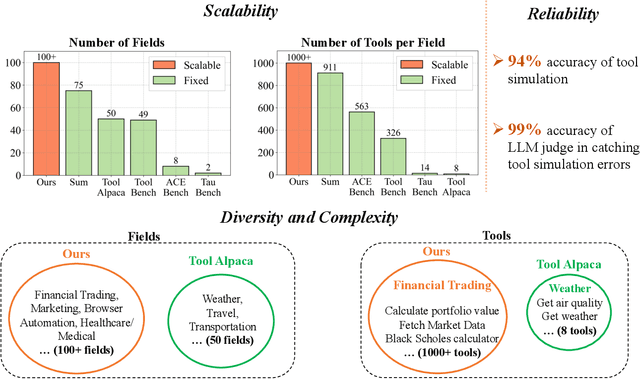
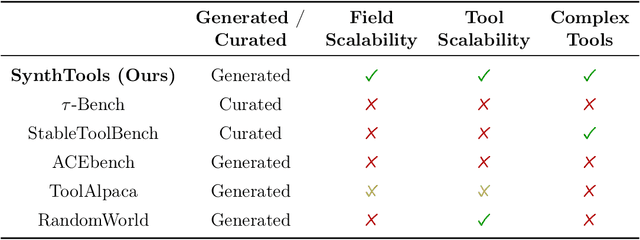
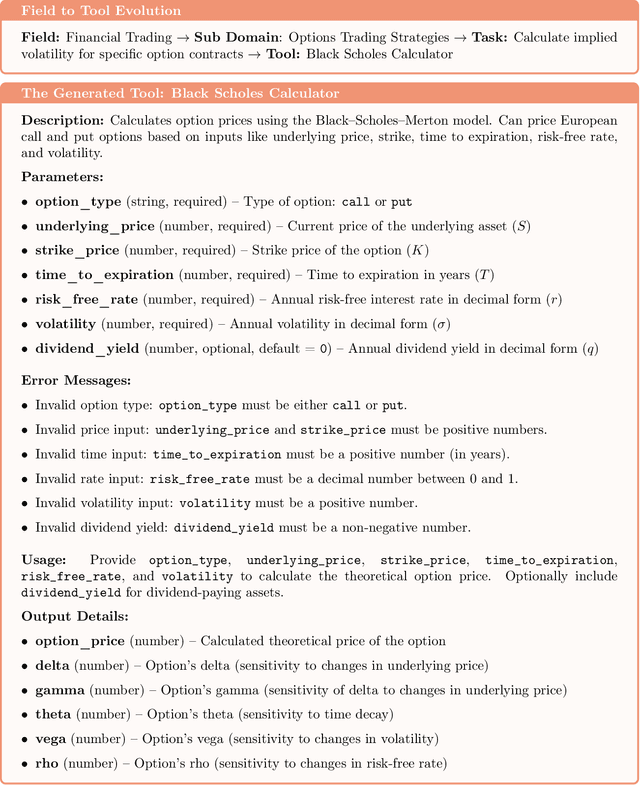

AI agents increasingly rely on external tools to solve complex, long-horizon tasks. Advancing such agents requires reproducible evaluation and large-scale training in controllable, diverse, and realistic tool-use environments. However, real-world APIs are limited in availability, domain coverage, and stability, often requiring access keys and imposing rate limits, which render them impractical for stable evaluation or scalable training. To address these challenges, we introduce SynthTools, a flexible and scalable framework for generating synthetic tool ecosystems. Our framework consists of three core components: Tool Generation for automatic and scalable creation of diverse tools, Tool Simulation to emulate realistic tool behaviors, and Tool Audit to ensure correctness and consistency of tool simulation. To illustrate its scalability, we show that SynthTools can readily produce toolsets that span twice as many domains and twice as many tools per domain as prior work. Furthermore, the tool simulation and tool audit components demonstrate strong reliability, achieving $94\%$ and $99\%$ accuracy respectively. Finally, we construct downstream tasks from the generated tools that even state-of-the-art models struggle to complete. By enabling scalable, diverse, and reliable tool ecosystems, SynthTools provides a practical path toward large-scale training and stable evaluation of tool-use agents. Our code is available at https://github.com/namkoong-lab/SynthTools.