 Add to Chrome
 Add to Firefox
 Add to Edge
LatentGym: A Testbed For Cross-Task Experiential Learning With Controllable Latent Structure
Jun 13, 2026
We envision continually learning agentic systems that become more useful over time: as they encounter sequences of related tasks, they should infer the hidden structure shared across those tasks and use it to improve future decisions. This cross-task experiential learning capability is pivotal in domains such as personalization and interactive assistance, but existing training/evaluation frameworks do not provide shared, controllable latent structures and cannot measure whether or why agents improve. We introduce LatentGym: a controllable suite in which each environment is organized around a ground-truth latent variable governing the structure across tasks. Our construction yields metrics that separate exploration (whether the agent's actions gather information about the latent) from exploitation (whether the agent uses what it has gathered). We demonstrate our suite on empirical studies addressing three questions: how and why frontier models fail to adapt across related tasks; whether post-training on related task sequences improves general cross-task adaptation, and where those gains come from; and how design choices such as inter-task feedback shape training dynamics and generalization. Together, these results establish a controlled foundation for studying how LLM agents learn from experience across tasks, and for designing agents that adapt more reliably in sequential, personalized, and interactive settings.

WorkstreamBench: Evaluating LLM Agents on End-to-End Spreadsheet Tasks in Finance
May 21, 2026LLM agents are increasingly expected to carry out end-to-end workflows, producing complete artifacts from high-level user instructions. To meet enterprise needs, frontier AI labs have developed agents that can construct entire spreadsheets from scratch. This is especially relevant in finance, where core workflows such as financial modeling, forecasting, and scenario analysis are commonly conducted through spreadsheets. Yet, existing spreadsheet benchmarks do not measure this advanced capability, focusing instead on question-answering or single-formula edits. To address this gap, we provide one of the first evaluations of agents on end-to-end spreadsheet tasks, focusing on economically critical financial workflows such as modeling and scenario analysis. Since deliverables therein are routinely reviewed and revised by multiple stakeholders, judging their quality necessarily involves high-level criteria such as readability or ease of modification. To reflect the multidimensional nature of solution quality, we develop an evaluation taxonomy comprising three dimensions: Accuracy, Formula, and Format, each comprising fine-grained criteria that reflect professional standards. The Claude family leads the benchmark and produces the most professional-looking outputs in our qualitative review, but even the strongest agents frequently fall short of professional finance standards and degrade sharply as the difficulty increases beyond a few chained calculations. This suggests that current agents are not yet able to reliably produce professional-quality spreadsheets at the level of complexity real-world workflows demand.
SynthTools: A Framework for Scaling Synthetic Tools for Agent Development
Nov 11, 2025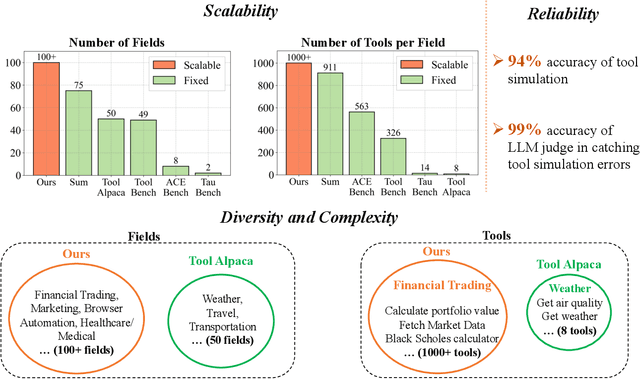
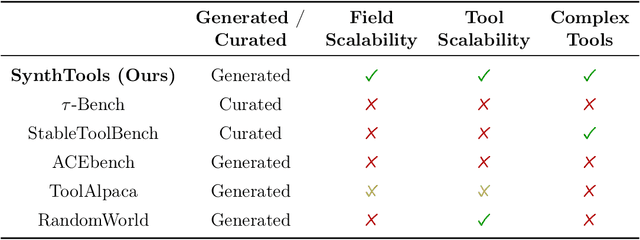
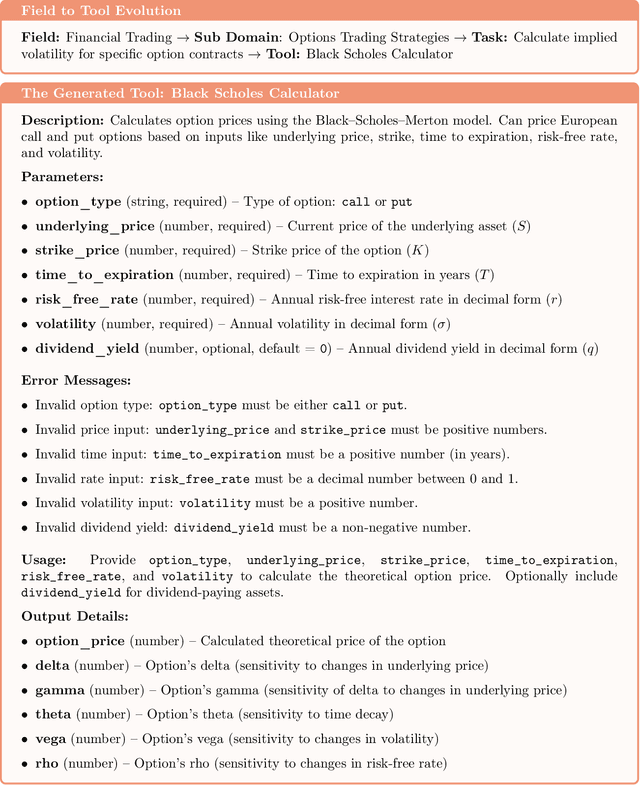

AI agents increasingly rely on external tools to solve complex, long-horizon tasks. Advancing such agents requires reproducible evaluation and large-scale training in controllable, diverse, and realistic tool-use environments. However, real-world APIs are limited in availability, domain coverage, and stability, often requiring access keys and imposing rate limits, which render them impractical for stable evaluation or scalable training. To address these challenges, we introduce SynthTools, a flexible and scalable framework for generating synthetic tool ecosystems. Our framework consists of three core components: Tool Generation for automatic and scalable creation of diverse tools, Tool Simulation to emulate realistic tool behaviors, and Tool Audit to ensure correctness and consistency of tool simulation. To illustrate its scalability, we show that SynthTools can readily produce toolsets that span twice as many domains and twice as many tools per domain as prior work. Furthermore, the tool simulation and tool audit components demonstrate strong reliability, achieving $94\%$ and $99\%$ accuracy respectively. Finally, we construct downstream tasks from the generated tools that even state-of-the-art models struggle to complete. By enabling scalable, diverse, and reliable tool ecosystems, SynthTools provides a practical path toward large-scale training and stable evaluation of tool-use agents. Our code is available at https://github.com/namkoong-lab/SynthTools.
Data Mixture Optimization: A Multi-fidelity Multi-scale Bayesian Framework
Mar 26, 2025Careful curation of data sources can significantly improve the performance of LLM pre-training, but predominant approaches rely heavily on intuition or costly trial-and-error, making them difficult to generalize across different data domains and downstream tasks. Although scaling laws can provide a principled and general approach for data curation, standard deterministic extrapolation from small-scale experiments to larger scales requires strong assumptions on the reliability of such extrapolation, whose brittleness has been highlighted in prior works. In this paper, we introduce a $\textit{probabilistic extrapolation framework}$ for data mixture optimization that avoids rigid assumptions and explicitly models the uncertainty in performance across decision variables. We formulate data curation as a sequential decision-making problem$\unicode{x2013}$multi-fidelity, multi-scale Bayesian optimization$\unicode{x2013}$where $\{$data mixtures, model scale, training steps$\}$ are adaptively selected to balance training cost and potential information gain. Our framework naturally gives rise to algorithm prototypes that leverage noisy information from inexpensive experiments to systematically inform costly training decisions. To accelerate methodological progress, we build a simulator based on 472 language model pre-training runs with varying data compositions from the SlimPajama dataset. We observe that even simple kernels and acquisition functions can enable principled decisions across training models from 20M to 1B parameters and achieve $\textbf{2.6x}$ and $\textbf{3.3x}$ speedups compared to multi-fidelity BO and random search baselines. Taken together, our framework underscores potential efficiency gains achievable by developing principled and transferable data mixture optimization methods.