 Add to Chrome
 Add to Firefox
 Add to Edge
LatentGym: A Testbed For Cross-Task Experiential Learning With Controllable Latent Structure
Jun 13, 2026
We envision continually learning agentic systems that become more useful over time: as they encounter sequences of related tasks, they should infer the hidden structure shared across those tasks and use it to improve future decisions. This cross-task experiential learning capability is pivotal in domains such as personalization and interactive assistance, but existing training/evaluation frameworks do not provide shared, controllable latent structures and cannot measure whether or why agents improve. We introduce LatentGym: a controllable suite in which each environment is organized around a ground-truth latent variable governing the structure across tasks. Our construction yields metrics that separate exploration (whether the agent's actions gather information about the latent) from exploitation (whether the agent uses what it has gathered). We demonstrate our suite on empirical studies addressing three questions: how and why frontier models fail to adapt across related tasks; whether post-training on related task sequences improves general cross-task adaptation, and where those gains come from; and how design choices such as inter-task feedback shape training dynamics and generalization. Together, these results establish a controlled foundation for studying how LLM agents learn from experience across tasks, and for designing agents that adapt more reliably in sequential, personalized, and interactive settings.

SynthTools: A Framework for Scaling Synthetic Tools for Agent Development
Nov 11, 2025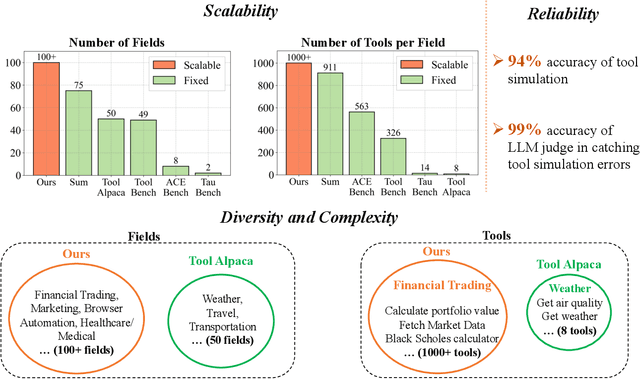
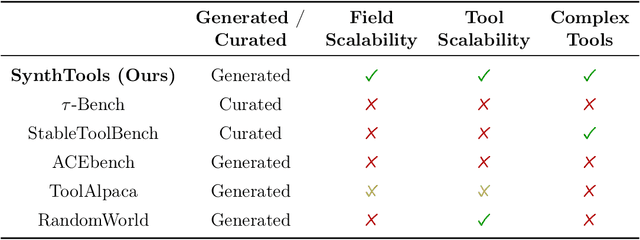
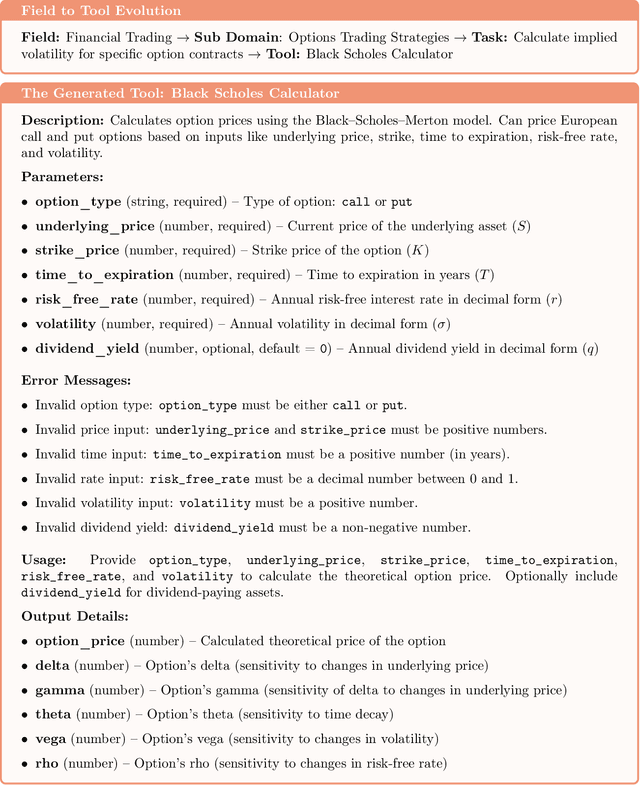

AI agents increasingly rely on external tools to solve complex, long-horizon tasks. Advancing such agents requires reproducible evaluation and large-scale training in controllable, diverse, and realistic tool-use environments. However, real-world APIs are limited in availability, domain coverage, and stability, often requiring access keys and imposing rate limits, which render them impractical for stable evaluation or scalable training. To address these challenges, we introduce SynthTools, a flexible and scalable framework for generating synthetic tool ecosystems. Our framework consists of three core components: Tool Generation for automatic and scalable creation of diverse tools, Tool Simulation to emulate realistic tool behaviors, and Tool Audit to ensure correctness and consistency of tool simulation. To illustrate its scalability, we show that SynthTools can readily produce toolsets that span twice as many domains and twice as many tools per domain as prior work. Furthermore, the tool simulation and tool audit components demonstrate strong reliability, achieving $94\%$ and $99\%$ accuracy respectively. Finally, we construct downstream tasks from the generated tools that even state-of-the-art models struggle to complete. By enabling scalable, diverse, and reliable tool ecosystems, SynthTools provides a practical path toward large-scale training and stable evaluation of tool-use agents. Our code is available at https://github.com/namkoong-lab/SynthTools.
Architectural and Inferential Inductive Biases For Exchangeable Sequence Modeling
Mar 03, 2025Autoregressive models have emerged as a powerful framework for modeling exchangeable sequences - i.i.d. observations when conditioned on some latent factor - enabling direct modeling of uncertainty from missing data (rather than a latent). Motivated by the critical role posterior inference plays as a subroutine in decision-making (e.g., active learning, bandits), we study the inferential and architectural inductive biases that are most effective for exchangeable sequence modeling. For the inference stage, we highlight a fundamental limitation of the prevalent single-step generation approach: inability to distinguish between epistemic and aleatoric uncertainty. Instead, a long line of works in Bayesian statistics advocates for multi-step autoregressive generation; we demonstrate this "correct approach" enables superior uncertainty quantification that translates into better performance on downstream decision-making tasks. This naturally leads to the next question: which architectures are best suited for multi-step inference? We identify a subtle yet important gap between recently proposed Transformer architectures for exchangeable sequences (Muller et al., 2022; Nguyen & Grover, 2022; Ye & Namkoong, 2024), and prove that they in fact cannot guarantee exchangeability despite introducing significant computational overhead. We illustrate our findings using controlled synthetic settings, demonstrating how custom architectures can significantly underperform standard causal masks, underscoring the need for new architectural innovations.
A Planning Framework for Adaptive Labeling
Feb 10, 2025Ground truth labels/outcomes are critical for advancing scientific and engineering applications, e.g., evaluating the treatment effect of an intervention or performance of a predictive model. Since randomly sampling inputs for labeling can be prohibitively expensive, we introduce an adaptive labeling framework where measurement effort can be reallocated in batches. We formulate this problem as a Markov decision process where posterior beliefs evolve over time as batches of labels are collected (state transition), and batches (actions) are chosen to minimize uncertainty at the end of data collection. We design a computational framework that is agnostic to different uncertainty quantification approaches including those based on deep learning, and allows a diverse array of policy gradient approaches by relying on continuous policy parameterizations. On real and synthetic datasets, we demonstrate even a one-step lookahead policy can substantially outperform common adaptive labeling heuristics, highlighting the virtue of planning. On the methodological side, we note that standard REINFORCE-style policy gradient estimators can suffer high variance since they rely only on zeroth order information. We propose a direct backpropagation-based approach, Smoothed-Autodiff, based on a carefully smoothed version of the original non-differentiable MDP. Our method enjoys low variance at the price of introducing bias, and we theoretically and empirically show that this trade-off can be favorable.