 Add to Chrome
 Add to Firefox
 Add to Edge
AxMoE: Characterizing the Impact of Approximate Multipliers on Mixture-of-Experts DNN Architectures
May 06, 2026
Deep neural network (DNN) inference at the edge demands simultaneous improvements in accuracy, computational efficiency, and energy consumption. Approximate computing and Mixture-of-Experts (MoE) architectures have each been studied as independent routes towards efficient inference, the former by replacing exact arithmetic with low-power approximate multipliers, the latter by routing inputs through specialized expert sub-networks to enable conditional computation. However, their interaction remains entirely unexplored. This paper presents AxMoE, the first study of the impact of approximate multiplication on MoE DNN architectures. We evaluate three MoE variants: Hard MoE, Soft MoE, and Cluster MoE against dense baselines across three CNN architectures (ResNet-20, VGG11_bn, VGG19_bn) on CIFAR-100 and a Vision Transformer (ViT-Small) on Tiny ImageNet-200 dataset, using eight 8-bit signed multipliers (including one exact baseline) from the EvoApproxLib library. Results show that, without retraining, the Dense baseline is the most resilient topology across all CNN architectures, whereas on ViT-Small, all topologies degrade at comparable rates regardless of routing strategy. After approximate-aware retraining, recovery varies substantially across architectures, topologies, and multipliers. ResNet-20 achieves full recovery across the entire multiplier range, whereas VGG architectures recover at moderate multipliers but fail irreversibly at aggressive ones for all topologies except Cluster MoE on VGG11_bn; on ViT-Small, Hard MoE outperforms Dense under aggressive approximation at equal normalized inference cost. These results pave the way for future approximate MoE hardware-software co-design strategies.

KANtize: Exploring Low-bit Quantization of Kolmogorov-Arnold Networks for Efficient Inference
Mar 18, 2026Kolmogorov-Arnold Networks (KANs) have gained attention for their potential to outperform Multi-Layer Perceptrons (MLPs) in terms of parameter efficiency and interpretability. Unlike traditional MLPs, KANs use learnable non-linear activation functions, typically spline functions, expressed as linear combinations of basis splines (B-splines). B-spline coefficients serve as the model's learnable parameters. However, evaluating these spline functions increases computational complexity during inference. Conventional quantization reduces this complexity by lowering the numerical precision of parameters and activations. However, the impact of quantization on KANs, and especially its effectiveness in reducing computational complexity, is largely unexplored, particularly for quantization levels below 8 bits. The study investigates the impact of low-bit quantization on KANs and its impact on computational complexity and hardware efficiency. Results show that B-splines can be quantized to 2-3 bits with negligible loss in accuracy, significantly reducing computational complexity. Hence, we investigate the potential of using low-bit quantized precomputed tables as a replacement for the recursive B-spline algorithm. This approach aims to further reduce the computational complexity of KANs and enhance hardware efficiency while maintaining accuracy. For example, ResKAN18 achieves a 50x reduction in BitOps without loss of accuracy using low-bit-quantized B-spline tables. Additionally, precomputed 8-bit lookup tables improve GPU inference speedup by up to 2.9x, while on FPGA-based systolic-array accelerators, reducing B-spline table precision from 8 to 3 bits cuts resource usage by 36%, increases clock frequency by 50%, and enhances speedup by 1.24x. On a 28nm FD-SOI ASIC, reducing the B-spline bit-width from 16 to 3 bits achieves 72% area reduction and 50% higher maximum frequency.
Domain-specific Hardware Acceleration for Model Predictive Path Integral Control
Jan 17, 2026Accurately controlling a robotic system in real time is a challenging problem. To address this, the robotics community has adopted various algorithms, such as Model Predictive Control (MPC) and Model Predictive Path Integral (MPPI) control. The first is difficult to implement on non-linear systems such as unmanned aerial vehicles, whilst the second requires a heavy computational load. GPUs have been successfully used to accelerate MPPI implementations; however, their power consumption is often excessive for autonomous or unmanned targets, especially when battery-powered. On the other hand, custom designs, often implemented on FPGAs, have been proposed to accelerate robotic algorithms while consuming considerably less energy than their GPU (or CPU) implementation. However, no MPPI custom accelerator has been proposed so far. In this work, we present a hardware accelerator for MPPI control and simulate its execution. Results show that the MPPI custom accelerator allows more accurate trajectories than GPU-based MPPI implementations.
PERTINENCE: Input-based Opportunistic Neural Network Dynamic Execution
Jul 02, 2025
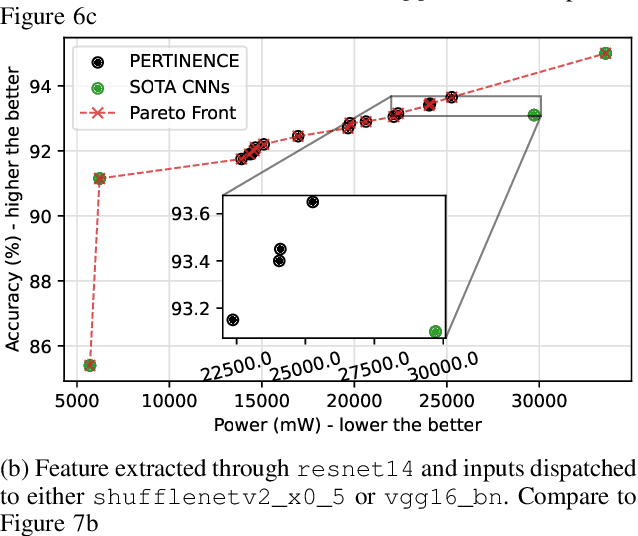
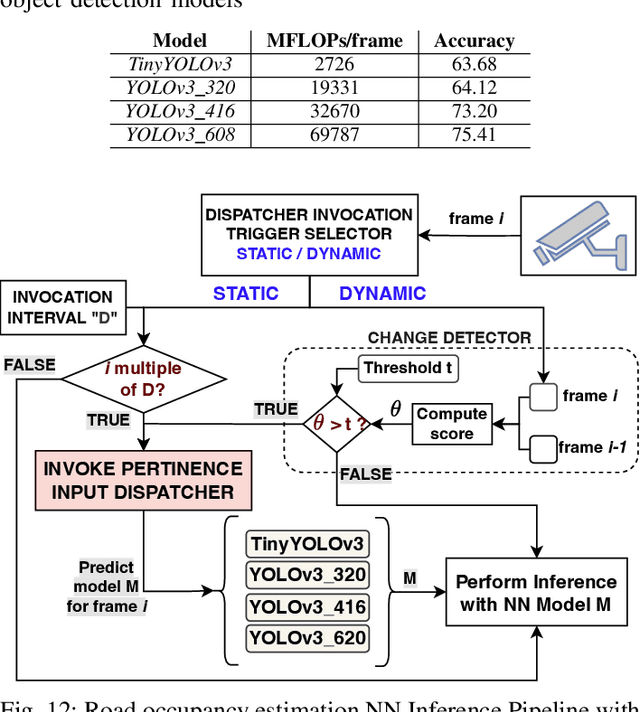
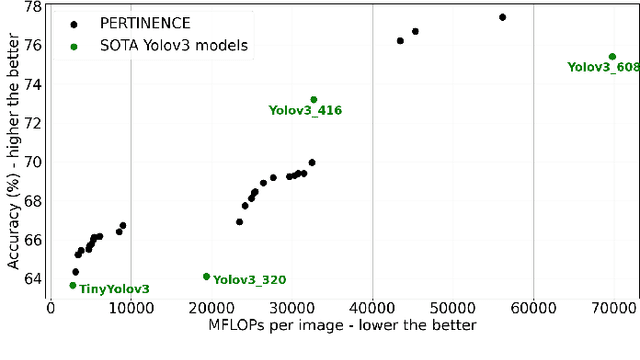
Deep neural networks (DNNs) have become ubiquitous thanks to their remarkable ability to model complex patterns across various domains such as computer vision, speech recognition, robotics, etc. While large DNN models are often more accurate than simpler, lightweight models, they are also resource- and energy-hungry. Hence, it is imperative to design methods to reduce reliance on such large models without significant degradation in output accuracy. The high computational cost of these models is often necessary only for a reduced set of challenging inputs, while lighter models can handle most simple ones. Thus, carefully combining properties of existing DNN models in a dynamic, input-based way opens opportunities to improve efficiency without impacting accuracy. In this work, we introduce PERTINENCE, a novel online method designed to analyze the complexity of input features and dynamically select the most suitable model from a pre-trained set to process a given input effectively. To achieve this, we employ a genetic algorithm to explore the training space of an ML-based input dispatcher, enabling convergence towards the Pareto front in the solution space that balances overall accuracy and computational efficiency. We showcase our approach on state-of-the-art Convolutional Neural Networks (CNNs) trained on the CIFAR-10 and CIFAR-100, as well as Vision Transformers (ViTs) trained on TinyImageNet dataset. We report results showing PERTINENCE's ability to provide alternative solutions to existing state-of-the-art models in terms of trade-offs between accuracy and number of operations. By opportunistically selecting among models trained for the same task, PERTINENCE achieves better or comparable accuracy with up to 36% fewer operations.