 Add to Chrome
 Add to Firefox
 Add to Edge
An End-to-End Approach for Microgrid Probabilistic Forecasting and Robust Operation via Decision-focused Learning
Dec 14, 2025
High penetration of renewable energy sources (RES) introduces significant uncertainty and intermittency into microgrid operations, posing challenges to economic and reliable scheduling. To address this, this paper proposes an end-to-end decision-focused framework that jointly optimizes probabilistic forecasting and robust operation for microgrids. A multilayer encoder-decoder (MED) probabilistic forecasting model is integrated with a two-stage robust optimization (TSRO) model involving direct load control (DLC) through a differentiable decision pathway, enabling gradient-based feedback from operational outcomes to improve forecasting performance. Unlike conventional sequential approaches, the proposed method aligns forecasting accuracy with operational objectives by directly minimizing decision regret via a surrogate smart predict-then-optimize (SPO) loss function. This integration ensures that probabilistic forecasts are optimized for downstream decisions, enhancing both economic efficiency and robustness. Case studies on modified IEEE 33-bus and 69-bus systems demonstrate that the proposed framework achieves superior forecasting accuracy and operational performance, reducing total and net operation costs by up to 18% compared with conventional forecasting and optimization combinations. The results verify the effectiveness and scalability of the end-to-end decision-focused approach for resilient and cost-efficient microgrid management under uncertainty.

Non-destructive Degradation Pattern Decoupling for Ultra-early Battery Prototype Verification Using Physics-informed Machine Learning
Jun 01, 2024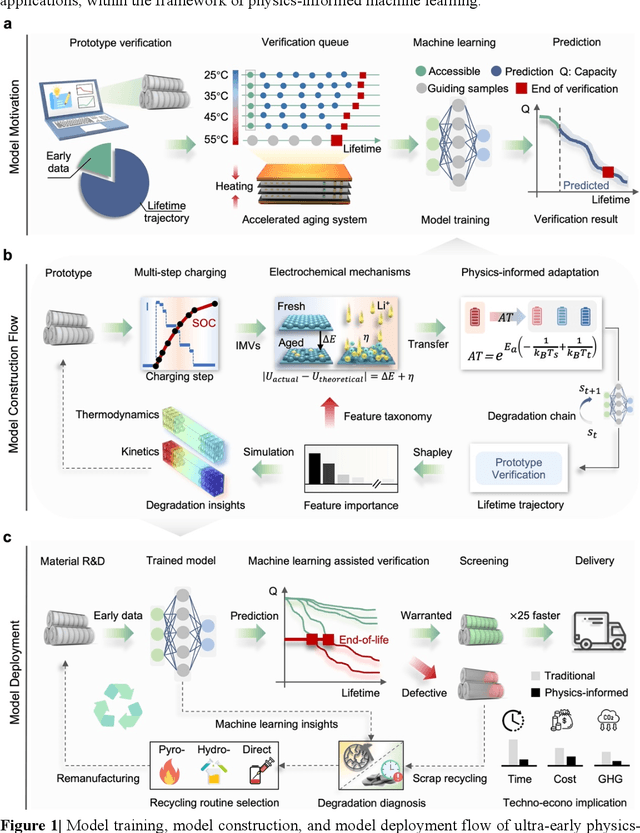
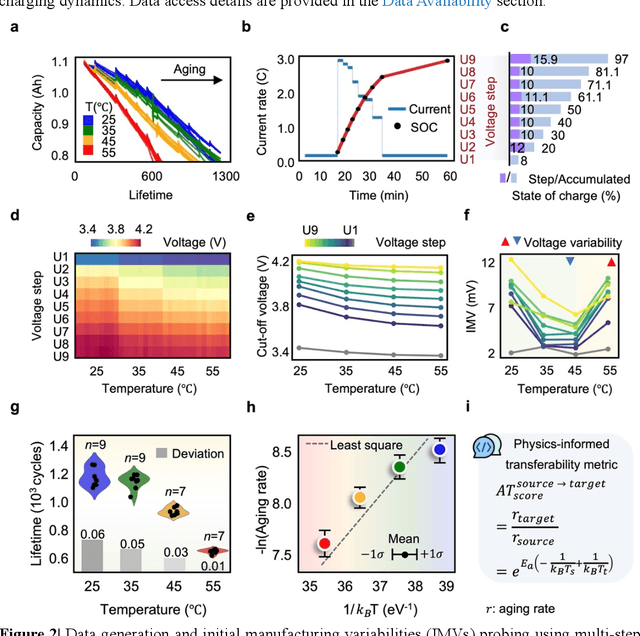
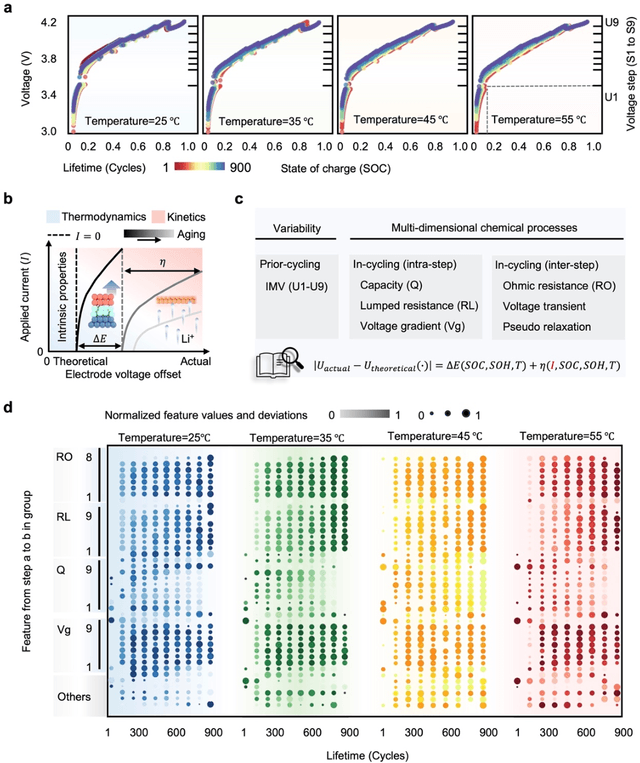
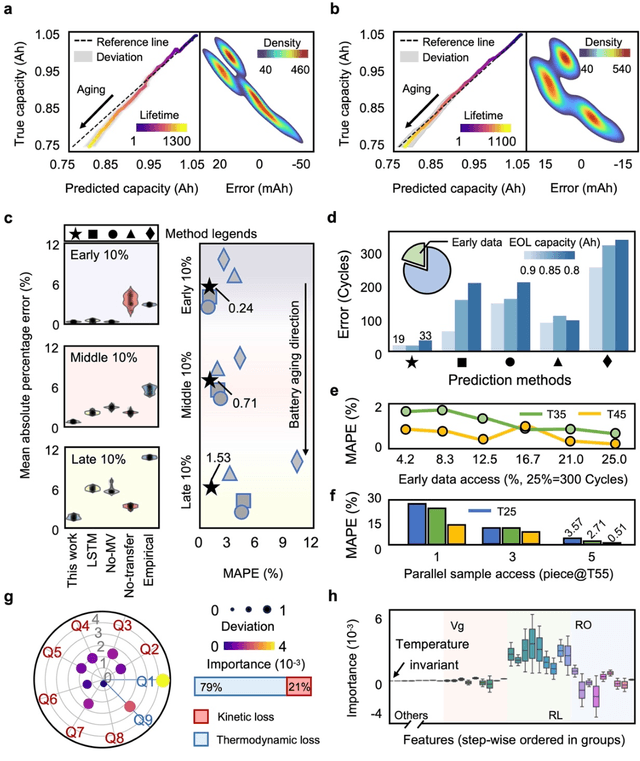
Manufacturing complexities and uncertainties have impeded the transition from material prototypes to commercial batteries, making prototype verification critical to quality assessment. A fundamental challenge involves deciphering intertwined chemical processes to characterize degradation patterns and their quantitative relationship with battery performance. Here we show that a physics-informed machine learning approach can quantify and visualize temporally resolved losses concerning thermodynamics and kinetics only using electric signals. Our method enables non-destructive degradation pattern characterization, expediting temperature-adaptable predictions of entire lifetime trajectories, rather than end-of-life points. The verification speed is 25 times faster yet maintaining 95.1% accuracy across temperatures. Such advances facilitate more sustainable management of defective prototypes before massive production, establishing a 19.76 billion USD scrap material recycling market by 2060 in China. By incorporating stepwise charge acceptance as a measure of the initial manufacturing variability of normally identical batteries, we can immediately identify long-term degradation variations. We attribute the predictive power to interpreting machine learning insights using material-agnostic featurization taxonomy for degradation pattern decoupling. Our findings offer new possibilities for dynamic system analysis, such as battery prototype degradation, demonstrating that complex pattern evolutions can be accurately predicted in a non-destructive and data-driven fashion by integrating physics-informed machine learning.