 Add to Chrome
 Add to Firefox
 Add to Edge
Multimodal Diffusion to Mutually Enhance Polarized Light and Low Resolution EBSD Data
Apr 24, 2026
In spite of the utility of 3-D electron back-scattered diffraction (EBSD) microscopy, the data collection process can be time-consuming with serial-sectioning. Hence, it is natural to look at other modalities, such as polarized light (PL) data, to accelerate EBSD data collection, supplemented with shared information. Complementarily, features in chaotic PL data could even be enriched with a handful of EBSD measurements. To inherently learn the complex dynamics between EBSD and PL to solve these inverse problems, we use an unconditional multimodal diffusion model, motivated by progress in diffusion models for inverse problems. Although trained solely on synthetic data once, our model has strong generalizable capabilities on real data which can be low-resolution, noisy, corrupted, and misregistered. With inference-time scaling, we show gains in performance on a variety of objectives including grain boundary prediction, super-resolution, and denoising. With our model, we demonstrate that there is little difference from full resolution performance with only 25% (1/4 the resolution) of EBSD data and corrupted PL data.

A Dictionary Approach to EBSD Indexing
Feb 27, 2015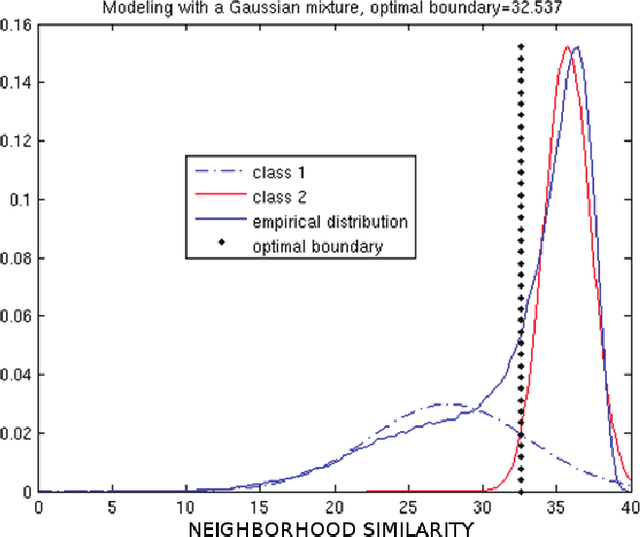
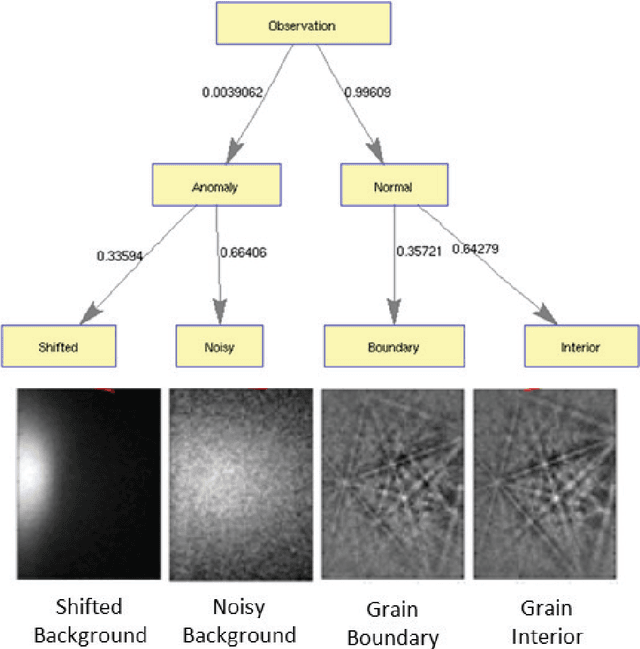
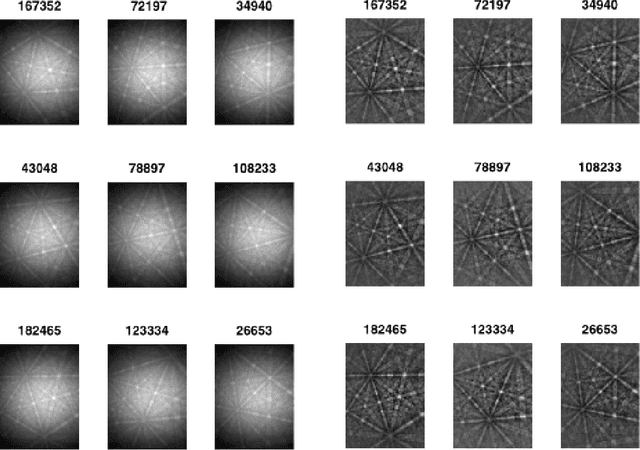
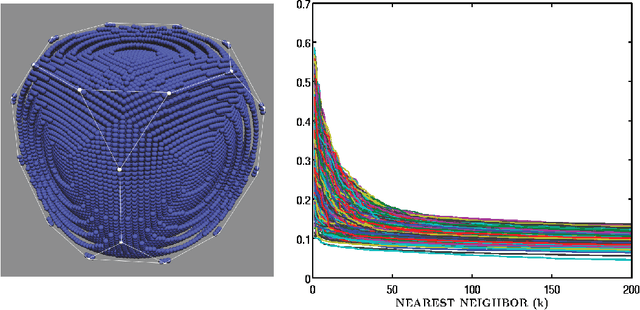
We propose a framework for indexing of grain and sub-grain structures in electron backscatter diffraction (EBSD) images of polycrystalline materials. The framework is based on a previously introduced physics-based forward model by Callahan and De Graef (2013) relating measured patterns to grain orientations (Euler angle). The forward model is tuned to the microscope and the sample symmetry group. We discretize the domain of the forward model onto a dense grid of Euler angles and for each measured pattern we identify the most similar patterns in the dictionary. These patterns are used to identify boundaries, detect anomalies, and index crystal orientations. The statistical distribution of these closest matches is used in an unsupervised binary decision tree (DT) classifier to identify grain boundaries and anomalous regions. The DT classifies a pattern as an anomaly if it has an abnormally low similarity to any pattern in the dictionary. It classifies a pixel as being near a grain boundary if the highly ranked patterns in the dictionary differ significantly over the pixels 3x3 neighborhood. Indexing is accomplished by computing the mean orientation of the closest dictionary matches to each pattern. The mean orientation is estimated using a maximum likelihood approach that models the orientation distribution as a mixture of Von Mises-Fisher distributions over the quaternionic 3-sphere. The proposed dictionary matching approach permits segmentation, anomaly detection, and indexing to be performed in a unified manner with the additional benefit of uncertainty quantification. We demonstrate the proposed dictionary-based approach on a Ni-base IN100 alloy.