 Add to Chrome
 Add to Firefox
 Add to Edge
Dual-Rate Diffusion: Accelerating diffusion models with an interleaved heavy-light network
May 18, 2026
Diffusion models achieve state-of-the-art generative performance but suffer from high computational costs during inference due to the repeated evaluation of a heavy neural network. In this work, we propose Dual-Rate Diffusion, a method to accelerate sampling by interleaving the execution of a heavy high-capacity context encoder and a light efficient denoising model. The context encoder is evaluated sparsely to extract high-dimensional features, which are effectively reused by the light denoising model at every step to refine the sample efficiently. This approach significantly accelerates inference without compromising sample quality. On ImageNet benchmarks, Dual-Rate Diffusion matches the performance of standard baselines while reducing computational cost by a factor of $2$-$4$. Furthermore, we demonstrate that our method is compatible with distillation techniques, such as Moment Matching Distillation, enabling further efficiency gains in few-step generation.

Covariance-aware sampling for Diffusion Models
May 13, 2026We present a covariance-aware sampler that improves the quality of pixel-space Diffusion Model (DM) sampling in the few-step regime. We hypothesize that in the few-step regime samplers fail because they rely solely on the predicted mean of the reverse distribution, while our solution explicitly models the reverse-process covariance. Our method combines Tweedie's formula to estimate the covariance with an efficient, structured Fourier-space decomposition of the covariance matrix. Implemented as an extension of DDIM, our method requires only a minimal overhead: one extra Jacobian-Vector Product (JVP) per step. We demonstrate that for pixel-based DMs, our method consistently produces superior samples compared to state-of-the-art second order samplers (Heun, DPM-Solver++) and the recent aDDIM sampler, at an identical number of function evaluations (NFE).
Beyond Single Tokens: Distilling Discrete Diffusion Models via Discrete MMD
Mar 20, 2026It is currently difficult to distill discrete diffusion models. In contrast, continuous diffusion literature has many distillation approaches methods that can reduce sampling steps to a handful. Our method, Discrete Moment Matching Distillation (D-MMD), leverages ideas that have been highly successful in the continuous domain. Whereas previous discrete distillation methods collapse, D-MMD maintains high quality and diversity (given sufficient sampling steps). This is demonstrated on both text and image datasets. Moreover, the newly distilled generators can outperform their teachers.
Unified Latents (UL): How to train your latents
Feb 19, 2026We present Unified Latents (UL), a framework for learning latent representations that are jointly regularized by a diffusion prior and decoded by a diffusion model. By linking the encoder's output noise to the prior's minimum noise level, we obtain a simple training objective that provides a tight upper bound on the latent bitrate. On ImageNet-512, our approach achieves competitive FID of 1.4, with high reconstruction quality (PSNR) while requiring fewer training FLOPs than models trained on Stable Diffusion latents. On Kinetics-600, we set a new state-of-the-art FVD of 1.3.
Simpler Diffusion (SiD2): 1.5 FID on ImageNet512 with pixel-space diffusion
Oct 25, 2024
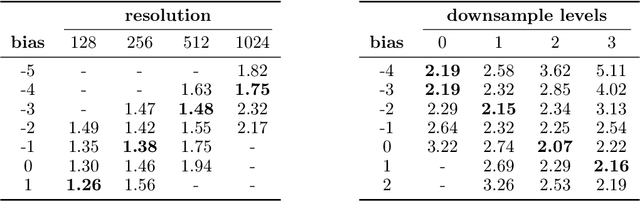


Latent diffusion models have become the popular choice for scaling up diffusion models for high resolution image synthesis. Compared to pixel-space models that are trained end-to-end, latent models are perceived to be more efficient and to produce higher image quality at high resolution. Here we challenge these notions, and show that pixel-space models can in fact be very competitive to latent approaches both in quality and efficiency, achieving 1.5 FID on ImageNet512 and new SOTA results on ImageNet128 and ImageNet256. We present a simple recipe for scaling end-to-end pixel-space diffusion models to high resolutions. 1: Use the sigmoid loss (Kingma & Gao, 2023) with our prescribed hyper-parameters. 2: Use our simplified memory-efficient architecture with fewer skip-connections. 3: Scale the model to favor processing the image at high resolution with fewer parameters, rather than using more parameters but at a lower resolution. When combining these three steps with recently proposed tricks like guidance intervals, we obtain a family of pixel-space diffusion models we call Simple Diffusion v2 (SiD2).
Multistep Distillation of Diffusion Models via Moment Matching
Jun 06, 2024We present a new method for making diffusion models faster to sample. The method distills many-step diffusion models into few-step models by matching conditional expectations of the clean data given noisy data along the sampling trajectory. Our approach extends recently proposed one-step methods to the multi-step case, and provides a new perspective by interpreting these approaches in terms of moment matching. By using up to 8 sampling steps, we obtain distilled models that outperform not only their one-step versions but also their original many-step teacher models, obtaining new state-of-the-art results on the Imagenet dataset. We also show promising results on a large text-to-image model where we achieve fast generation of high resolution images directly in image space, without needing autoencoders or upsamplers.
EM Distillation for One-step Diffusion Models
May 27, 2024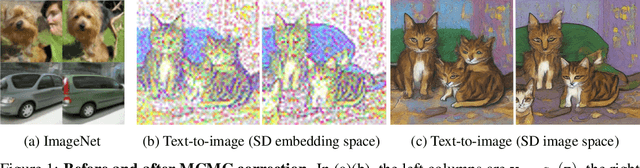
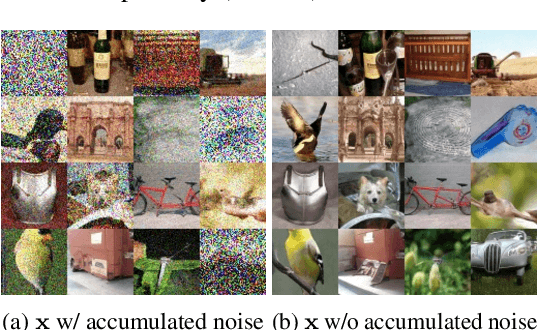
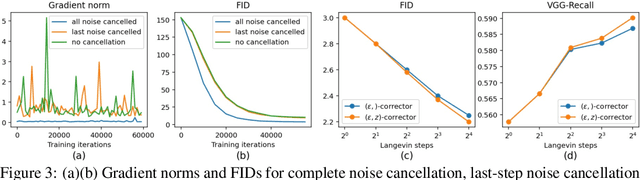
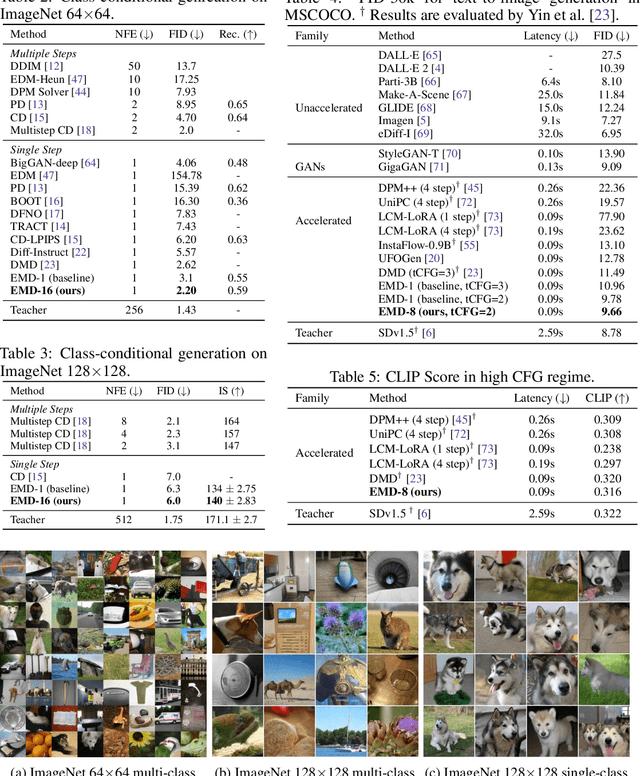
While diffusion models can learn complex distributions, sampling requires a computationally expensive iterative process. Existing distillation methods enable efficient sampling, but have notable limitations, such as performance degradation with very few sampling steps, reliance on training data access, or mode-seeking optimization that may fail to capture the full distribution. We propose EM Distillation (EMD), a maximum likelihood-based approach that distills a diffusion model to a one-step generator model with minimal loss of perceptual quality. Our approach is derived through the lens of Expectation-Maximization (EM), where the generator parameters are updated using samples from the joint distribution of the diffusion teacher prior and inferred generator latents. We develop a reparametrized sampling scheme and a noise cancellation technique that together stabilizes the distillation process. We further reveal an interesting connection of our method with existing methods that minimize mode-seeking KL. EMD outperforms existing one-step generative methods in terms of FID scores on ImageNet-64 and ImageNet-128, and compares favorably with prior work on distilling text-to-image diffusion models.
Multistep Consistency Models
Mar 11, 2024


Diffusion models are relatively easy to train but require many steps to generate samples. Consistency models are far more difficult to train, but generate samples in a single step. In this paper we propose Multistep Consistency Models: A unification between Consistency Models (Song et al., 2023) and TRACT (Berthelot et al., 2023) that can interpolate between a consistency model and a diffusion model: a trade-off between sampling speed and sampling quality. Specifically, a 1-step consistency model is a conventional consistency model whereas we show that a $\infty$-step consistency model is a diffusion model. Multistep Consistency Models work really well in practice. By increasing the sample budget from a single step to 2-8 steps, we can train models more easily that generate higher quality samples, while retaining much of the sampling speed benefits. Notable results are 1.4 FID on Imagenet 64 in 8 step and 2.1 FID on Imagenet128 in 8 steps with consistency distillation. We also show that our method scales to a text-to-image diffusion model, generating samples that are very close to the quality of the original model.
Rolling Diffusion Models
Feb 12, 2024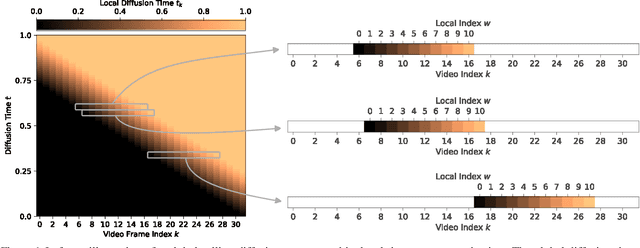
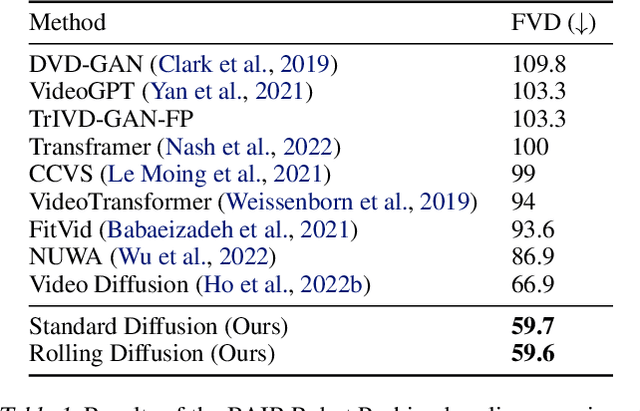
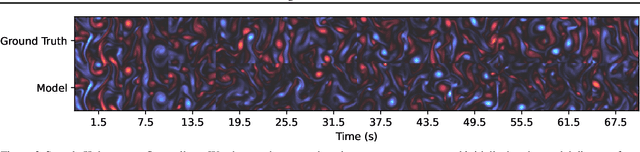
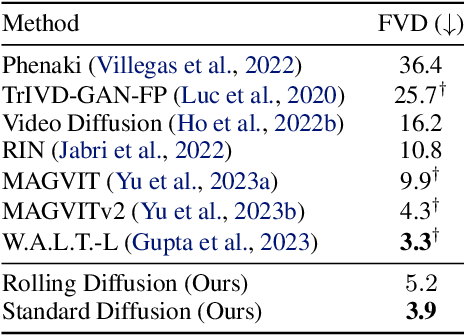
Diffusion models have recently been increasingly applied to temporal data such as video, fluid mechanics simulations, or climate data. These methods generally treat subsequent frames equally regarding the amount of noise in the diffusion process. This paper explores Rolling Diffusion: a new approach that uses a sliding window denoising process. It ensures that the diffusion process progressively corrupts through time by assigning more noise to frames that appear later in a sequence, reflecting greater uncertainty about the future as the generation process unfolds. Empirically, we show that when the temporal dynamics are complex, Rolling Diffusion is superior to standard diffusion. In particular, this result is demonstrated in a video prediction task using the Kinetics-600 video dataset and in a chaotic fluid dynamics forecasting experiment.
simple diffusion: End-to-end diffusion for high resolution images
Jan 26, 2023
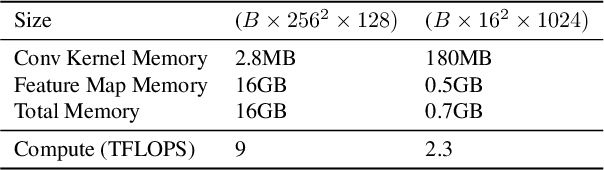
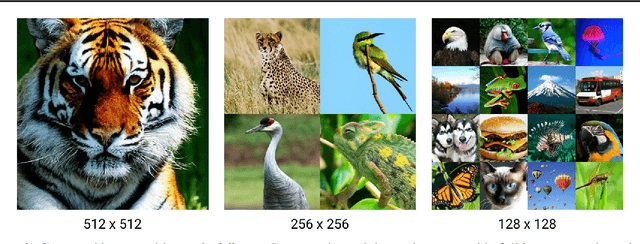
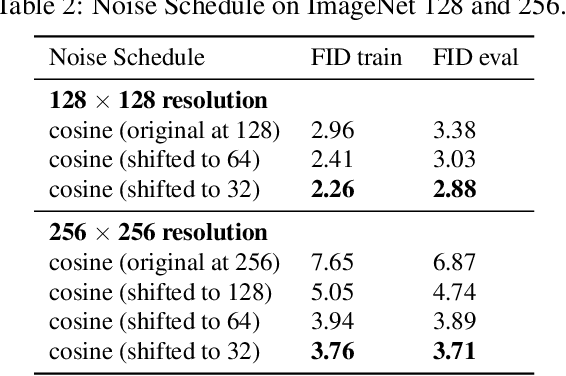
Currently, applying diffusion models in pixel space of high resolution images is difficult. Instead, existing approaches focus on diffusion in lower dimensional spaces (latent diffusion), or have multiple super-resolution levels of generation referred to as cascades. The downside is that these approaches add additional complexity to the diffusion framework. This paper aims to improve denoising diffusion for high resolution images while keeping the model as simple as possible. The paper is centered around the research question: How can one train a standard denoising diffusion models on high resolution images, and still obtain performance comparable to these alternate approaches? The four main findings are: 1) the noise schedule should be adjusted for high resolution images, 2) It is sufficient to scale only a particular part of the architecture, 3) dropout should be added at specific locations in the architecture, and 4) downsampling is an effective strategy to avoid high resolution feature maps. Combining these simple yet effective techniques, we achieve state-of-the-art on image generation among diffusion models without sampling modifiers on ImageNet.