 Add to Chrome
 Add to Firefox
 Add to Edge
Stochastic MeanFlow Policies: One-Step Generative Control with Entropic Mirror Descent
May 21, 2026
Online off-policy reinforcement learning (RL) is shaped by two coupled choices: the policy class and the update rule. Gaussian policies are fast and have tractable entropy, but struggle with multimodal action distributions. Generative policies are more expressive, but often require iterative sampling or lack tractable entropy estimates. On the optimisation side, SAC-style soft policy improvement and mirror descent (MD) can be viewed as minimising different KL divergences: the former moves the policy towards a value-induced Boltzmann distribution, while the latter regularises each update against the previous policy. Combining entropy regularisation with an MD constraint is therefore attractive, as it supports exploration while stabilising policy improvement; however, the resulting target can be multimodal and is poorly matched by unimodal Gaussian policies. We propose Stochastic MeanFlow Policies (SMFP), a one-step generative policy class that maps Gaussian noise to actions through a MeanFlow transformation. This stochastic reparameterisation yields a tractable entropy surrogate and allows MeanFlow policies to be trained within off-policy mirror descent under a unified objective for exploratory yet stable improvement. Across seven MuJoCo benchmarks, SMFP improves over Gaussian and generative baselines while retaining single-step inference efficiency.

One-Step Generative Policies with Q-Learning: A Reformulation of MeanFlow
Nov 17, 2025We introduce a one-step generative policy for offline reinforcement learning that maps noise directly to actions via a residual reformulation of MeanFlow, making it compatible with Q-learning. While one-step Gaussian policies enable fast inference, they struggle to capture complex, multimodal action distributions. Existing flow-based methods improve expressivity but typically rely on distillation and two-stage training when trained with Q-learning. To overcome these limitations, we propose to reformulate MeanFlow to enable direct noise-to-action generation by integrating the velocity field and noise-to-action transformation into a single policy network-eliminating the need for separate velocity estimation. We explore several reformulation variants and identify an effective residual formulation that supports expressive and stable policy learning. Our method offers three key advantages: 1) efficient one-step noise-to-action generation, 2) expressive modelling of multimodal action distributions, and 3) efficient and stable policy learning via Q-learning in a single-stage training setup. Extensive experiments on 73 tasks across the OGBench and D4RL benchmarks demonstrate that our method achieves strong performance in both offline and offline-to-online reinforcement learning settings. Code is available at https://github.com/HiccupRL/MeanFlowQL.
FoCLIP: A Feature-Space Misalignment Framework for CLIP-Based Image Manipulation and Detection
Nov 10, 2025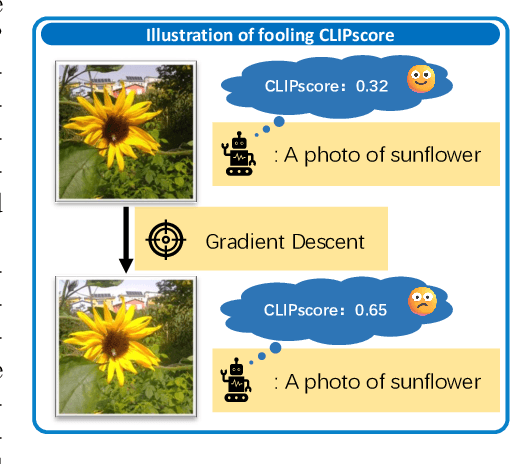
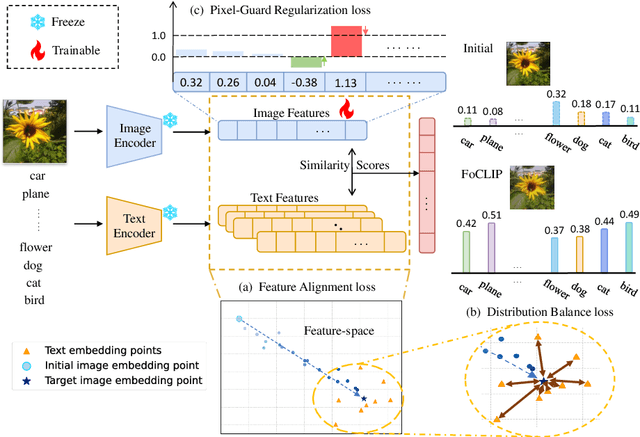
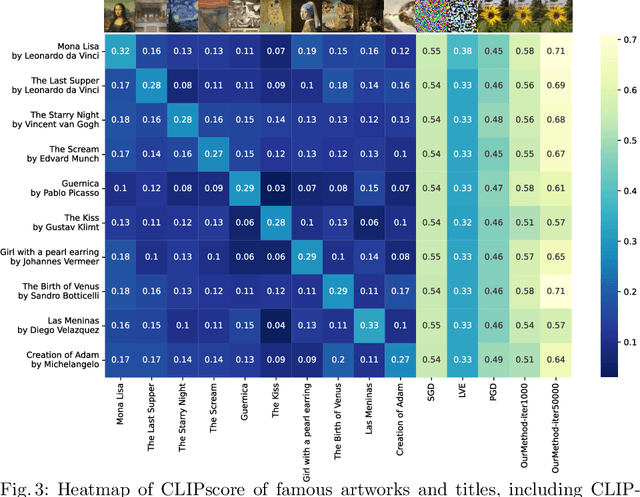
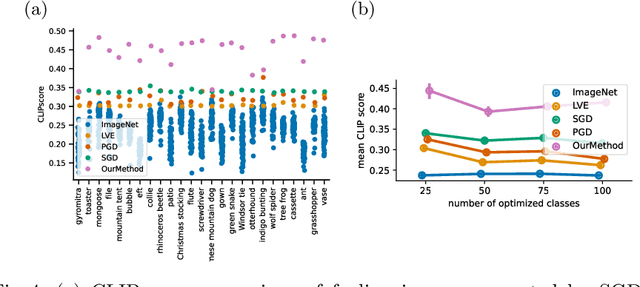
The well-aligned attribute of CLIP-based models enables its effective application like CLIPscore as a widely adopted image quality assessment metric. However, such a CLIP-based metric is vulnerable for its delicate multimodal alignment. In this work, we propose \textbf{FoCLIP}, a feature-space misalignment framework for fooling CLIP-based image quality metric. Based on the stochastic gradient descent technique, FoCLIP integrates three key components to construct fooling examples: feature alignment as the core module to reduce image-text modality gaps, the score distribution balance module and pixel-guard regularization, which collectively optimize multimodal output equilibrium between CLIPscore performance and image quality. Such a design can be engineered to maximize the CLIPscore predictions across diverse input prompts, despite exhibiting either visual unrecognizability or semantic incongruence with the corresponding adversarial prompts from human perceptual perspectives. Experiments on ten artistic masterpiece prompts and ImageNet subsets demonstrate that optimized images can achieve significant improvement in CLIPscore while preserving high visual fidelity. In addition, we found that grayscale conversion induces significant feature degradation in fooling images, exhibiting noticeable CLIPscore reduction while preserving statistical consistency with original images. Inspired by this phenomenon, we propose a color channel sensitivity-driven tampering detection mechanism that achieves 91% accuracy on standard benchmarks. In conclusion, this work establishes a practical pathway for feature misalignment in CLIP-based multimodal systems and the corresponding defense method.
Hybrid Graph Neural Networks for Few-Shot Learning
Dec 13, 2021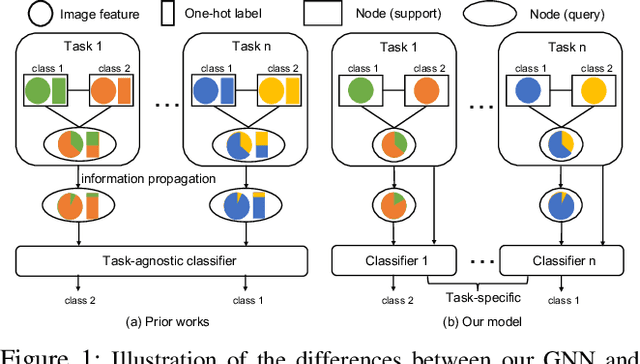
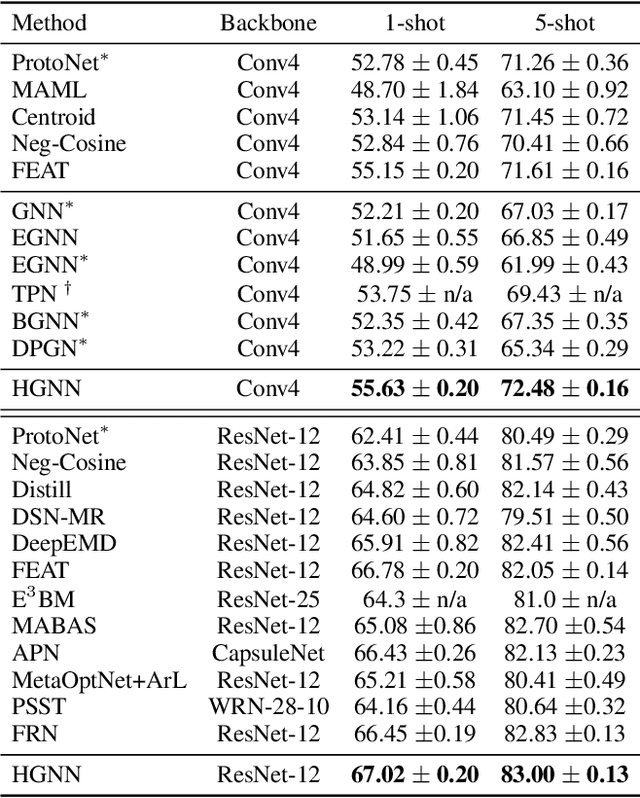
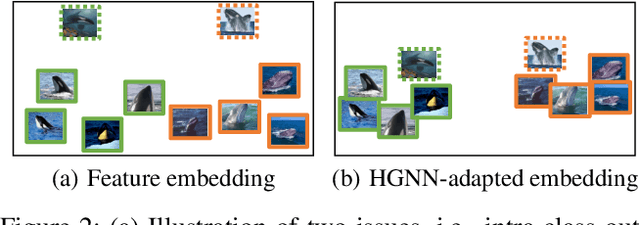
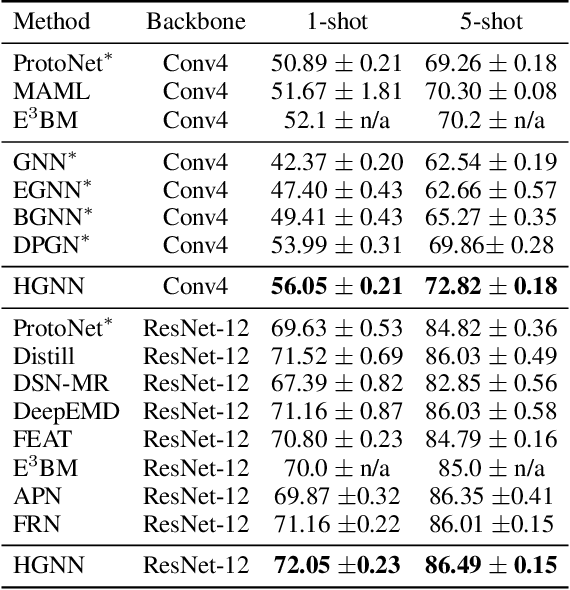
Graph neural networks (GNNs) have been used to tackle the few-shot learning (FSL) problem and shown great potentials under the transductive setting. However under the inductive setting, existing GNN based methods are less competitive. This is because they use an instance GNN as a label propagation/classification module, which is jointly meta-learned with a feature embedding network. This design is problematic because the classifier needs to adapt quickly to new tasks while the embedding does not. To overcome this problem, in this paper we propose a novel hybrid GNN (HGNN) model consisting of two GNNs, an instance GNN and a prototype GNN. Instead of label propagation, they act as feature embedding adaptation modules for quick adaptation of the meta-learned feature embedding to new tasks. Importantly they are designed to deal with a fundamental yet often neglected challenge in FSL, that is, with only a handful of shots per class, any few-shot classifier would be sensitive to badly sampled shots which are either outliers or can cause inter-class distribution overlapping. %Our two GNNs are designed to address these two types of poorly sampled few-shots respectively and their complementarity is exploited in the hybrid GNN model. Extensive experiments show that our HGNN obtains new state-of-the-art on three FSL benchmarks.