 Add to Chrome
 Add to Firefox
 Add to Edge
CoGoal3D: Collaborative 3D Object Detection with 3D-Aware Fusion and Refinement
Jul 21, 2026
V2X collaborative object detection features overcoming the limitations of single-vehicle systems by aggregating environmental features from multiple collaborative agents. However, existing mainstream V2X perception methods mainly focus on 2D BEV object detection. When 3D detection task is concerned, inferior results are obtained because they ignore the 3D spatial misalignment caused by differing height and attitude among the collaborators. In this paper, we propose a novel collaborative 3D object detection framework called CoGoal3D, which extracts and refines the 3D feature gradually in a two-stage pipeline. In the first stage, a multiscale 3D-aware global fusion module is designed to mitigate the 3D spatial misalignment. The resulting proposals are then refined in the second stage with an auxiliary task of 3D point reconstruction. An effective multi-agent collaborative data augmentation strategy is further proposed to enrich the training data while minimizing information loss. Extensive experiments on public real-world datasets demonstrate that our CoGoal3D achieves new state-of-the-art performance, with 3D AP@0.7 improvements of 10.86%, 10.34%, and 10.18% on the DAIR-V2X, V2V4Real, and V2X-Real datasets, respectively. Code is available at https://github.com/Megalo-f/CoGoal3D.

MIDAS: Modeling Ground-Truth Distributions with Dark Knowledge for Domain Generalized Stereo Matching
Mar 06, 2025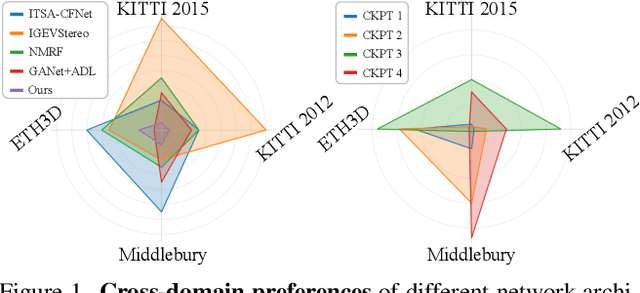
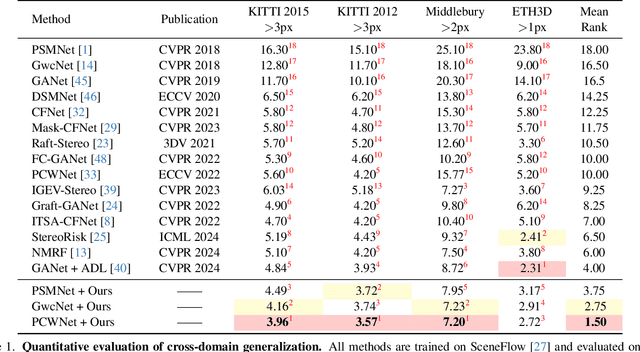
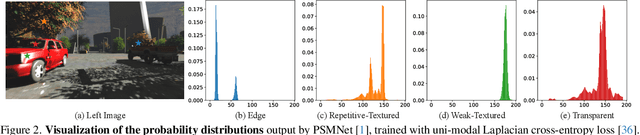
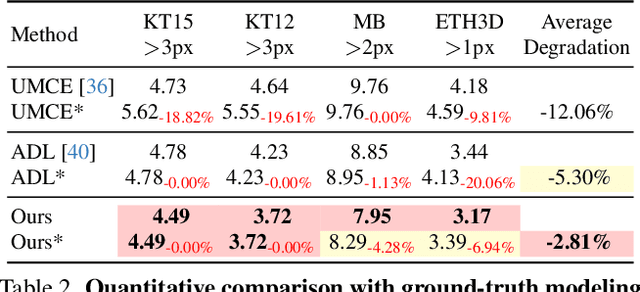
Despite the significant advances in domain generalized stereo matching, existing methods still exhibit domain-specific preferences when transferring from synthetic to real domains, hindering their practical applications in complex and diverse scenarios. The probability distributions predicted by the stereo network naturally encode rich similarity and uncertainty information. Inspired by this observation, we propose to extract these two types of dark knowledge from the pre-trained network to model intuitive multi-modal ground-truth distributions for both edge and non-edge regions. To mitigate the inherent domain preferences of a single network, we adopt network ensemble and further distinguish between objective and biased knowledge in the Laplace parameter space. Finally, the objective knowledge and the original disparity labels are jointly modeled as a mixture of Laplacians to provide fine-grained supervision for the stereo network training. Extensive experiments demonstrate that: 1) Our method is generic and effectively improves the generalization of existing networks. 2) PCWNet with our method achieves the state-of-the-art generalization performance on both KITTI 2015 and 2012 datasets. 3) Our method outperforms existing methods in comprehensive ranking across four popular real-world datasets.
SCKD: Semi-Supervised Cross-Modality Knowledge Distillation for 4D Radar Object Detection
Dec 19, 20243D object detection is one of the fundamental perception tasks for autonomous vehicles. Fulfilling such a task with a 4D millimeter-wave radar is very attractive since the sensor is able to acquire 3D point clouds similar to Lidar while maintaining robust measurements under adverse weather. However, due to the high sparsity and noise associated with the radar point clouds, the performance of the existing methods is still much lower than expected. In this paper, we propose a novel Semi-supervised Cross-modality Knowledge Distillation (SCKD) method for 4D radar-based 3D object detection. It characterizes the capability of learning the feature from a Lidar-radar-fused teacher network with semi-supervised distillation. We first propose an adaptive fusion module in the teacher network to boost its performance. Then, two feature distillation modules are designed to facilitate the cross-modality knowledge transfer. Finally, a semi-supervised output distillation is proposed to increase the effectiveness and flexibility of the distillation framework. With the same network structure, our radar-only student trained by SCKD boosts the mAP by 10.38% over the baseline and outperforms the state-of-the-art works on the VoD dataset. The experiment on ZJUODset also shows 5.12% mAP improvements on the moderate difficulty level over the baseline when extra unlabeled data are available. Code is available at https://github.com/Ruoyu-Xu/SCKD.