 Add to Chrome
 Add to Firefox
 Add to Edge
Track2Map: Online Deformable SLAM with Motion-Aware Pose Optimization in Robotic Surgery
Jul 09, 2026
Gaussian splatting is the current state-of-the-art for dense, deformable 3D anatomy reconstruction in robot-assisted minimally invasive surgery (RAMIS); however, most pipelines are offline and depend on accurate camera trajectory priors (often from robotic kinematics), limiting applicability when priors are missing or noisy. To address these limitations, we propose Track2Map, an online 3D Gaussian Splatting pipeline that jointly optimizes camera trajectory and 3D deformable scene representation directly from surgical video. Track2Map is therefore capable of robust 3D reconstructions when camera trajectory priors are either absent or noisy, and due to its online nature it effectively works as a Simultaneous Localisation and Mapping (SLAM) method. To stabilize optimization in the presence of tissue motion and ambiguous visual cues, we introduce a track-anchored deformation initialization using dense 2D point tracks. Track statistics are further utilized to disentangle camera motion from scene deformation by detecting static camera periods and reducing drift during incremental mapping. Experiments on StereoMIS show improved reconstruction quality and camera trajectory against competing SLAM methods, as well as compared to non-SLAM methods that utilize camera trajectory priors. The code is available at https://track2map.github.io/.

Causal-Story: Local Causal Attention Utilizing Parameter-Efficient Tuning For Visual Story Synthesis
Sep 21, 2023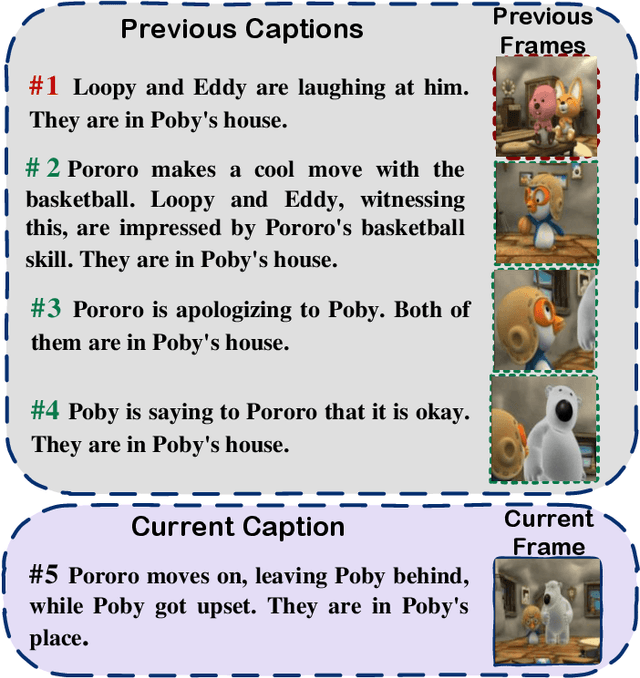
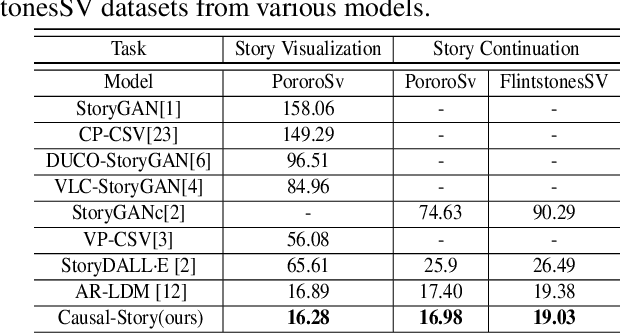
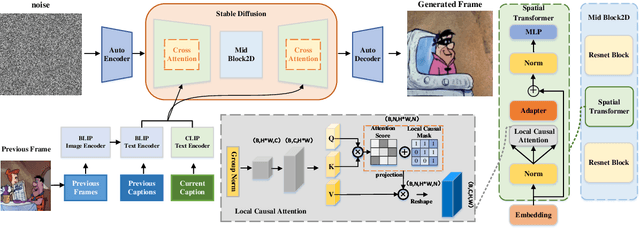
The excellent text-to-image synthesis capability of diffusion models has driven progress in synthesizing coherent visual stories. The current state-of-the-art method combines the features of historical captions, historical frames, and the current captions as conditions for generating the current frame. However, this method treats each historical frame and caption as the same contribution. It connects them in order with equal weights, ignoring that not all historical conditions are associated with the generation of the current frame. To address this issue, we propose Causal-Story. This model incorporates a local causal attention mechanism that considers the causal relationship between previous captions, frames, and current captions. By assigning weights based on this relationship, Causal-Story generates the current frame, thereby improving the global consistency of story generation. We evaluated our model on the PororoSV and FlintstonesSV datasets and obtained state-of-the-art FID scores, and the generated frames also demonstrate better storytelling in visuals.