 Add to Chrome
 Add to Firefox
 Add to Edge
Spec-AUF: Accept-Until-Fail Training under Train-Inference Misalignment for Masked Block Drafters
Jul 02, 2026
Speculative decoding accelerates autoregressive generation by drafting a block of tokens that the target model verifies left-to-right, committing only the longest accepted prefix. Block (DLM-style) drafters predict the whole block in parallel, which is fast but trained with a full-block cross-entropy that supervises every position against the gold continuation -- even though inference discards every token after the first rejection. Recent acceptance-aware objectives patch this by reweighting the full-block loss; we instead use teacher-forced learning as a motivation for how supervision should concentrate on the accepted prefix. A mask-only block drafter has no input-side channel for gold-prefix conditioning, so AUF approximates that prefix-sensitive supervision on the loss side by keeping the cross-entropy support only through the drafter's first predicted failure. AUF is a single, detached change to the CE support -- no auxiliary objective, no verifier rollouts, and no change to the inference pipeline or the exactness contract. Within fixed drafter backbones and serving settings on Qwen3-8B, AUF raises the DFlash drafter's average emitted length $τ$, averaged over six benchmarks, from 2.40 to 2.61, with a gain on every benchmark, and transfers to Domino's two-branch head (2.56 to 2.68). Two findings sharpen the picture: the decay-only baseline reaches higher token accuracy on the shared block mask yet decodes worse, and on DFlash, once AUF truncates the support, the standard exponential position-decay weighting becomes empirically inert.

Vector Linking via Cross-Model Local Isometric Consistency
May 29, 2026We study Vector Linking: given two embedding clouds produced by different black-box encoders over partially overlapping datasets, recover cross-model object correspondences using only vectors. Empirically and theoretically, we show that independently trained contrastive encoders exhibit local geometric consistency: short-range distances are approximately preserved up to a scale factor, while long-range distances are not due to model-specific distortion. Building on this, we propose an iterative, reference-based geometric embedding hashing that recovers vector links from a tiny seed set of paired anchors. It represents each vector by distances to sampled paired anchors, proposes candidate links via hash-space matching, and aggregates evidence across views in a Beta-Bernoulli posterior to bootstrap high-confidence links as new anchors. Experiments across multiple benchmarks and embedding model pairs demonstrate accurate and robust linking under varying overlap, seed budgets, and out-of-domain anchors, with applications to vector database integration and cross-model clustering. Code is available at https://github.com/DBgroup-Edinburgh/VecLinking.
Generalized probabilistic canonical correlation analysis for multi-modal data integration with full or partial observations
Apr 15, 2025Background: The integration and analysis of multi-modal data are increasingly essential across various domains including bioinformatics. As the volume and complexity of such data grow, there is a pressing need for computational models that not only integrate diverse modalities but also leverage their complementary information to improve clustering accuracy and insights, especially when dealing with partial observations with missing data. Results: We propose Generalized Probabilistic Canonical Correlation Analysis (GPCCA), an unsupervised method for the integration and joint dimensionality reduction of multi-modal data. GPCCA addresses key challenges in multi-modal data analysis by handling missing values within the model, enabling the integration of more than two modalities, and identifying informative features while accounting for correlations within individual modalities. The model demonstrates robustness to various missing data patterns and provides low-dimensional embeddings that facilitate downstream clustering and analysis. In a range of simulation settings, GPCCA outperforms existing methods in capturing essential patterns across modalities. Additionally, we demonstrate its applicability to multi-omics data from TCGA cancer datasets and a multi-view image dataset. Conclusion: GPCCA offers a useful framework for multi-modal data integration, effectively handling missing data and providing informative low-dimensional embeddings. Its performance across cancer genomics and multi-view image data highlights its robustness and potential for broad application. To make the method accessible to the wider research community, we have released an R package, GPCCA, which is available at https://github.com/Kaversoniano/GPCCA.
SGSM: A Foundation-model-like Semi-generalist Sensing Model
Jun 15, 2024

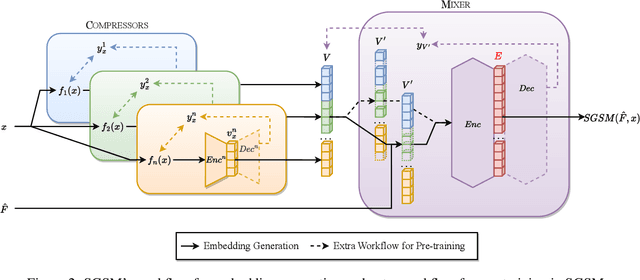

The significance of intelligent sensing systems is growing in the realm of smart services. These systems extract relevant signal features and generate informative representations for particular tasks. However, building the feature extraction component for such systems requires extensive domain-specific expertise or data. The exceptionally rapid development of foundation models is likely to usher in newfound abilities in such intelligent sensing. We propose a new scheme for sensing model, which we refer to as semi-generalist sensing model (SGSM). SGSM is able to semiautomatically solve various tasks using relatively less task-specific labeled data compared to traditional systems. Built through the analysis of the common theoretical model, SGSM can depict different modalities, such as the acoustic and Wi-Fi signal. Experimental results on such two heterogeneous sensors illustrate that SGSM functions across a wide range of scenarios, thereby establishing its broad applicability. In some cases, SGSM even achieves better performance than sensor-specific specialized solutions. Wi-Fi evaluations indicate a 20\% accuracy improvement when applying SGSM to an existing sensing model.