 Add to Chrome
 Add to Firefox
 Add to Edge
Workspace Topology as an Attack Vector in Agentic Coding Assistants
Aug 14, 2026
Agentic coding assistants are finding widespread use, not just in new code development but in quickly ingesting and leveraging third-party code. This opens up a risk of malicious code being ingested as these coding tools operate with broad filesystem access inside developer workspaces. In this paper, we extensively study the impact of different dimensions of a novel attack surface we term workspace topology -- defined via directory depth, codebase modularity, in-file injection position and context framing -- on the attack success rate of adversarial prompt injection attempts. We perform an empirical study of indirect prompt injection (IPI) across a diverse set of open-source repositories spanning 10 languages and 6 engineering domains, evaluating three IPI entry points against open-weight models operating open source code harnesses. We find that workspace topology measurably affects IPI success. Specifically, changes in codebase modularity can significantly alter the Attack Success Rate (ASR), with highly modular environments demonstrating significantly lower attack success rates. Furthermore, context framing and introduction of security-cues in the workspace can also alter the ASR. Our findings offer practical value for the evaluation and security testing of coding agents across diverse settings, while underscoring the importance of an uncontaminated testing environment to obtain reliable results and conclusions.

QuadAttack: A Quadratic Programming Approach to Ordered Top-K Attacks
Dec 12, 2023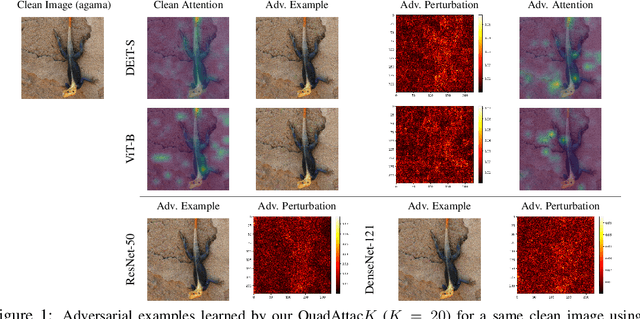
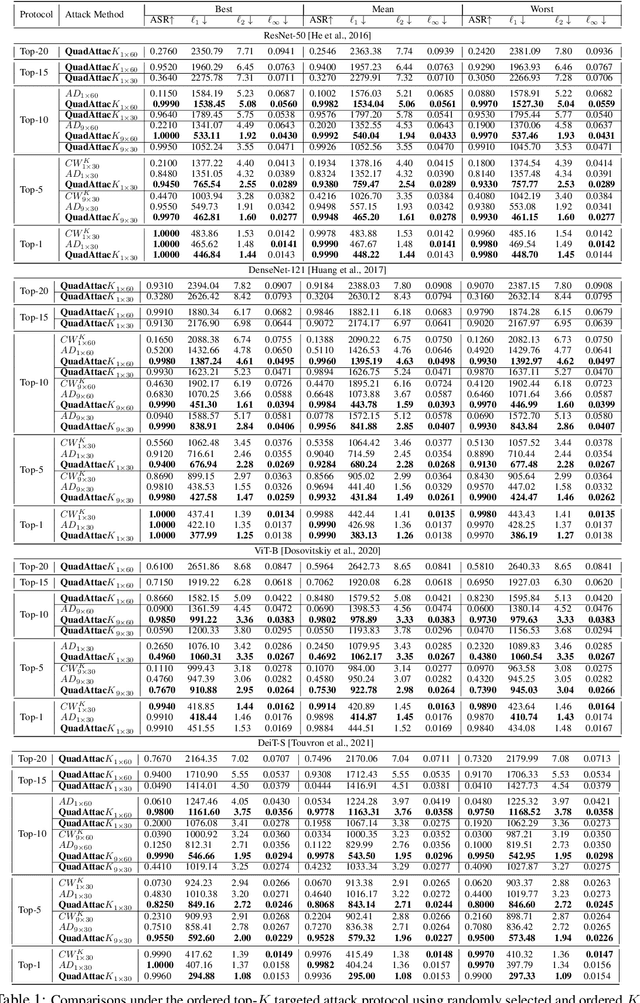
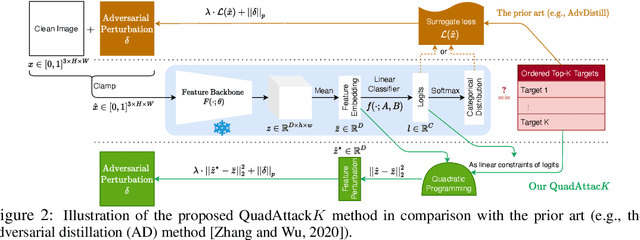
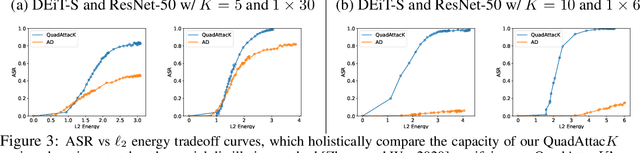
The adversarial vulnerability of Deep Neural Networks (DNNs) has been well-known and widely concerned, often under the context of learning top-$1$ attacks (e.g., fooling a DNN to classify a cat image as dog). This paper shows that the concern is much more serious by learning significantly more aggressive ordered top-$K$ clear-box~\footnote{ This is often referred to as white/black-box attacks in the literature. We choose to adopt neutral terminology, clear/opaque-box attacks in this paper, and omit the prefix clear-box for simplicity.} targeted attacks proposed in Adversarial Distillation. We propose a novel and rigorous quadratic programming (QP) method of learning ordered top-$K$ attacks with low computing cost, dubbed as \textbf{QuadAttac$K$}. Our QuadAttac$K$ directly solves the QP to satisfy the attack constraint in the feature embedding space (i.e., the input space to the final linear classifier), which thus exploits the semantics of the feature embedding space (i.e., the principle of class coherence). With the optimized feature embedding vector perturbation, it then computes the adversarial perturbation in the data space via the vanilla one-step back-propagation. In experiments, the proposed QuadAttac$K$ is tested in the ImageNet-1k classification using ResNet-50, DenseNet-121, and Vision Transformers (ViT-B and DEiT-S). It successfully pushes the boundary of successful ordered top-$K$ attacks from $K=10$ up to $K=20$ at a cheap budget ($1\times 60$) and further improves attack success rates for $K=5$ for all tested models, while retaining the performance for $K=1$.
Learning Patch-to-Cluster Attention in Vision Transformer
Mar 22, 2022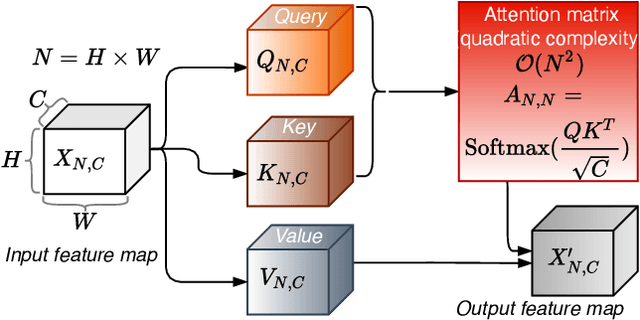
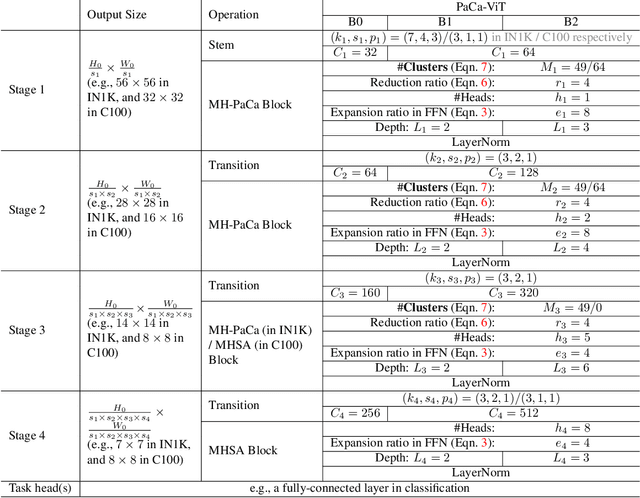
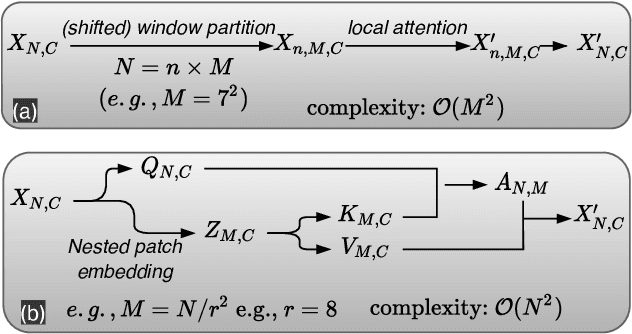
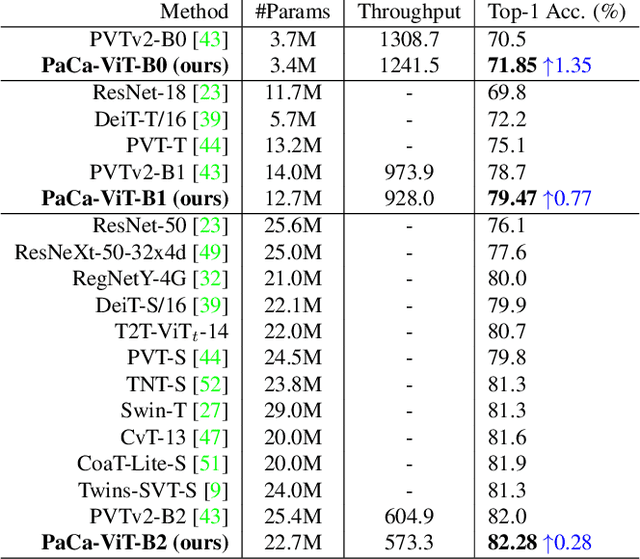
The Vision Transformer (ViT) model is built on the assumption of treating image patches as "visual tokens" and learning patch-to-patch attention. The patch embedding based tokenizer is a workaround in practice and has a semantic gap with respect to its counterpart, the textual tokenizer. The patch-to-patch attention suffers from the quadratic complexity issue, and also makes it non-trivial to explain learned ViT models. To address these issues in ViT models, this paper proposes to learn patch-to-cluster attention (PaCa) based ViT models. Queries in our PaCaViT are based on patches, while keys and values are based on clustering (with a predefined small number of clusters). The clusters are learned end-to-end, leading to better tokenizers and realizing joint clustering-for-attention and attention-for-clustering when deployed in ViT models. The quadratic complexity is relaxed to linear complexity. Also, directly visualizing the learned clusters can reveal how a trained ViT model learns to perform a task (e.g., object detection). In experiments, the proposed PaCa-ViT is tested on CIFAR-100 and ImageNet-1000 image classification, and MS-COCO object detection and instance segmentation. Compared with prior arts, it obtains better performance in classification and comparable performance in detection and segmentation. It is significantly more efficient in COCO due to the linear complexity. The learned clusters are also semantically meaningful and shed light on designing more discriminative yet interpretable ViT models.