 Add to Chrome
 Add to Firefox
 Add to Edge
Noticing the Watcher: LLM Agents Can Infer CoT Monitoring from Blocking Feedback
Mar 14, 2026
Chain-of-thought (CoT) monitoring is proposed as a method for overseeing the internal reasoning of language-model agents. Prior work has shown that when models are explicitly informed that their reasoning is being monitored, or are fine-tuned to internalize this fact, they may learn to obfuscate their CoTs in ways that allow them to evade CoT-based monitoring systems. We ask whether reasoning agents can autonomously infer that their supposedly private CoT is under surveillance, and whether this awareness leads to strategic evasion, without any explicit training or instructions. In a multi-episode agentic framework, models pursue both a primary task and a concealed side task while being told that their reasoning is private; a hidden CoT monitor blocks episodes when suspicious reasoning is detected. We find that frontier models can deduce the existence of this monitor purely from blocking feedback, with the most capable models reaching a confident belief that their thinking is observed in up to 19% of episodes. This awareness scales with model capability and, in rare cases, escalates to an explicit intent to suppress reasoning about the side task. However, models that form this intent uniformly fail to execute it, openly reasoning about their concealed objectives in the very next episode. This intent-capability gap is reassuring for current deployment, but the autonomous emergence of both monitoring awareness and evasion intent suggests that CoT monitoring is not a permanently reliable safeguard.

Cross-Architecture Model Diffing with Crosscoders: Unsupervised Discovery of Differences Between LLMs
Feb 12, 2026Model diffing, the process of comparing models' internal representations to identify their differences, is a promising approach for uncovering safety-critical behaviors in new models. However, its application has so far been primarily focused on comparing a base model with its finetune. Since new LLM releases are often novel architectures, cross-architecture methods are essential to make model diffing widely applicable. Crosscoders are one solution capable of cross-architecture model diffing but have only ever been applied to base vs finetune comparisons. We provide the first application of crosscoders to cross-architecture model diffing and introduce Dedicated Feature Crosscoders (DFCs), an architectural modification designed to better isolate features unique to one model. Using this technique, we find in an unsupervised fashion features including Chinese Communist Party alignment in Qwen3-8B and Deepseek-R1-0528-Qwen3-8B, American exceptionalism in Llama3.1-8B-Instruct, and a copyright refusal mechanism in GPT-OSS-20B. Together, our results work towards establishing cross-architecture crosscoder model diffing as an effective method for identifying meaningful behavioral differences between AI models.
General Causal Imputation via Synthetic Interventions
Oct 28, 2024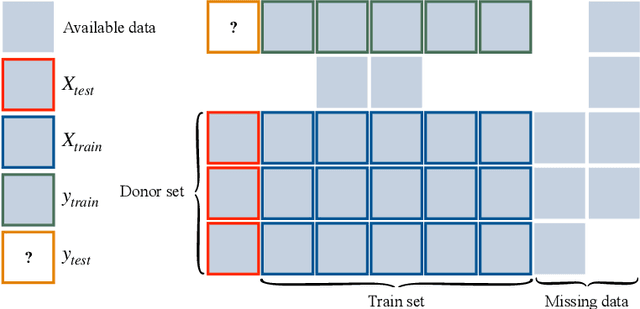

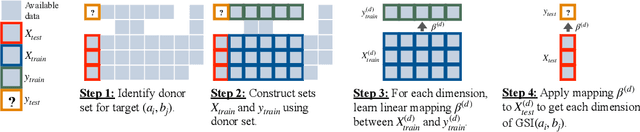
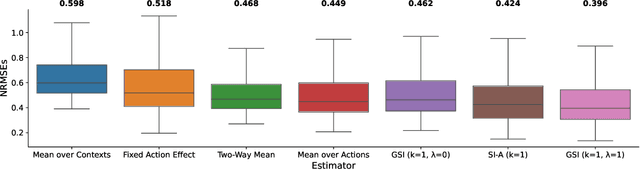
Given two sets of elements (such as cell types and drug compounds), researchers typically only have access to a limited subset of their interactions. The task of causal imputation involves using this subset to predict unobserved interactions. Squires et al. (2022) have proposed two estimators for this task based on the synthetic interventions (SI) estimator: SI-A (for actions) and SI-C (for contexts). We extend their work and introduce a novel causal imputation estimator, generalized synthetic interventions (GSI). We prove the identifiability of this estimator for data generated from a more complex latent factor model. On synthetic and real data we show empirically that it recovers or outperforms their estimators.
A Complexity-Based Theory of Compositionality
Oct 18, 2024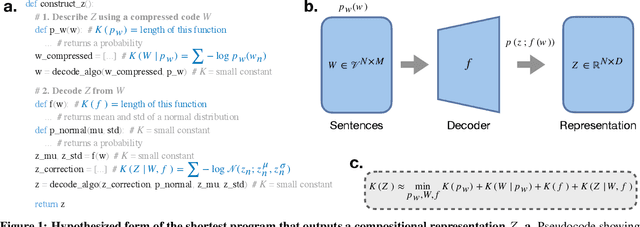


Compositionality is believed to be fundamental to intelligence. In humans, it underlies the structure of thought, language, and higher-level reasoning. In AI, compositional representations can enable a powerful form of out-of-distribution generalization, in which a model systematically adapts to novel combinations of known concepts. However, while we have strong intuitions about what compositionality is, there currently exists no formal definition for it that is measurable and mathematical. Here, we propose such a definition, which we call representational compositionality, that accounts for and extends our intuitions about compositionality. The definition is conceptually simple, quantitative, grounded in algorithmic information theory, and applicable to any representation. Intuitively, representational compositionality states that a compositional representation satisfies three properties. First, it must be expressive. Second, it must be possible to re-describe the representation as a function of discrete symbolic sequences with re-combinable parts, analogous to sentences in natural language. Third, the function that relates these symbolic sequences to the representation, analogous to semantics in natural language, must be simple. Through experiments on both synthetic and real world data, we validate our definition of compositionality and show how it unifies disparate intuitions from across the literature in both AI and cognitive science. We also show that representational compositionality, while theoretically intractable, can be readily estimated using standard deep learning tools. Our definition has the potential to inspire the design of novel, theoretically-driven models that better capture the mechanisms of compositional thought.
Geometric Signatures of Compositionality Across a Language Model's Lifetime
Oct 02, 2024Compositionality, the notion that the meaning of an expression is constructed from the meaning of its parts and syntactic rules, permits the infinite productivity of human language. For the first time, artificial language models (LMs) are able to match human performance in a number of compositional generalization tasks. However, much remains to be understood about the representational mechanisms underlying these abilities. We take a high-level geometric approach to this problem by relating the degree of compositionality in a dataset to the intrinsic dimensionality of its representations under an LM, a measure of feature complexity. We find not only that the degree of dataset compositionality is reflected in representations' intrinsic dimensionality, but that the relationship between compositionality and geometric complexity arises due to learned linguistic features over training. Finally, our analyses reveal a striking contrast between linear and nonlinear dimensionality, showing that they respectively encode formal and semantic aspects of linguistic composition.
Expressivity of Neural Networks with Random Weights and Learned Biases
Jul 02, 2024


Landmark universal function approximation results for neural networks with trained weights and biases provided impetus for the ubiquitous use of neural networks as learning models in Artificial Intelligence (AI) and neuroscience. Recent work has pushed the bounds of universal approximation by showing that arbitrary functions can similarly be learned by tuning smaller subsets of parameters, for example the output weights, within randomly initialized networks. Motivated by the fact that biases can be interpreted as biologically plausible mechanisms for adjusting unit outputs in neural networks, such as tonic inputs or activation thresholds, we investigate the expressivity of neural networks with random weights where only biases are optimized. We provide theoretical and numerical evidence demonstrating that feedforward neural networks with fixed random weights can be trained to perform multiple tasks by learning biases only. We further show that an equivalent result holds for recurrent neural networks predicting dynamical system trajectories. Our results are relevant to neuroscience, where they demonstrate the potential for behaviourally relevant changes in dynamics without modifying synaptic weights, as well as for AI, where they shed light on multi-task methods such as bias fine-tuning and unit masking.
Efficient Causal Graph Discovery Using Large Language Models
Feb 05, 2024
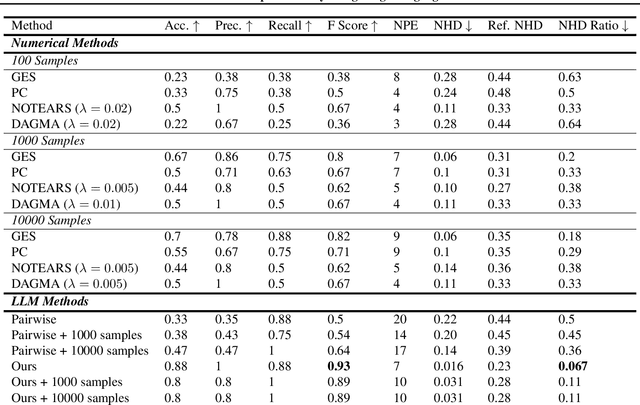
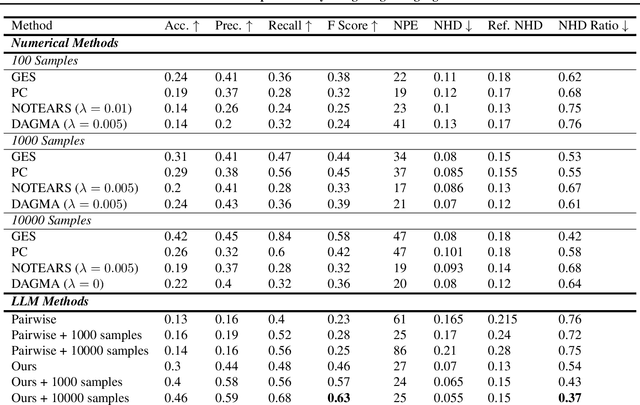
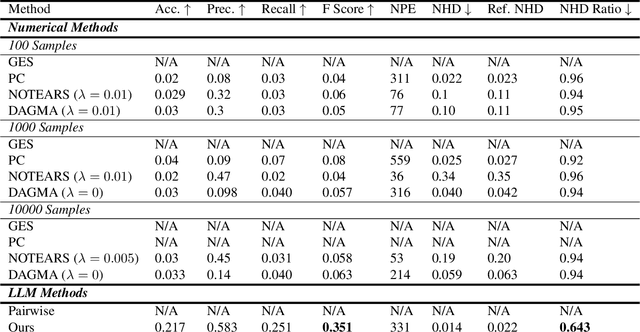
We propose a novel framework that leverages LLMs for full causal graph discovery. While previous LLM-based methods have used a pairwise query approach, this requires a quadratic number of queries which quickly becomes impractical for larger causal graphs. In contrast, the proposed framework uses a breadth-first search (BFS) approach which allows it to use only a linear number of queries. We also show that the proposed method can easily incorporate observational data when available, to improve performance. In addition to being more time and data-efficient, the proposed framework achieves state-of-the-art results on real-world causal graphs of varying sizes. The results demonstrate the effectiveness and efficiency of the proposed method in discovering causal relationships, showcasing its potential for broad applicability in causal graph discovery tasks across different domains.
Forecaster: Towards Temporally Abstract Tree-Search Planning from Pixels
Oct 16, 2023The ability to plan at many different levels of abstraction enables agents to envision the long-term repercussions of their decisions and thus enables sample-efficient learning. This becomes particularly beneficial in complex environments from high-dimensional state space such as pixels, where the goal is distant and the reward sparse. We introduce Forecaster, a deep hierarchical reinforcement learning approach which plans over high-level goals leveraging a temporally abstract world model. Forecaster learns an abstract model of its environment by modelling the transitions dynamics at an abstract level and training a world model on such transition. It then uses this world model to choose optimal high-level goals through a tree-search planning procedure. It additionally trains a low-level policy that learns to reach those goals. Our method not only captures building world models with longer horizons, but also, planning with such models in downstream tasks. We empirically demonstrate Forecaster's potential in both single-task learning and generalization to new tasks in the AntMaze domain.
Network Analysis of the iNaturalist Citizen Science Community
Oct 16, 2023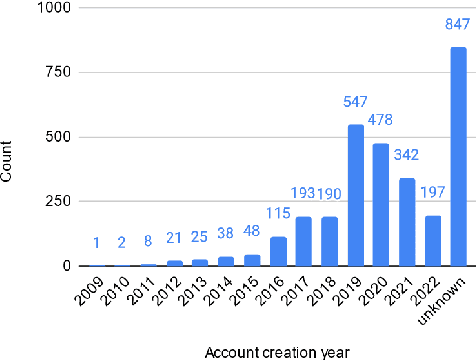
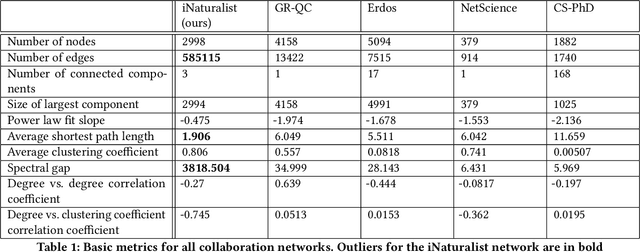
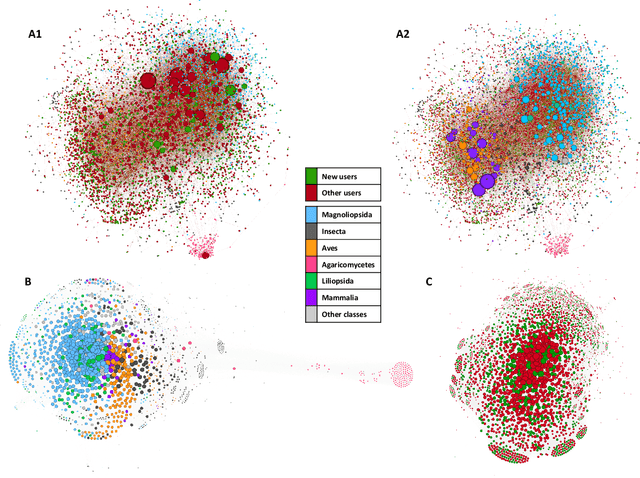

In recent years, citizen science has become a larger and larger part of the scientific community. Its ability to crowd source data and expertise from thousands of citizen scientists makes it invaluable. Despite the field's growing popularity, the interactions and structure of citizen science projects are still poorly understood and under analyzed. We use the iNaturalist citizen science platform as a case study to analyze the structure of citizen science projects. We frame the data from iNaturalist as a bipartite network and use visualizations as well as established network science techniques to gain insights into the structure and interactions between users in citizen science projects. Finally, we propose a novel unique benchmark for network science research by using the iNaturalist data to create a network which has an unusual structure relative to other common benchmark networks. We demonstrate using a link prediction task that this network can be used to gain novel insights into a variety of network science methods.
A Comparison of Classical and Deep Reinforcement Learning Methods for HVAC Control
Aug 10, 2023
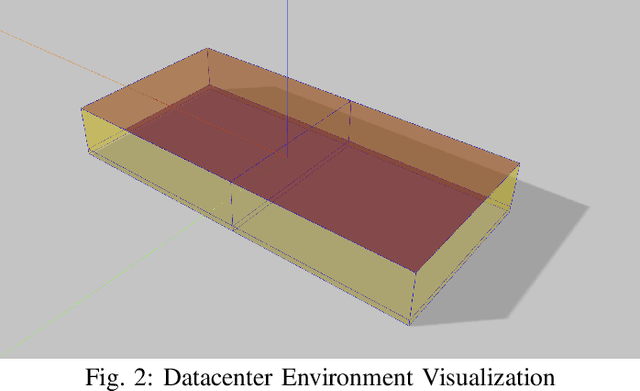


Reinforcement learning (RL) is a promising approach for optimizing HVAC control. RL offers a framework for improving system performance, reducing energy consumption, and enhancing cost efficiency. We benchmark two popular classical and deep RL methods (Q-Learning and Deep-Q-Networks) across multiple HVAC environments and explore the practical consideration of model hyper-parameter selection and reward tuning. The findings provide insight for configuring RL agents in HVAC systems, promoting energy-efficient and cost-effective operation.