 Add to Chrome
 Add to Firefox
 Add to Edge
Fast Voxelwise SNR Estimation for Iterative MRI Reconstructions
May 10, 2026
Purpose: To develop a fast, general-purpose framework for voxelwise noise characterization in linear and nonlinear iterative MRI reconstructions, recovering the image-domain noise variance from which SNR, $g$-factor, and related image-quality metrics are derived. The framework addresses both the intractability of closed-form formulas beyond Cartesian sampling and the long runtime of Pseudo Multiple Replica (PMR) methods. Methods: We propose PICO (Probing Image-space COvariance), an estimator that operates in the image domain by probing the image-domain noise covariance operator -- or, for nonlinear compressed-sensing reconstructions, the Jacobian of the converged solution -- with random probe images. Complex random-phase probes are shown theoretically and empirically to minimize estimator variance compared with Gaussian or real-valued alternatives. PICO was validated against analytical benchmarks and high-replica PMR references using retrospective Cartesian knee data ($R=2$), prospective non-Cartesian spiral brain phantom data ($R=2,3,4$), and compressed-sensing knee reconstructions ($R=2$). Results: In Cartesian experiments, PICO accurately reproduced analytical SENSE $g$-factor maps. In non-Cartesian spiral imaging ($R=2$), it achieved 1% estimation error in 64 s compared with 462 s for PMR (approximately 7.2x speedup), with the efficiency advantage persisting at higher acceleration. For nonlinear compressed sensing, the Jacobian-based estimator produced noise maps consistent with PMR while converging faster (52 s vs. 95 s; approximately 1.8x speedup). Conclusion: PICO provides a computationally efficient alternative to PMR for voxelwise noise and $g$-factor estimation across generalized iterative MRI reconstructions. By reusing existing reconstruction primitives, it enables voxelwise noise maps to be produced as a routine by-product of the reconstruction pipeline.

NYUSIM: A Roadmap to AI-Enabled Statistical Channel Modeling and Simulation
Feb 17, 2026Integrating artificial intelligence (AI) into wireless channel modeling requires large, accurate, and physically consistent datasets derived from real measurements. Such datasets are essential for training and validating models that learn spatio-temporal channel behavior across frequencies and environments. NYUSIM, introduced by NYU WIRELESS in 2016, generates realistic spatio-temporal channel data using extensive outdoor and indoor measurements between 28 and 142 GHz. To improve scalability and support 6G research, we migrated the complete NYUSIM framework from MATLAB to Python, and are incorporating new statistical model generation capabilities from extensive field measurements in the new 6G upper mid-band spectrum at 6.75 GHz (FR1(C)) and 16.95 GHz (FR3) [1]. The NYUSIM Python also incorporates a 3D antenna data format, referred to as Ant3D, which is a standardized, full-sphere format for defining canonical, commercial, or measured antenna patterns for any statistical or site-specific ray tracing modeling tool. Migration from MATLAB to Python was rigorously validated through Kolmogorov-Smirnov (K-S) tests, moment analysis, and end-to-end testing with unified randomness control, confirming statistical consistency and reproduction of spatio-temporal channel statistics, including spatial consistency with the open-source MATLAB NYUSIM v4.0 implementation. The NYUSIM Python version is designed to integrate with modern AI workflows and enable large-scale parallel data generation, establishing a robust, verified, and extensible foundation for future AI-enabled channel modeling.
Fully 3D Unrolled Magnetic Resonance Fingerprinting Reconstruction via Staged Pretraining and Implicit Gridding
Jan 23, 2026Magnetic Resonance Fingerprinting (MRF) enables fast quantitative imaging, yet reconstructing high-resolution 3D data remains computationally demanding. Non-Cartesian reconstructions require repeated non-uniform FFTs, and the commonly used Locally Low Rank (LLR) prior adds computational overhead and becomes insufficient at high accelerations. Learned 3D priors could address these limitations, but training them at scale is challenging due to memory and runtime demands. We propose SPUR-iG, a fully 3D deep unrolled subspace reconstruction framework that integrates efficient data consistency with a progressive training strategy. Data consistency leverages implicit GROG, which grids non-Cartesian data onto a Cartesian grid with an implicitly learned kernel, enabling FFT-based updates with minimal artifacts. Training proceeds in three stages: (1) pretraining a denoiser with extensive data augmentation, (2) greedy per-iteration unrolled training, and (3) final fine-tuning with gradient checkpointing. Together, these stages make large-scale 3D unrolled learning feasible within a reasonable compute budget. On a large in vivo dataset with retrospective undersampling, SPUR-iG improves subspace coefficient maps quality and quantitative accuracy at 1-mm isotropic resolution compared with LLR and a hybrid 2D/3D unrolled baseline. Whole-brain reconstructions complete in under 15-seconds, with up to $\times$111 speedup for 2-minute acquisitions. Notably, $T_1$ maps with our method from 30-second scans achieve accuracy on par with or exceeding LLR reconstructions from 2-minute scans. Overall, the framework improves both accuracy and speed in large-scale 3D MRF reconstruction, enabling efficient and reliable accelerated quantitative imaging.
Fast Reconstruction of Motion-Corrupted Data with Mobile-GRAPPA: Motion and dB0 Inhomogeneity Correction Leveraging Efficient GRAPPA
Nov 09, 2025Advanced motion navigations now enable rapid tracking of subject motion and dB0-induced phase, but accurately incorporating this high-temporal-resolution information into SENSE (Aligned-SENSE) is often computationally prohibitive. We propose "Mobile-GRAPPA", a k-space "cleaning" approach that uses local GRAPPA operators to remove motion and dB0 related corruption so that the resulting data can be reconstructed with standard SENSE. We efficiently train a family of k-space-position-specific Mobile-GRAPPA kernels via a lightweight multilayer perceptron (MLP) and apply them across k-space to generate clean data. In experiments on highly motion-corrupted 1-mm whole-brain GRE (Tacq = 10 min; 1,620 motion/dB0 trackings) and EPTI (Tacq = 2 min; 544 trackings), Mobile-GRAPPA enabled accurate reconstruction with negligible time penalty, whereas full Aligned-SENSE was impractical (reconstruction times > 10 h for GRE and > 10 days for EPTI). These results show that Mobile-GRAPPA incorporates detailed motion and dB0 tracking into SENSE with minimal computational overhead, enabling fast, high-quality reconstructions of challenging data.
ACE-Net: AutofoCus-Enhanced Convolutional Network for Field Imperfection Estimation with application to high b-value spiral Diffusion MRI
Nov 21, 2024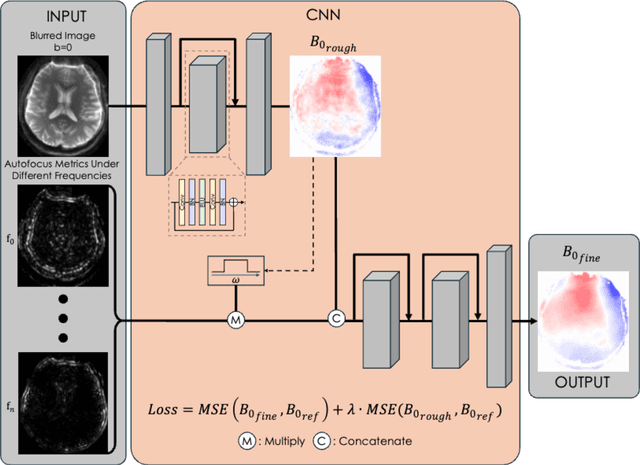
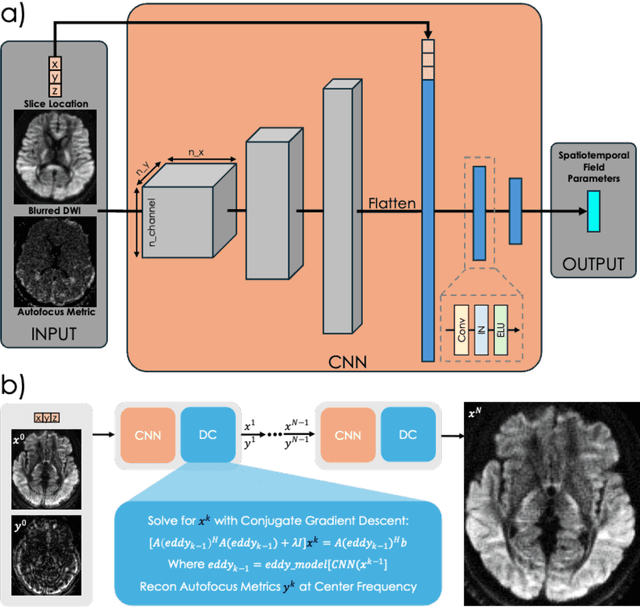
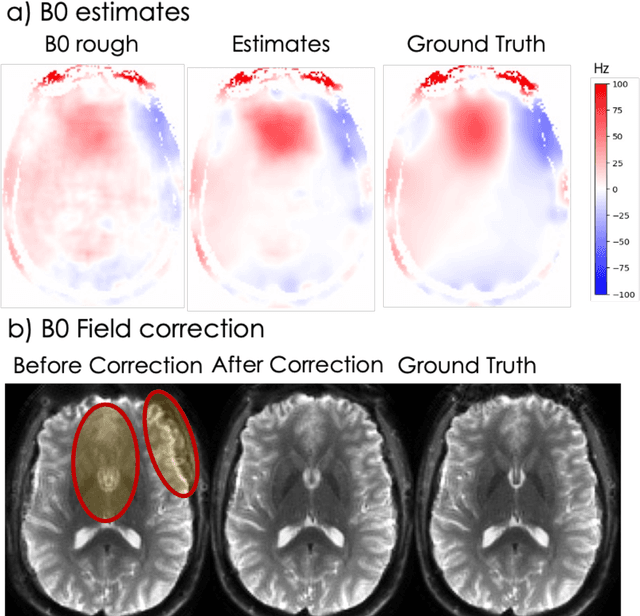
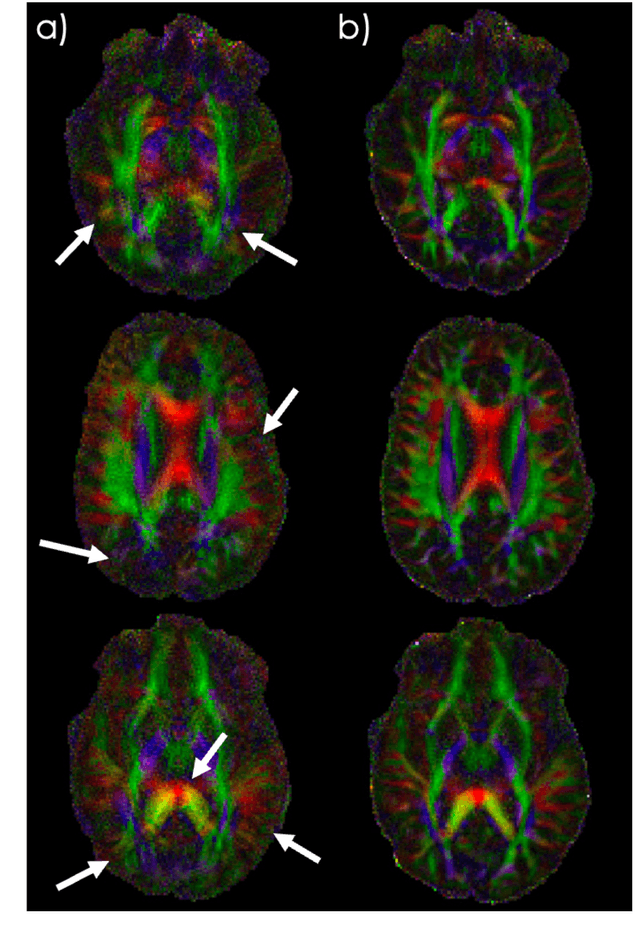
Spatiotemporal magnetic field variations from B0-inhomogeneity and diffusion-encoding-induced eddy-currents can be detrimental to rapid image-encoding schemes such as spiral, EPI and 3D-cones, resulting in undesirable image artifacts. In this work, a data driven approach for automatic estimation of these field imperfections is developed by combining autofocus metrics with deep learning, and by leveraging a compact basis representation of the expected field imperfections. The method was applied to single-shot spiral diffusion MRI at high b-values where accurate estimation of B0 and eddy were obtained, resulting in high quality image reconstruction without need for additional external calibrations.
Sequence adaptive field-imperfection estimation (SAFE): retrospective estimation and correction of $B_1^+$ and $B_0$ inhomogeneities for enhanced MRF quantification
Dec 15, 2023
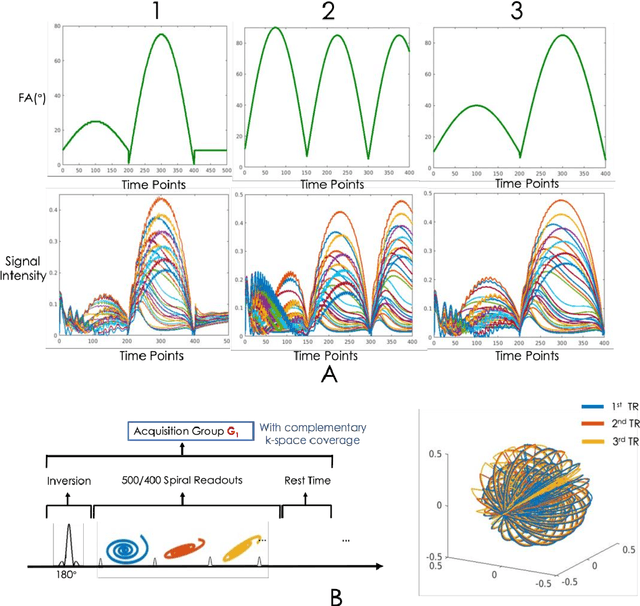
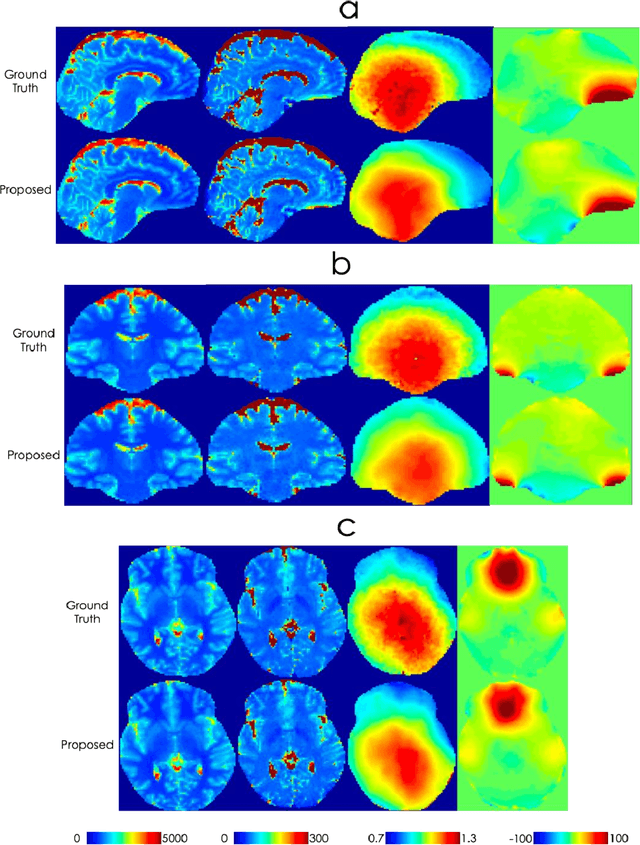

$B_1^+$ and $B_0$ field-inhomogeneities can significantly reduce accuracy and robustness of MRF's quantitative parameter estimates. Additional $B_1^+$ and $B_0$ calibration scans can mitigate this but add scan time and cannot be applied retrospectively to previously collected data. Here, we proposed a calibration-free sequence-adaptive deep-learning framework, to estimate and correct for $B_1^+$ and $B_0$ effects of any MRF sequence. We demonstrate its capability on arbitrary MRF sequences at 3T, where no training data were previously obtained. Such approach can be applied to any previously-acquired and future MRF-scans. The flexibility in directly applying this framework to other quantitative sequences is also highlighted.
Rapid Non-cartesian Reconstruction Using an Implicit Representation of GROG Kernels
Oct 16, 2023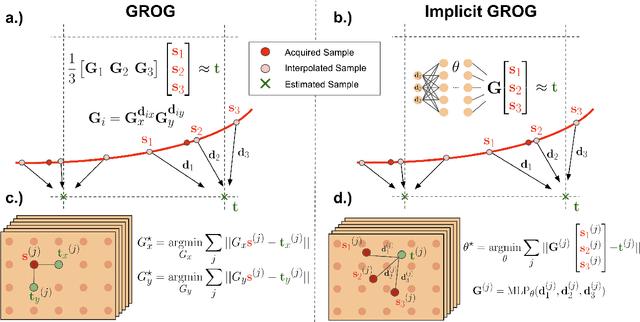
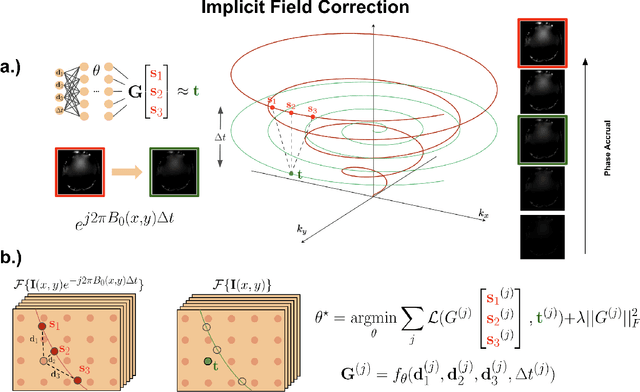

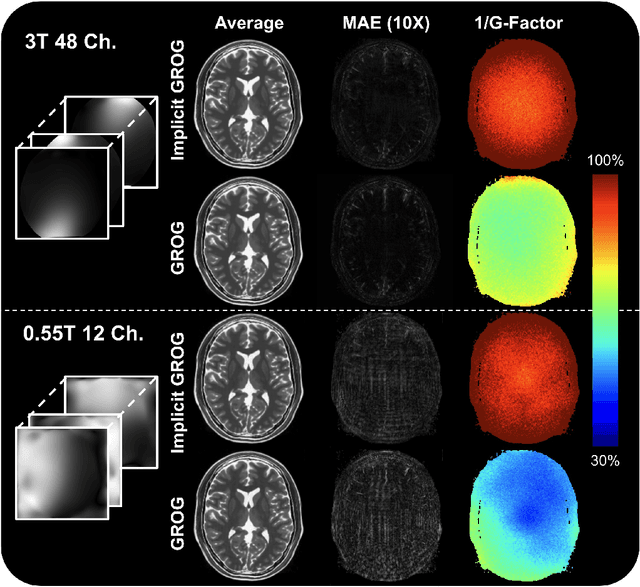
MRI data is acquired in Fourier space. Data acquisition is typically performed on a Cartesian grid in this space to enable the use of a fast Fourier transform algorithm to achieve fast and efficient reconstruction. However, it has been shown that for multiple applications, non-Cartesian data acquisition can improve the performance of MR imaging by providing fast and more efficient data acquisition, and improving motion robustness. Nonetheless, the image reconstruction process of non-Cartesian data is more involved and can be time-consuming, even through the use of efficient algorithms such as non-uniform FFT (NUFFT). This work provides an efficient approach (iGROG) to transform the non-Cartesian data into Cartesian data, to achieve simpler and faster reconstruction which should help enable non-Cartesian data sampling to be performed more widely in MRI.