 Add to Chrome
 Add to Firefox
 Add to Edge
Towards an Agent-First Web: Redesigning the Web for AI Agents
Jun 17, 2026
The World Wide Web was built on an assumption held for three decades: the primary consumer of web content is a human being. This permeates every layer; its access model presumes human visitors, its economics rest on human attention, and its content targets human perception. The rapid emergence of AI agents as intermediaries between humans and web content invalidates this assumption. Yet the web resists agents through blanket blocking, CAPTCHA-based exclusion, and economic models that treat agent access as extraction rather than legitimate interaction. This paper proposes a principled redesign across three layers. At the access layer, agents acting for humans should inherit equivalent access rights, governed by rate limiting and agent identification metadata in HTTP requests, analogous to browser headers, alongside a dual-layer architecture serving human-readable and agent-optimized content from the same domain. At the economic layer, we propose an intent-based tier framework grounded in the agent-as-human-proxy principle: an agent's economic obligation mirrors that of the human it represents. A token-based subscription model meters content in tokens rather than pageviews, alongside a commissioned content economy anchoring AI content production in human intentionality. At the content layer, we identify epistemic recursion, the self-referential loop in which AI-generated content is consumed by agents to produce further content, progressively detaching web knowledge from human ground truth. We propose the Agent Text Markup Language (ATML), a four-level human supervision tier model, and a cryptographic provenance chain to counter this threat. Together these constitute ten design principles for an agent-first internet, one in which agents are first-class citizens whose integration requires renegotiating the web's foundational social contract across access, economics, and content.

Think Before You Act -- A Neurocognitive Governance Model for Autonomous AI Agents
Apr 28, 2026The rapid deployment of autonomous AI agents across enterprise, healthcare, and safety-critical environments has created a fundamental governance gap. Existing approaches, runtime guardrails, training-time alignment, and post-hoc auditing treat governance as an external constraint rather than an internalized behavioral principle, leaving agents vulnerable to unsafe and irreversible actions. We address this gap by drawing on how humans self-govern naturally: before acting, humans engage deliberate cognitive processes grounded in executive function, inhibitory control, and internalized organizational rules to evaluate whether an intended action is permissible, requires modification, or demands escalation. This paper proposes a neurocognitive governance framework that formally maps this human self-governance process to LLM-driven agent reasoning, establishing a structural parallel between the human brain and the large language model as the cognitive core of an agent. We formalize a Pre-Action Governance Reasoning Loop (PAGRL) in which agents consult a four-layer governance rule set: global, workflow-specific, agent-specific, and situational before every consequential action, mirroring how human organizations structure compliance hierarchies across enterprise, department, and role levels. Implemented on a production-grade retail supply chain workflow, the framework achieves 95% compliance accuracy and zero false escalations to human oversight, demonstrating that embedding governance into agent reasoning produces more consistent, explainable, and auditable compliance than external enforcement. This work offers a principled foundation for autonomous AI agents that govern themselves the way humans do: not because rules are imposed upon them, but because deliberation is embedded in how they think.
Flowr -- Scaling Up Retail Supply Chain Operations Through Agentic AI in Large Scale Supermarket Chains
Apr 07, 2026Retail supply chain operations in supermarket chains involve continuous, high-volume manual workflows spanning demand forecasting, procurement, supplier coordination, and inventory replenishment, processes that are repetitive, decision-intensive, and difficult to scale without significant human effort. Despite growing investment in data analytics, the decision-making and coordination layers of these workflows remain predominantly manual, reactive, and fragmented across outlets, distribution centers, and supplier networks. This paper introduces Flowr, a novel agentic AI framework for automating end-to-end retail supply chain workflows in large-scale supermarket operations. Flowr systematically decomposes manual supply chain operations into specialized AI agents, each responsible for a clearly defined cognitive role, enabling automation of processes previously dependent on continuous human coordination. To ensure task accuracy and adherence to responsible AI principles, the framework employs a consortium of fine-tuned, domain-specialized large language models coordinated by a central reasoning LLM. Central to the framework is a human-in-the-loop orchestration model in which supply chain managers supervise and intervene across workflow stages via a Model Context Protocol (MCP)-enabled interface, preserving accountability and organizational control. Evaluation demonstrates that Flowr significantly reduces manual coordination overhead, improves demand-supply alignment, and enables proactive exception handling at a scale unachievable through manual processes. The framework was validated in collaboration with a large-scale supermarket chain and is domain-independent, offering a generalizable blueprint for agentic AI-driven supply chain automation across large-scale enterprise settings.
Towards Responsible and Explainable AI Agents with Consensus-Driven Reasoning
Dec 25, 2025Agentic AI represents a major shift in how autonomous systems reason, plan, and execute multi-step tasks through the coordination of Large Language Models (LLMs), Vision Language Models (VLMs), tools, and external services. While these systems enable powerful new capabilities, increasing autonomy introduces critical challenges related to explainability, accountability, robustness, and governance, especially when agent outputs influence downstream actions or decisions. Existing agentic AI implementations often emphasize functionality and scalability, yet provide limited mechanisms for understanding decision rationale or enforcing responsibility across agent interactions. This paper presents a Responsible(RAI) and Explainable(XAI) AI Agent Architecture for production-grade agentic workflows based on multi-model consensus and reasoning-layer governance. In the proposed design, a consortium of heterogeneous LLM and VLM agents independently generates candidate outputs from a shared input context, explicitly exposing uncertainty, disagreement, and alternative interpretations. A dedicated reasoning agent then performs structured consolidation across these outputs, enforcing safety and policy constraints, mitigating hallucinations and bias, and producing auditable, evidence-backed decisions. Explainability is achieved through explicit cross-model comparison and preserved intermediate outputs, while responsibility is enforced through centralized reasoning-layer control and agent-level constraints. We evaluate the architecture across multiple real-world agentic AI workflows, demonstrating that consensus-driven reasoning improves robustness, transparency, and operational trust across diverse application domains. This work provides practical guidance for designing agentic AI systems that are autonomous and scalable, yet responsible and explainable by construction.
6G Resilience -- White Paper
Sep 10, 2025
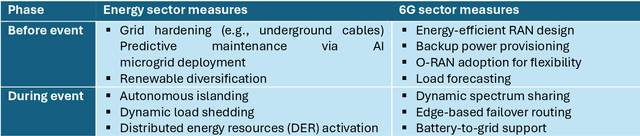


6G must be designed to withstand, adapt to, and evolve amid prolonged, complex disruptions. Mobile networks' shift from efficiency-first to sustainability-aware has motivated this white paper to assert that resilience is a primary design goal, alongside sustainability and efficiency, encompassing technology, architecture, and economics. We promote resilience by analysing dependencies between mobile networks and other critical systems, such as energy, transport, and emergency services, and illustrate how cascading failures spread through infrastructures. We formalise resilience using the 3R framework: reliability, robustness, resilience. Subsequently, we translate this into measurable capabilities: graceful degradation, situational awareness, rapid reconfiguration, and learning-driven improvement and recovery. Architecturally, we promote edge-native and locality-aware designs, open interfaces, and programmability to enable islanded operations, fallback modes, and multi-layer diversity (radio, compute, energy, timing). Key enablers include AI-native control loops with verifiable behaviour, zero-trust security rooted in hardware and supply-chain integrity, and networking techniques that prioritise critical traffic, time-sensitive flows, and inter-domain coordination. Resilience also has a techno-economic aspect: open platforms and high-quality complementors generate ecosystem externalities that enhance resilience while opening new markets. We identify nine business-model groups and several patterns aligned with the 3R objectives, and we outline governance and standardisation. This white paper serves as an initial step and catalyst for 6G resilience. It aims to inspire researchers, professionals, government officials, and the public, providing them with the essential components to understand and shape the development of 6G resilience.