 Add to Chrome
 Add to Firefox
 Add to Edge
SPARC-Rad: A Multimodal Benchmark Dataset and Evaluation Pipeline for Spatial and Anatomical Reasoning in Radiology Vision-Language Models
Jul 30, 2026
Vision-language models (VLMs) are increasingly being evaluated for medical imaging, but many available benchmarks emphasize disease classification, report generation, or broad visual question answering rather than the spatial and anatomical reasoning required for radiology. We developed the Spatial Perception and Anatomical Reasoning in Clinical Radiology (SPARC-Rad) Benchmark, a manually curated multimodal benchmark dataset and evaluation pipeline for assessing these capabilities in radiology VLMs. SPARC-Rad includes 300 image-question pairs derived from healthy control imaging studies in The Cancer Imaging Archive (TCIA), spanning CT, MRI, and radiography across the abdomen, chest, breast, neuro, and musculoskeletal categories. Radiology trainees manually designed and annotated questions to evaluate anatomical identification, localization, laterality, regional recognition, device identification, and inter-structure spatial relationships. The evaluation pipeline supports standardized prompting, structured output collection, response normalization, LLM-as-judge grading, human quality review, binary correctness scoring, and subgroup analysis by modality, anatomy, and reasoning type. SPARC-Rad provides a reusable framework for evaluating whether VLMs can provide reasoning for radiologic anatomy as a spatial system, supporting future model development, failure-mode analysis, and pre-deployment assessment.

RAISE -- Radiology AI Safety, an End-to-end lifecycle approach
Nov 24, 2023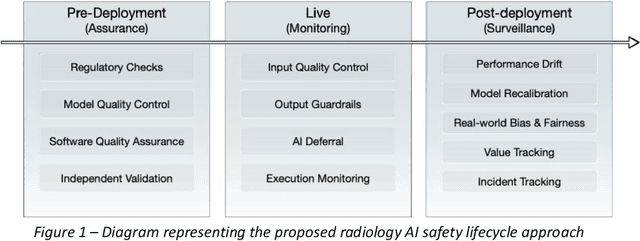
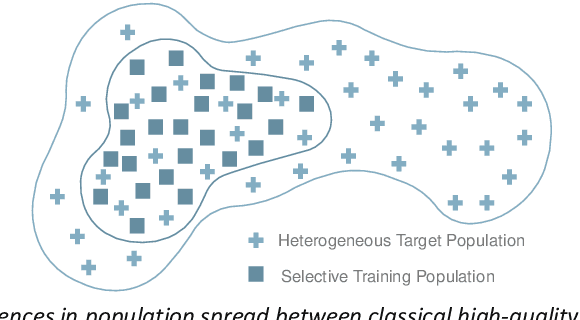
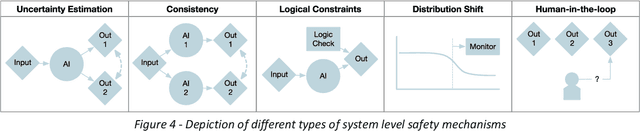
The integration of AI into radiology introduces opportunities for improved clinical care provision and efficiency but it demands a meticulous approach to mitigate potential risks as with any other new technology. Beginning with rigorous pre-deployment evaluation and validation, the focus should be on ensuring models meet the highest standards of safety, effectiveness and efficacy for their intended applications. Input and output guardrails implemented during production usage act as an additional layer of protection, identifying and addressing individual failures as they occur. Continuous post-deployment monitoring allows for tracking population-level performance (data drift), fairness, and value delivery over time. Scheduling reviews of post-deployment model performance and educating radiologists about new algorithmic-driven findings is critical for AI to be effective in clinical practice. Recognizing that no single AI solution can provide absolute assurance even when limited to its intended use, the synergistic application of quality assurance at multiple levels - regulatory, clinical, technical, and ethical - is emphasized. Collaborative efforts between stakeholders spanning healthcare systems, industry, academia, and government are imperative to address the multifaceted challenges involved. Trust in AI is an earned privilege, contingent on a broad set of goals, among them transparently demonstrating that the AI adheres to the same rigorous safety, effectiveness and efficacy standards as other established medical technologies. By doing so, developers can instil confidence among providers and patients alike, enabling the responsible scaling of AI and the realization of its potential benefits. The roadmap presented herein aims to expedite the achievement of deployable, reliable, and safe AI in radiology.