 Add to Chrome
 Add to Firefox
 Add to Edge
Pace: Physics-Aware Attentive Temporal Convolutional Network for Battery Health Estimation
Dec 16, 2025
Batteries are critical components in modern energy systems such as electric vehicles and power grid energy storage. Effective battery health management is essential for battery system safety, cost-efficiency, and sustainability. In this paper, we propose Pace, a physics-aware attentive temporal convolutional network for battery health estimation. Pace integrates raw sensor measurements with battery physics features derived from the equivalent circuit model. We develop three battery-specific modules, including dilated temporal blocks for efficient temporal encoding, chunked attention blocks for context modeling, and a dual-head output block for fusing short- and long-term battery degradation patterns. Together, the modules enable Pace to predict battery health accurately and efficiently in various battery usage conditions. In a large public dataset, Pace performs much better than existing models, achieving an average performance improvement of 6.5 and 2.0x compared to two best-performing baseline models. We further demonstrate its practical viability with a real-time edge deployment on a Raspberry Pi. These results establish Pace as a practical and high-performance solution for battery health analytics.

GiNet: Integrating Sequential and Context-Aware Learning for Battery Capacity Prediction
Jan 09, 2025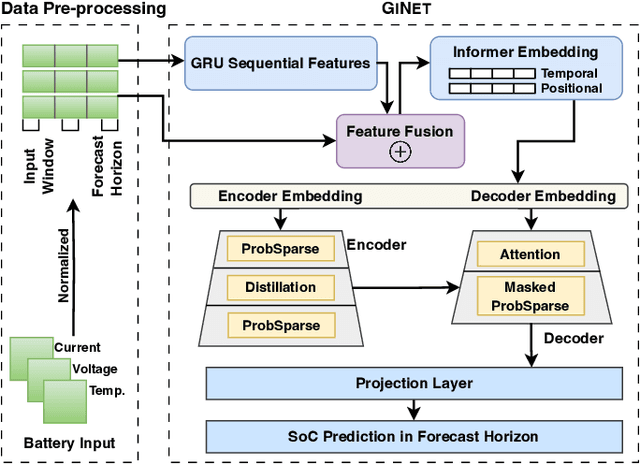
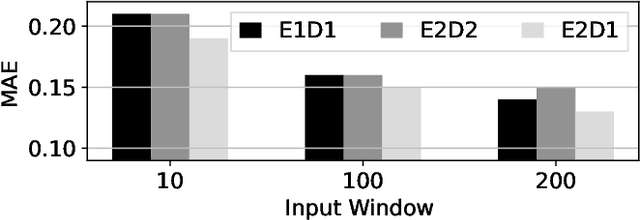
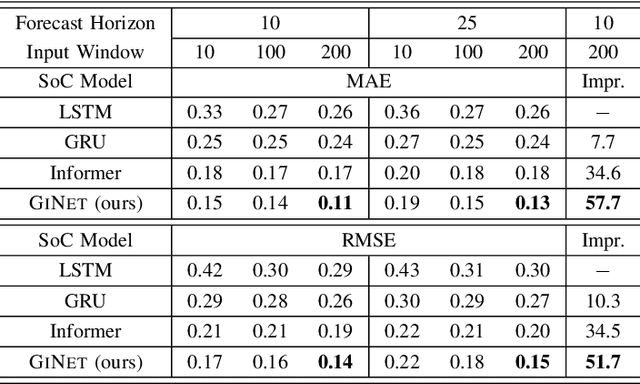
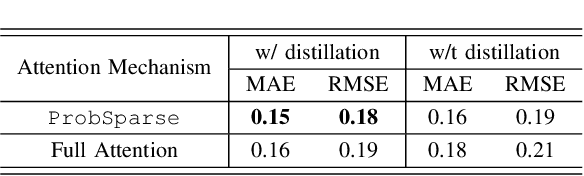
The surging demand for batteries requires advanced battery management systems, where battery capacity modelling is a key functionality. In this paper, we aim to achieve accurate battery capacity prediction by learning from historical measurements of battery dynamics. We propose GiNet, a gated recurrent units enhanced Informer network, for predicting battery's capacity. The novelty and competitiveness of GiNet lies in its capability of capturing sequential and contextual information from raw battery data and reflecting the battery's complex behaviors with both temporal dynamics and long-term dependencies. We conducted an experimental study based on a publicly available dataset to showcase GiNet's strength of gaining a holistic understanding of battery behavior and predicting battery capacity accurately. GiNet achieves 0.11 mean absolute error for predicting the battery capacity in a sequence of future time slots without knowing the historical battery capacity. It also outperforms the latest algorithms significantly with 27% error reduction on average compared to Informer. The promising results highlight the importance of customized and optimized integration of algorithm and battery knowledge and shed light on other industry applications as well.
GET-DIPP: Graph-Embedded Transformer for Differentiable Integrated Prediction and Planning
Nov 11, 2022


Accurately predicting interactive road agents' future trajectories and planning a socially compliant and human-like trajectory accordingly are important for autonomous vehicles. In this paper, we propose a planning-centric prediction neural network, which takes surrounding agents' historical states and map context information as input, and outputs the joint multi-modal prediction trajectories for surrounding agents, as well as a sequence of control commands for the ego vehicle by imitation learning. An agent-agent interaction module along the time axis is proposed in our network architecture to better comprehend the relationship among all the other intelligent agents on the road. To incorporate the map's topological information, a Dynamic Graph Convolutional Neural Network (DGCNN) is employed to process the road network topology. Besides, the whole architecture can serve as a backbone for the Differentiable Integrated motion Prediction with Planning (DIPP) method by providing accurate prediction results and initial planning commands. Experiments are conducted on real-world datasets to demonstrate the improvements made by our proposed method in both planning and prediction accuracy compared to the previous state-of-the-art methods.