 Add to Chrome
 Add to Firefox
 Add to Edge
Improving Item Discoverability in e-Commerce Search via Related Intent Generation
Jul 29, 2026
Traditional search systems are optimized to retrieve items that strictly match a query, often prioritizing precision over recall. In e-commerce marketplaces and particularly grocery, this paradigm is limiting, as user satisfaction and commercial outcomes depend heavily on the discoverability of substitute, complementary, and thematically related items. In this paper, we present a scalable system for discovery-augmented search that leverages intent-conditioned recall expansion. Our approach generates implicit user intents to expand candidate recall while maintaining relevance. The system addresses the cost-quality tradeoff of generative retrieval through a two-stage hybrid architecture. First, we leverage closed-weight large language models (LLMs) to maximize discoverability for head queries. To extend these benefits to tail queries, we then introduce a finetuned small language model (SLM), trained via LoRA adapters and teacher-student distillation. We evaluate the system using a rigorous dual framework: (a) LLM-as-a-judge metrics validated against human preferences for semantic quality, and (b) end-to-end session-level purchase analysis. Results demonstrate that our approach improves both intent generation quality and downstream retrieval effectiveness, extending discovery coverage from approximately 60% to 80% of query traffic at roughly 30% of the teacher model's inference cost, offering a viable path for deployment in large-scale marketplaces. Beyond relevance gains, discovery-augmented search may serve as a marketplace-balancing mechanism, giving long-tail and emerging supply an opportunity for query-conditioned exposure.

Mitigating Pooling Bias in E-commerce Search via False Negative Estimation
Nov 18, 2023


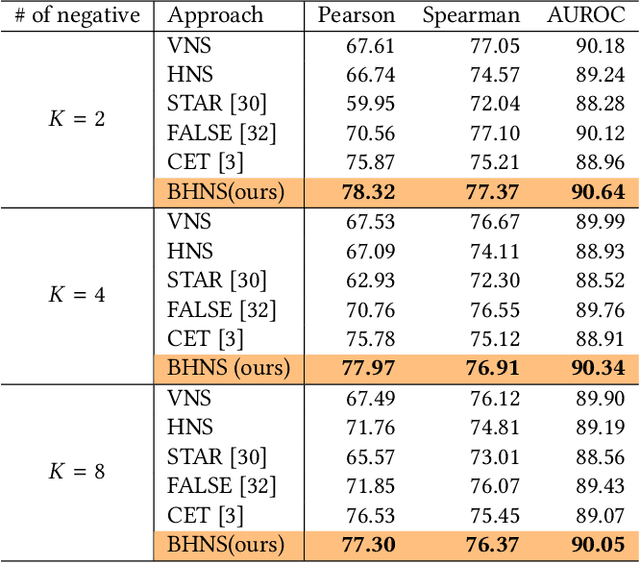
Efficient and accurate product relevance assessment is critical for user experiences and business success. Training a proficient relevance assessment model requires high-quality query-product pairs, often obtained through negative sampling strategies. Unfortunately, current methods introduce pooling bias by mistakenly sampling false negatives, diminishing performance and business impact. To address this, we present Bias-mitigating Hard Negative Sampling (BHNS), a novel negative sampling strategy tailored to identify and adjust for false negatives, building upon our original False Negative Estimation algorithm. Our experiments in the Instacart search setting confirm BHNS as effective for practical e-commerce use. Furthermore, comparative analyses on public dataset showcase its domain-agnostic potential for diverse applications.
An Embedding-Based Grocery Search Model at Instacart
Sep 12, 2022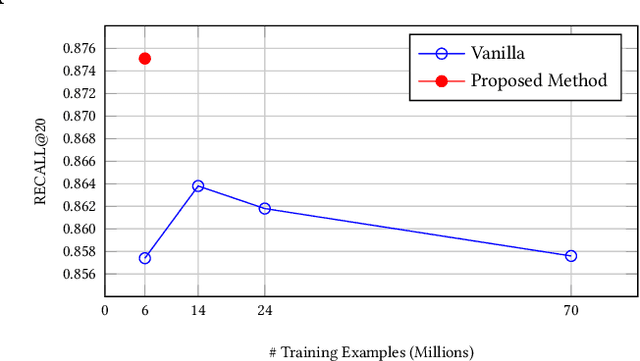

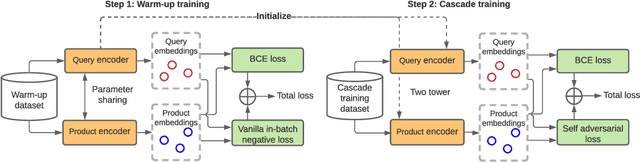
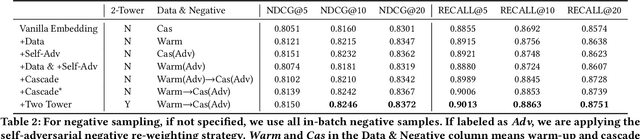
The key to e-commerce search is how to best utilize the large yet noisy log data. In this paper, we present our embedding-based model for grocery search at Instacart. The system learns query and product representations with a two-tower transformer-based encoder architecture. To tackle the cold-start problem, we focus on content-based features. To train the model efficiently on noisy data, we propose a self-adversarial learning method and a cascade training method. AccOn an offline human evaluation dataset, we achieve 10% relative improvement in RECALL@20, and for online A/B testing, we achieve 4.1% cart-adds per search (CAPS) and 1.5% gross merchandise value (GMV) improvement. We describe how we train and deploy the embedding based search model and give a detailed analysis of the effectiveness of our method.