 Add to Chrome
 Add to Firefox
 Add to Edge
Beyond Activation Alignment:The Alignment-Diversity Tradeoff in Task-Aware LLM Quantization
Jul 01, 2026
Mixed-precision quantization (MPQ) has become a key technique for deploying large language models under stringent memory and compute constraints. We first identify a phenomenon that we term the Perplexity Illusion: layers ranked as important by perplexity-based sensitivity show little rank correlation with those that are most influential for complex reasoning performance, with Kendall $τ\approx 0$ in our analysis. We further reveal an Alignment-Diversity Tradeoff: using only target-task calibration data can degrade post-quantization performance, whereas incorporating general-domain data stabilizes sensitivity estimation and improves robustness across tasks. Based on these observations, we propose TASA (Task-Aware Sensitivity Analysis), a two-level framework that jointly optimizes calibration-data composition and mixed-precision bit allocation. Specifically, TASA searches for a calibration-data mixture using a training-free gradient-trace alignment criterion, and then aggregates perplexity and reasoning-oriented sensitivity signals to guide both inter-layer and intra-layer bit allocation. Experiments on LLaMA-3-8B and Qwen2.5-7B reveal a precision inversion: appropriately allocated 3.5-bit models can match or surpass less task-aware 4-bit baselines. At an average precision of 3.5 bits, TASA matches or outperforms several competitive 4-bit uniform baselines in aggregate accuracy, and improves over the strongest W3 baseline on GSM8K by more than 20 absolute points on LLaMA-3-8B. These results show that calibration-data composition substantially affects task-sensitive quantization, a factor underexplored in prior work.

Enhanced Capture Point Control Using Thruster Dynamics and QP-Based Optimization for Harpy
Nov 21, 2024Our work aims to make significant strides in understanding unexplored locomotion control paradigms based on the integration of posture manipulation and thrust vectoring. These techniques are commonly seen in nature, such as Chukar birds using their wings to run on a nearly vertical wall. In this work, we developed a capture-point-based controller integrated with a quadratic programming (QP) solver which is used to create a thruster-assisted dynamic bipedal walking controller for our state-of-the-art Harpy platform. Harpy is a bipedal robot capable of legged-aerial locomotion using its legs and thrusters attached to its main frame. While capture point control based on centroidal models for bipedal systems has been extensively studied, the use of these thrusters in determining the capture point for a bipedal robot has not been extensively explored. The addition of these external thrust forces can lead to interesting interpretations of locomotion, such as virtual buoyancy studied in aquatic-legged locomotion. In this work, we derive a thruster-assisted bipedal walking with the capture point controller and implement it in simulation to study its performance.
Conjugate momentum based thruster force estimate in dynamic multimodal robot
Nov 21, 2024In a multi-modal system which combines thruster and legged locomotion such our state-of-the-art Harpy platform to perform dynamic locomotion. Therefore, it is very important to have a proper estimate of Thruster force. Harpy is a bipedal robot capable of legged-aerial locomotion using its legs and thrusters attached to its main frame. we can characterize thruster force using a thrust stand but it generally does not account for working conditions such as battery voltage. In this study, we present a momentum-based thruster force estimator. One of the key information required to estimate is terrain information. we show estimation results with and without terrain knowledge. In this work, we derive a conjugate momentum thruster force estimator and implement it on a numerical simulator that uses thruster force to perform thruster-assisted walking.
Capture Point Control in Thruster-Assisted Bipedal Locomotion
Jun 21, 2024


Despite major advancements in control design that are robust to unplanned disturbances, bipedal robots are still susceptible to falling over and struggle to negotiate rough terrains. By utilizing thrusters in our bipedal robot, we can perform additional posture manipulation and expand the modes of locomotion to enhance the robot's stability and ability to negotiate rough and difficult-to-navigate terrains. In this paper, we present our efforts in designing a controller based on capture point control for our thruster-assisted walking model named Harpy and explore its control design possibilities. While capture point control based on centroidal models for bipedal systems has been extensively studied, the incorporation of external forces that can influence the dynamics of linear inverted pendulum models, often used in capture point-based works, has not been explored before. The inclusion of these external forces can lead to interesting interpretations of locomotion, such as virtual buoyancy studied in aquatic-legged locomotion. This paper outlines the dynamical model of our robot, the capture point method we use to assist the upper body stabilization, and the simulation work done to show the controller's feasibility.
Banking Turn of High-DOF Dynamic Morphing Wing Flight by Shifting Structure Response Using Optimization
May 09, 2024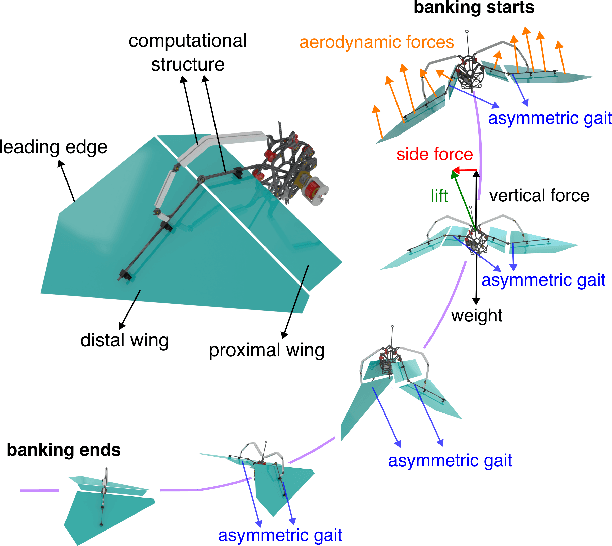
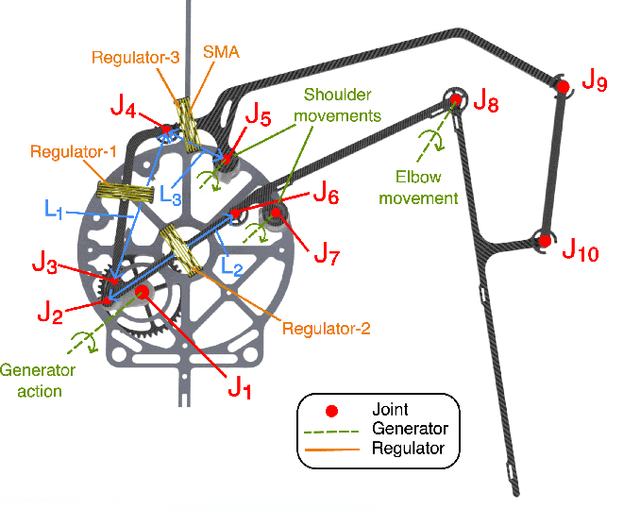
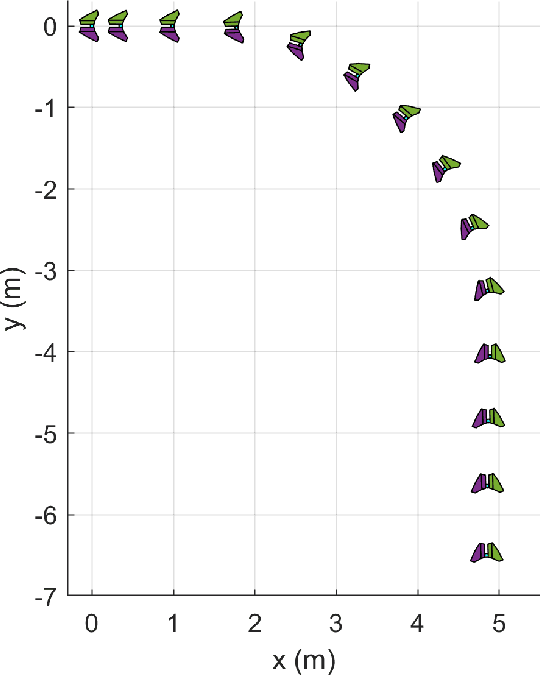
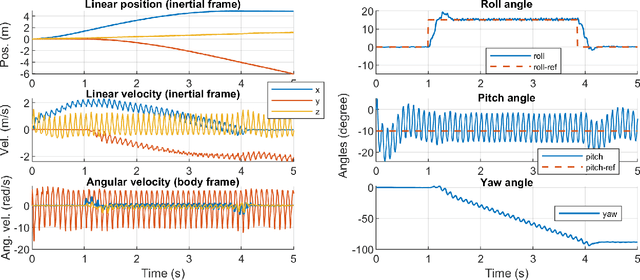
The 3D flight control of a flapping wing robot is a very challenging problem. The robot stabilizes and controls its pose through the aerodynamic forces acting on the wing membrane which has complex dynamics and it is difficult to develop a control method to interact with such a complex system. Bats, in particular, are capable of performing highly agile aerial maneuvers such as tight banking and bounding flight solely using their highly flexible wings. In this work, we develop a control method for a bio-inspired bat robot, the Aerobat, using small low-powered actuators to manipulate the flapping gait and the resulting aerodynamic forces. We implemented a controller based on collocation approach to track a desired roll and perform a banking maneuver to be used in a trajectory tracking controller. This controller is implemented in a simulation to show its performance and feasibility.