 Add to Chrome
 Add to Firefox
 Add to Edge
JSGS: JPEG State-Guided Supervision for 3D Gaussian Splatting from Mixed-Quality Views
Aug 09, 2026
Standard 3D Gaussian Splatting (3DGS) assumes that every input image faithfully samples scene radiance. However, mixed-quality JPEG images violate this assumption because compression-induced blocking and ringing artifacts can corrupt updates to Gaussians shared across views. To address this problem, we propose JPEG State-Guided Supervision for 3D Gaussian Splatting from Mixed-Quality Views (JSGS). JSGS uses luminance and chrominance quantization tables stored in each JPEG file to construct a view-specific JPEG observation operator. This operator encodes and decodes each rendered view for domain-matched comparison with the corresponding decoded input image. The luminance quantization table supplies continuous weights within a fixed middle frequency band. A loss in the low frequency band anchors coarse structure, while the weighted middle frequency loss redistributes supervision among the selected DCT coordinates. The resulting block disagreement also guides the Gaussian Controller to regularize small primitives with high opacity in disagreement regions. Across seven scenes and three mixed-quality schedules, JSGS achieves the lowest mean LPIPS and the highest mean SSIM under every schedule while rendering at approximately 150 FPS. Code: https://github.com/Jayden-Cui/JSGS.

Listen, Look, and Learn: Learning Without Forgetting through SAM-Audio
Jun 09, 2026Class-Incremental Learning (CIL) aims to continuously learn new classes without forgetting previously acquired knowledge. While recent CIL advances have spurred significant interest across various modalities, the audio-visual setting remains underexplored. Furthermore, although foundational multimodal models like SAM-Audio encapsulate rich static priors, our empirical analysis reveals that these representations struggle in incremental settings. This work bridges this gap by integrating SAM-Audio's audio-visual priors into the CIL setting. Specifically, we leverage its dense audio and visual representations and employ a novel guided attention strategy where the audio features contextually guide the visual representations. To further mitigate catastrophic forgetting, we introduce dual-level distillation objectives at both the feature and logit levels. Extensive evaluations on audio-visual CIL benchmarks demonstrate that our approach consistently outperforms state-of-the-art methods.
IAN: The Individual Aggregation Network for Person Search
May 16, 2017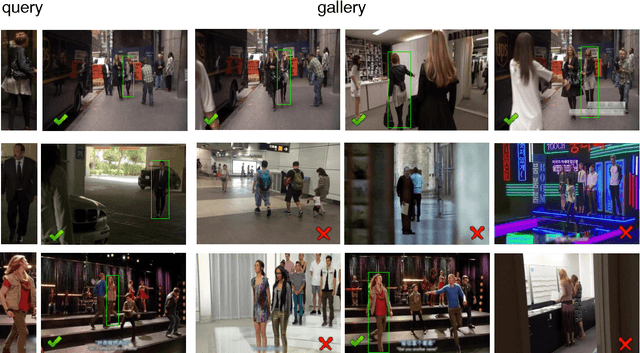
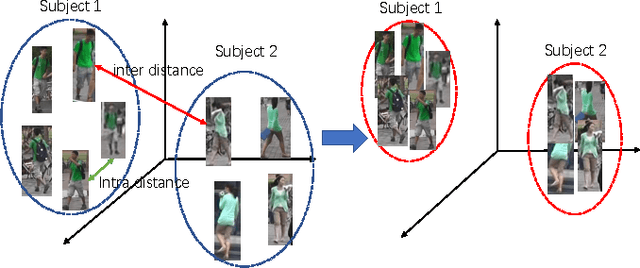
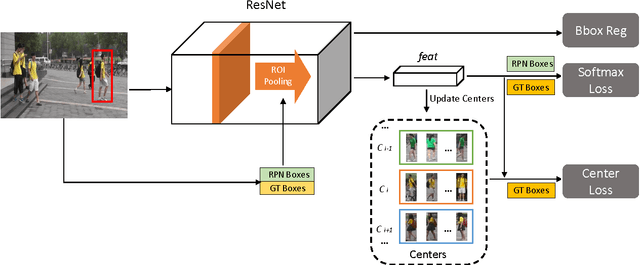
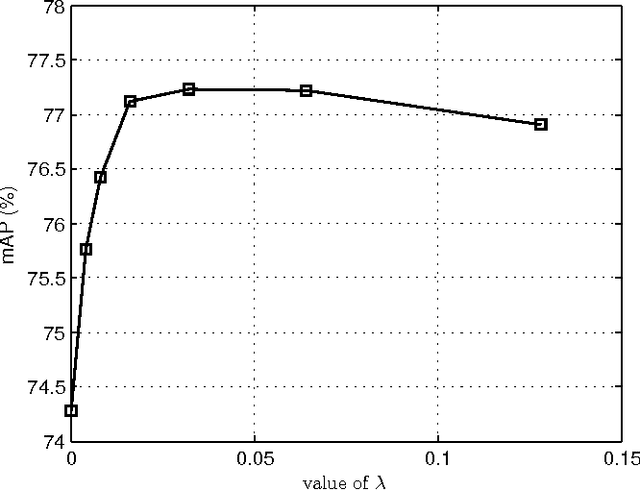
Person search in real-world scenarios is a new challenging computer version task with many meaningful applications. The challenge of this task mainly comes from: (1) unavailable bounding boxes for pedestrians and the model needs to search for the person over the whole gallery images; (2) huge variance of visual appearance of a particular person owing to varying poses, lighting conditions, and occlusions. To address these two critical issues in modern person search applications, we propose a novel Individual Aggregation Network (IAN) that can accurately localize persons by learning to minimize intra-person feature variations. IAN is built upon the state-of-the-art object detection framework, i.e., faster R-CNN, so that high-quality region proposals for pedestrians can be produced in an online manner. In addition, to relieve the negative effect caused by varying visual appearances of the same individual, IAN introduces a novel center loss that can increase the intra-class compactness of feature representations. The engaged center loss encourages persons with the same identity to have similar feature characteristics. Extensive experimental results on two benchmarks, i.e., CUHK-SYSU and PRW, well demonstrate the superiority of the proposed model. In particular, IAN achieves 77.23% mAP and 80.45% top-1 accuracy on CUHK-SYSU, which outperform the state-of-the-art by 1.7% and 1.85%, respectively.