 Add to Chrome
 Add to Firefox
 Add to Edge
Listen, Look, and Learn: Learning Without Forgetting through SAM-Audio
Jun 09, 2026
Class-Incremental Learning (CIL) aims to continuously learn new classes without forgetting previously acquired knowledge. While recent CIL advances have spurred significant interest across various modalities, the audio-visual setting remains underexplored. Furthermore, although foundational multimodal models like SAM-Audio encapsulate rich static priors, our empirical analysis reveals that these representations struggle in incremental settings. This work bridges this gap by integrating SAM-Audio's audio-visual priors into the CIL setting. Specifically, we leverage its dense audio and visual representations and employ a novel guided attention strategy where the audio features contextually guide the visual representations. To further mitigate catastrophic forgetting, we introduce dual-level distillation objectives at both the feature and logit levels. Extensive evaluations on audio-visual CIL benchmarks demonstrate that our approach consistently outperforms state-of-the-art methods.

Attack Agnostic Statistical Method for Adversarial Detection
Nov 22, 2019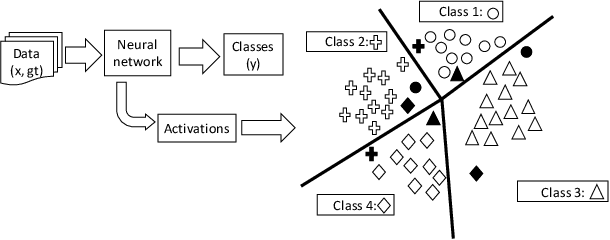
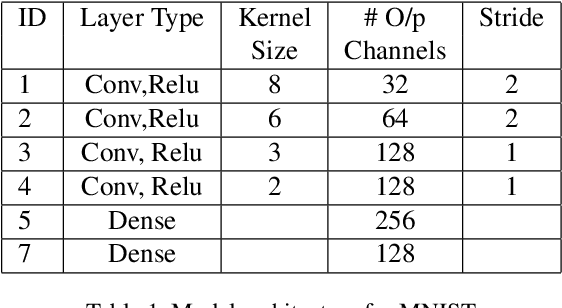
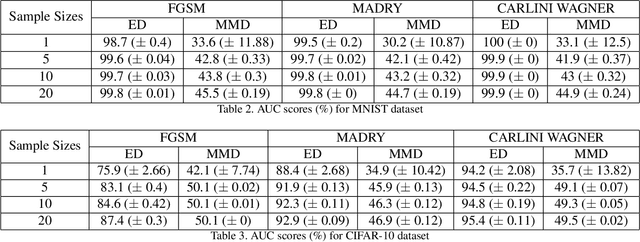
Deep Learning based AI systems have shown great promise in various domains such as vision, audio, autonomous systems (vehicles, drones), etc. Recent research on neural networks has shown the susceptibility of deep networks to adversarial attacks - a technique of adding small perturbations to the inputs which can fool a deep network into misclassifying them. Developing defenses against such adversarial attacks is an active research area, with some approaches proposing robust models that are immune to such adversaries, while other techniques attempt to detect such adversarial inputs. In this paper, we present a novel statistical approach for adversarial detection in image classification. Our approach is based on constructing a per-class feature distribution and detecting adversaries based on comparison of features of a test image with the feature distribution of its class. For this purpose, we make use of various statistical distances such as ED (Energy Distance), MMD (Maximum Mean Discrepancy) for adversarial detection, and analyze the performance of each metric. We experimentally show that our approach achieves good adversarial detection performance on MNIST and CIFAR-10 datasets irrespective of the attack method, sample size and the degree of adversarial perturbation.