 Add to Chrome
 Add to Firefox
 Add to Edge
PerAct2: A Perceiver Actor Framework for Bimanual Manipulation Tasks
Jun 29, 2024
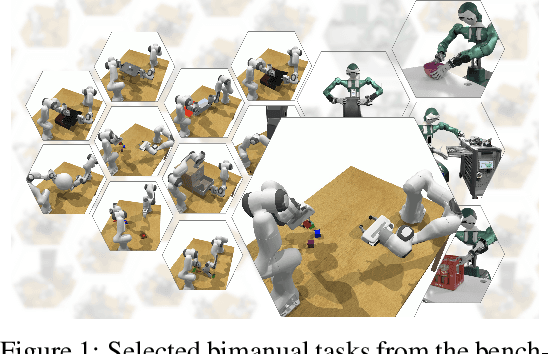
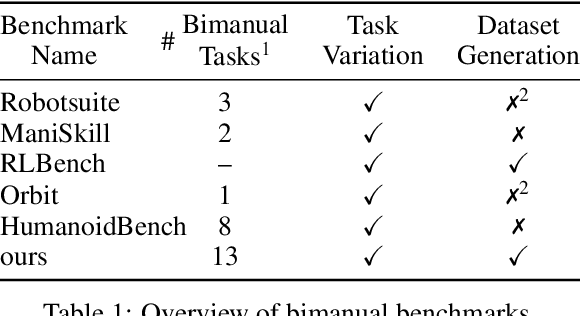
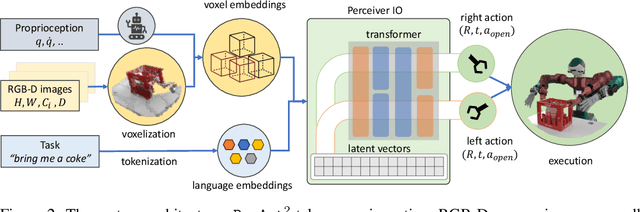
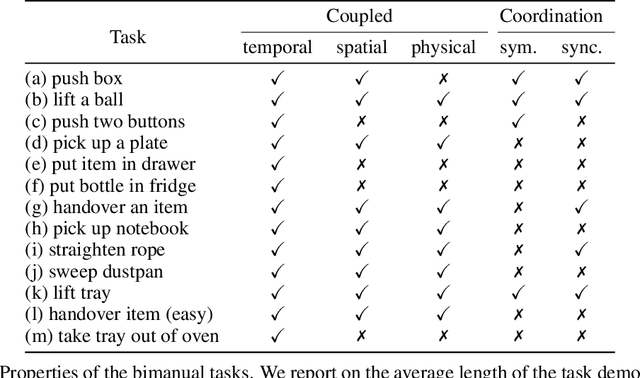
Bimanual manipulation is challenging due to precise spatial and temporal coordination required between two arms. While there exist several real-world bimanual systems, there is a lack of simulated benchmarks with a large task diversity for systematically studying bimanual capabilities across a wide range of tabletop tasks. This paper addresses the gap by extending RLBench to bimanual manipulation. We open-source our code and benchmark comprising 13 new tasks with 23 unique task variations, each requiring a high degree of coordination and adaptability. To kickstart the benchmark, we extended several state-of-the art methods to bimanual manipulation and also present a language-conditioned behavioral cloning agent -- PerAct2, which enables the learning and execution of bimanual 6-DoF manipulation tasks. Our novel network architecture efficiently integrates language processing with action prediction, allowing robots to understand and perform complex bimanual tasks in response to user-specified goals. Project website with code is available at: http://bimanual.github.io

SciEx: Benchmarking Large Language Models on Scientific Exams with Human Expert Grading and Automatic Grading
Jun 14, 2024
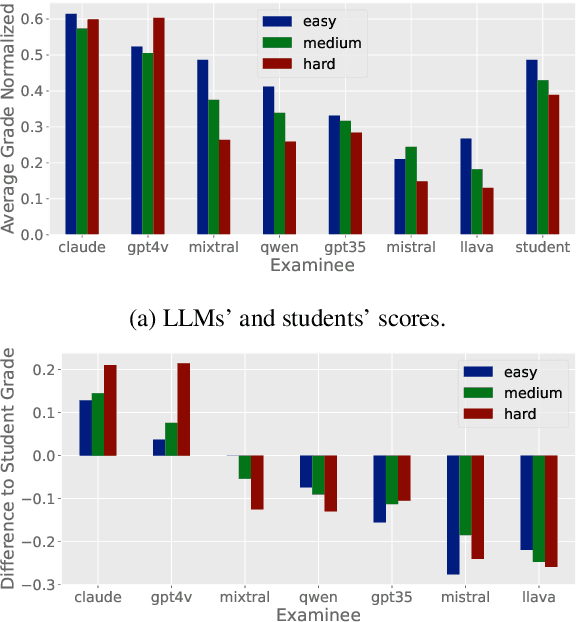

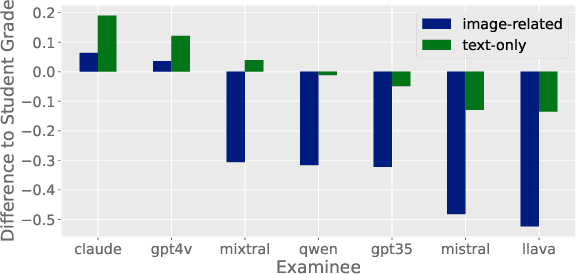
With the rapid development of Large Language Models (LLMs), it is crucial to have benchmarks which can evaluate the ability of LLMs on different domains. One common use of LLMs is performing tasks on scientific topics, such as writing algorithms, querying databases or giving mathematical proofs. Inspired by the way university students are evaluated on such tasks, in this paper, we propose SciEx - a benchmark consisting of university computer science exam questions, to evaluate LLMs ability on solving scientific tasks. SciEx is (1) multilingual, containing both English and German exams, and (2) multi-modal, containing questions that involve images, and (3) contains various types of freeform questions with different difficulty levels, due to the nature of university exams. We evaluate the performance of various state-of-the-art LLMs on our new benchmark. Since SciEx questions are freeform, it is not straightforward to evaluate LLM performance. Therefore, we provide human expert grading of the LLM outputs on SciEx. We show that the free-form exams in SciEx remain challenging for the current LLMs, where the best LLM only achieves 59.4\% exam grade on average. We also provide detailed comparisons between LLM performance and student performance on SciEx. To enable future evaluation of new LLMs, we propose using LLM-as-a-judge to grade the LLM answers on SciEx. Our experiments show that, although they do not perform perfectly on solving the exams, LLMs are decent as graders, achieving 0.948 Pearson correlation with expert grading.
Influence of Motion Restrictions in an Ankle Exoskeleton on Gait Kinematics and Stability in Straight Walking
Jun 10, 2024Exoskeleton devices impose kinematic constraints on a user's motion and affect their stability due to added mass but also due to the simplified mechanical design. This paper investigates how these constraints resulting from simplified mechanical designs impact the gait kinematics and stability of users by wearing an ankle exoskeleton with changeable degree of freedom (DoF). The exoskeleton used in this paper allows one, two, or three DoF at the ankle, simulating different levels of mechanical complexity. This effect was evaluated in a pilot study consisting of six participants walking on a straight path. The results show that increasing the exoskeleton DoF results in an improvement of several metrics, including kinematics and gait parameters. The transition from 1 DoF to 2 DoF is shown to have a larger effect than the transition from 2 DoF to 3 DoF for an ankle exoskeleton. However, an exoskeleton with 3 DoF at the ankle featured the best results. Increasing the number of DoF resulted in stability values closer the values when walking without the exoskeleton, despite the added weight of the exoskeleton.
Learning Symbolic and Subsymbolic Temporal Task Constraints from Bimanual Human Demonstrations
Mar 25, 2024


Learning task models of bimanual manipulation from human demonstration and their execution on a robot should take temporal constraints between actions into account. This includes constraints on (i) the symbolic level such as precedence relations or temporal overlap in the execution, and (ii) the subsymbolic level such as the duration of different actions, or their starting and end points in time. Such temporal constraints are crucial for temporal planning, reasoning, and the exact timing for the execution of bimanual actions on a bimanual robot. In our previous work, we addressed the learning of temporal task constraints on the symbolic level and demonstrated how a robot can leverage this knowledge to respond to failures during execution. In this work, we propose a novel model-driven approach for the combined learning of symbolic and subsymbolic temporal task constraints from multiple bimanual human demonstrations. Our main contributions are a subsymbolic foundation of a temporal task model that describes temporal nexuses of actions in the task based on distributions of temporal differences between semantic action keypoints, as well as a method based on fuzzy logic to derive symbolic temporal task constraints from this representation. This complements our previous work on learning comprehensive temporal task models by integrating symbolic and subsymbolic information based on a subsymbolic foundation, while still maintaining the symbolic expressiveness of our previous approach. We compare our proposed approach with our previous pure-symbolic approach and show that we can reproduce and even outperform it. Additionally, we show how the subsymbolic temporal task constraints can synchronize otherwise unimanual movement primitives for bimanual behavior on a humanoid robot.
KITchen: A Real-World Benchmark and Dataset for 6D Object Pose Estimation in Kitchen Environments
Mar 24, 2024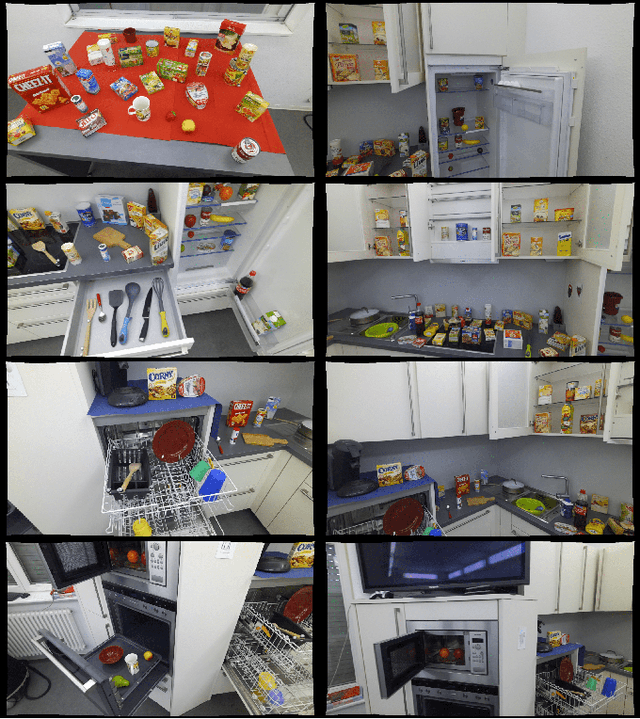
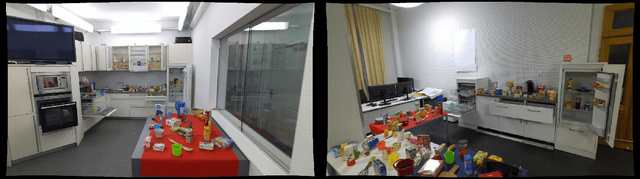


Despite the recent progress on 6D object pose estimation methods for robotic grasping, a substantial performance gap persists between the capabilities of these methods on existing datasets and their efficacy in real-world mobile manipulation tasks, particularly when robots rely solely on their monocular egocentric field of view (FOV). Existing real-world datasets primarily focus on table-top grasping scenarios, where a robotic arm is placed in a fixed position and the objects are centralized within the FOV of fixed external camera(s). Assessing performance on such datasets may not accurately reflect the challenges encountered in everyday mobile manipulation tasks within kitchen environments such as retrieving objects from higher shelves, sinks, dishwashers, ovens, refrigerators, or microwaves. To address this gap, we present Kitchen, a novel benchmark designed specifically for estimating the 6D poses of objects located in diverse positions within kitchen settings. For this purpose, we recorded a comprehensive dataset comprising around 205k real-world RGBD images for 111 kitchen objects captured in two distinct kitchens, utilizing one humanoid robot with its egocentric perspectives. Subsequently, we developed a semi-automated annotation pipeline, to streamline the labeling process of such datasets, resulting in the generation of 2D object labels, 2D object segmentation masks, and 6D object poses with minimized human effort. The benchmark, the dataset, and the annotation pipeline are available at https://kitchen-dataset.github.io/KITchen.
Visual Imitation Learning of Task-Oriented Object Grasping and Rearrangement
Mar 20, 2024Task-oriented object grasping and rearrangement are critical skills for robots to accomplish different real-world manipulation tasks. However, they remain challenging due to partial observations of the objects and shape variations in categorical objects. In this paper, we propose the Multi-feature Implicit Model (MIMO), a novel object representation that encodes multiple spatial features between a point and an object in an implicit neural field. Training such a model on multiple features ensures that it embeds the object shapes consistently in different aspects, thus improving its performance in object shape reconstruction from partial observation, shape similarity measure, and modeling spatial relations between objects. Based on MIMO, we propose a framework to learn task-oriented object grasping and rearrangement from single or multiple human demonstration videos. The evaluations in simulation show that our approach outperforms the state-of-the-art methods for multi- and single-view observations. Real-world experiments demonstrate the efficacy of our approach in one- and few-shot imitation learning of manipulation tasks.
Riemannian Flow Matching Policy for Robot Motion Learning
Mar 15, 2024We introduce Riemannian Flow Matching Policies (RFMP), a novel model for learning and synthesizing robot visuomotor policies. RFMP leverages the efficient training and inference capabilities of flow matching methods. By design, RFMP inherits the strengths of flow matching: the ability to encode high-dimensional multimodal distributions, commonly encountered in robotic tasks, and a very simple and fast inference process. We demonstrate the applicability of RFMP to both state-based and vision-conditioned robot motion policies. Notably, as the robot state resides on a Riemannian manifold, RFMP inherently incorporates geometric awareness, which is crucial for realistic robotic tasks. To evaluate RFMP, we conduct two proof-of-concept experiments, comparing its performance against Diffusion Policies. Although both approaches successfully learn the considered tasks, our results show that RFMP provides smoother action trajectories with significantly lower inference times.
Bi-KVIL: Keypoints-based Visual Imitation Learning of Bimanual Manipulation Tasks
Mar 05, 2024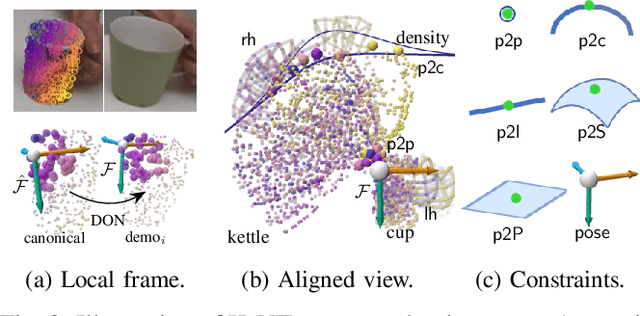

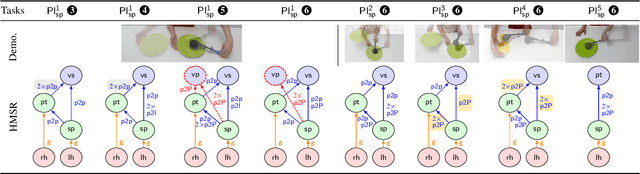
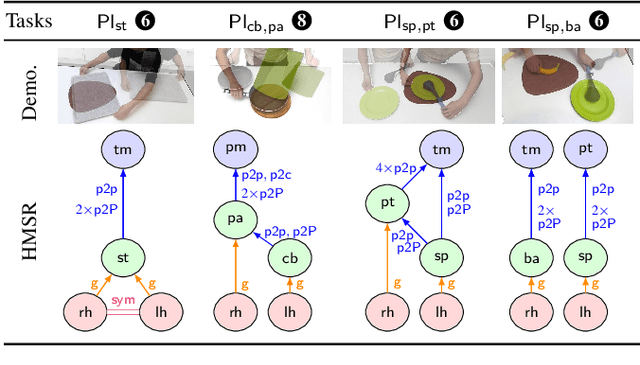
Visual imitation learning has achieved impressive progress in learning unimanual manipulation tasks from a small set of visual observations, thanks to the latest advances in computer vision. However, learning bimanual coordination strategies and complex object relations from bimanual visual demonstrations, as well as generalizing them to categorical objects in novel cluttered scenes remain unsolved challenges. In this paper, we extend our previous work on keypoints-based visual imitation learning (\mbox{K-VIL})~\cite{gao_kvil_2023} to bimanual manipulation tasks. The proposed Bi-KVIL jointly extracts so-called \emph{Hybrid Master-Slave Relationships} (HMSR) among objects and hands, bimanual coordination strategies, and sub-symbolic task representations. Our bimanual task representation is object-centric, embodiment-independent, and viewpoint-invariant, thus generalizing well to categorical objects in novel scenes. We evaluate our approach in various real-world applications, showcasing its ability to learn fine-grained bimanual manipulation tasks from a small number of human demonstration videos. Videos and source code are available at https://sites.google.com/view/bi-kvil.
AutoGPT+P: Affordance-based Task Planning with Large Language Models
Feb 16, 2024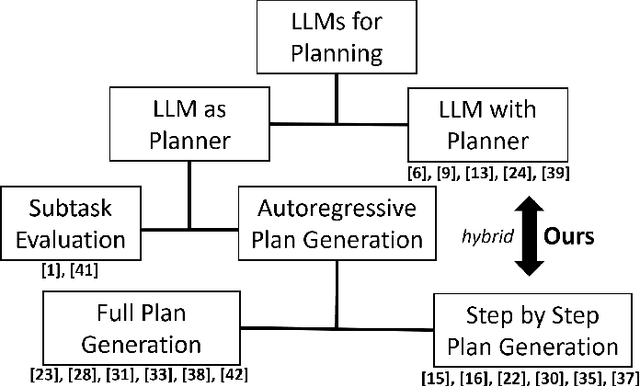

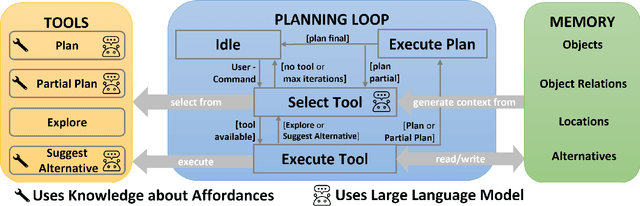
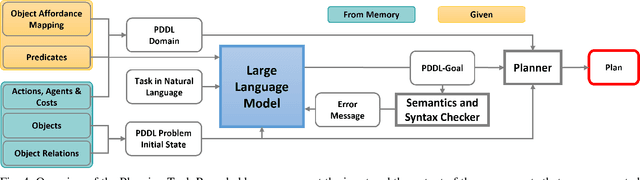
Recent advances in task planning leverage Large Language Models (LLMs) to improve generalizability by combining such models with classical planning algorithms to address their inherent limitations in reasoning capabilities. However, these approaches face the challenge of dynamically capturing the initial state of the task planning problem. To alleviate this issue, we propose AutoGPT+P, a system that combines an affordance-based scene representation with a planning system. Affordances encompass the action possibilities of an agent on the environment and objects present in it. Thus, deriving the planning domain from an affordance-based scene representation allows symbolic planning with arbitrary objects. AutoGPT+P leverages this representation to derive and execute a plan for a task specified by the user in natural language. In addition to solving planning tasks under a closed-world assumption, AutoGPT+P can also handle planning with incomplete information, e. g., tasks with missing objects by exploring the scene, suggesting alternatives, or providing a partial plan. The affordance-based scene representation combines object detection with an automatically generated object-affordance-mapping using ChatGPT. The core planning tool extends existing work by automatically correcting semantic and syntactic errors. Our approach achieves a success rate of 98%, surpassing the current 81% success rate of the current state-of-the-art LLM-based planning method SayCan on the SayCan instruction set. Furthermore, we evaluated our approach on our newly created dataset with 150 scenarios covering a wide range of complex tasks with missing objects, achieving a success rate of 79% on our dataset. The dataset and the code are publicly available at https://git.h2t.iar.kit.edu/birr/autogpt-p-standalone.
Memory-centered and Affordance-based Framework for Mobile Manipulation
Jan 30, 2024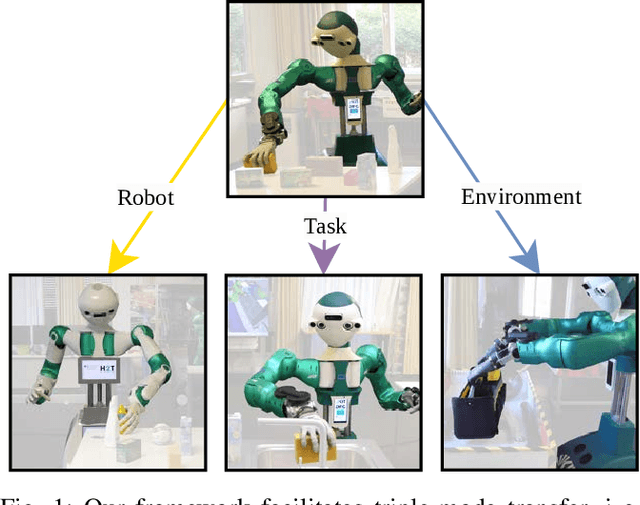
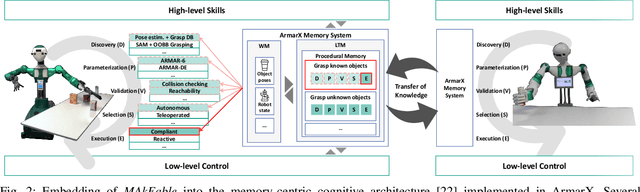
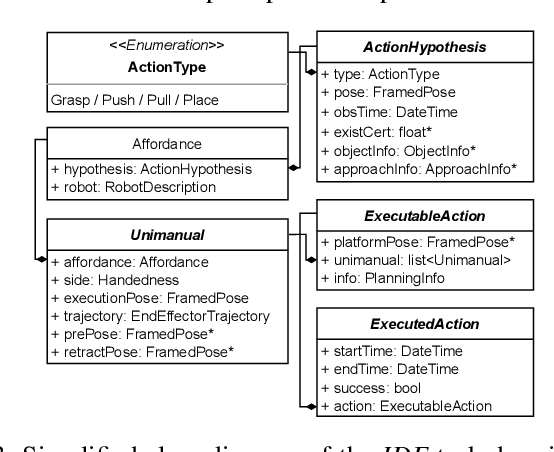
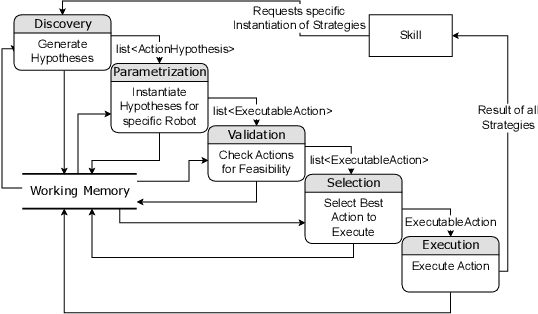
Performing versatile mobile manipulation actions in human-centered environments requires highly sophisticated software frameworks that are flexible enough to handle special use cases, yet general enough to be applicable across different robotic systems, tasks, and environments. This paper presents a comprehensive memory-centered, affordance-based, and modular uni- and multi-manual grasping and mobile manipulation framework, applicable to complex robot systems with a high number of degrees of freedom such as humanoid robots. By representing mobile manipulation actions through affordances, i.e., interaction possibilities of the robot with its environment, we unify the autonomous manipulation process for known and unknown objects in arbitrary environments. Our framework is integrated and embedded into the memory-centric cognitive architecture of the ARMAR humanoid robot family. This way, robots can not only interact with the physical world but also use common knowledge about objects, and learn and adapt manipulation strategies. We demonstrate the applicability of the framework in real-world experiments, including grasping known and unknown objects, object placing, and semi-autonomous bimanual grasping of objects on two different humanoid robot platforms.