 Add to Chrome
 Add to Firefox
 Add to Edge
Generalization from Low- to Moderate-Resolution Spectra with Neural Networks for Stellar Parameter Estimation: A Case Study with DESI
Feb 16, 2026
Cross-survey generalization is a critical challenge in stellar spectral analysis, particularly in cases such as transferring from low- to moderate-resolution surveys. We investigate this problem using pre-trained models, focusing on simple neural networks such as multilayer perceptrons (MLPs), with a case study transferring from LAMOST low-resolution spectra (LRS) to DESI medium-resolution spectra (MRS). Specifically, we pre-train MLPs on either LRS or their embeddings and fine-tune them for application to DESI stellar spectra. We compare MLPs trained directly on spectra with those trained on embeddings derived from transformer-based models (self-supervised foundation models pre-trained for multiple downstream tasks). We also evaluate different fine-tuning strategies, including residual-head adapters, LoRA, and full fine-tuning. We find that MLPs pre-trained on LAMOST LRS achieve strong performance, even without fine-tuning, and that modest fine-tuning with DESI spectra further improves the results. For iron abundance, embeddings from a transformer-based model yield advantages in the metal-rich ([Fe/H] > -1.0) regime, but underperform in the metal-poor regime compared to MLPs trained directly on LRS. We also show that the optimal fine-tuning strategy depends on the specific stellar parameter under consideration. These results highlight that simple pre-trained MLPs can provide competitive cross-survey generalization, while the role of spectral foundation models for cross-survey stellar parameter estimation requires further exploration.

AstroClearNet: Deep image prior for multi-frame astronomical image restoration
Apr 08, 2025Recovering high-fidelity images of the night sky from blurred observations is a fundamental problem in astronomy, where traditional methods typically fall short. In ground-based astronomy, combining multiple exposures to enhance signal-to-noise ratios is further complicated by variations in the point-spread function caused by atmospheric turbulence. In this work, we present a self-supervised multi-frame method, based on deep image priors, for denoising, deblurring, and coadding ground-based exposures. Central to our approach is a carefully designed convolutional neural network that integrates information across multiple observations and enforces physically motivated constraints. We demonstrate the method's potential by processing Hyper Suprime-Cam exposures, yielding promising preliminary results with sharper restored images.
Mapping the Similarities of Spectra: Global and Locally-biased Approaches to SDSS Galaxy Data
Sep 13, 2016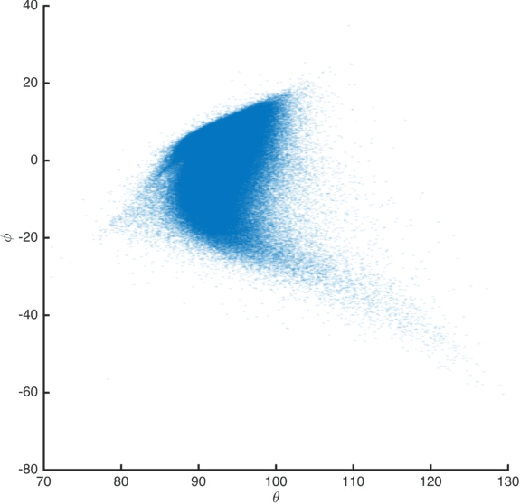
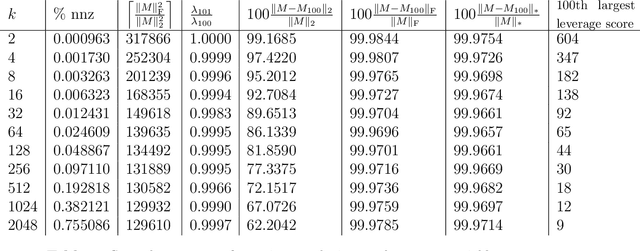
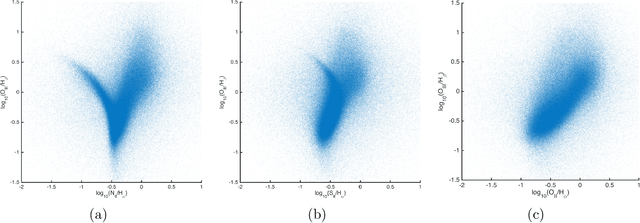
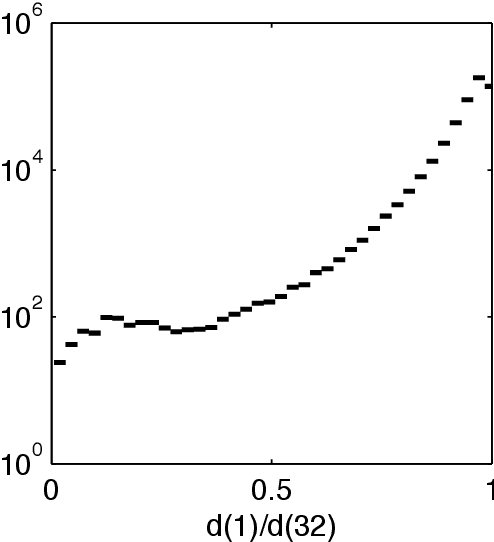
We apply a novel spectral graph technique, that of locally-biased semi-supervised eigenvectors, to study the diversity of galaxies. This technique permits us to characterize empirically the natural variations in observed spectra data, and we illustrate how this approach can be used in an exploratory manner to highlight both large-scale global as well as small-scale local structure in Sloan Digital Sky Survey (SDSS) data. We use this method in a way that simultaneously takes into account the measurements of spectral lines as well as the continuum shape. Unlike Principal Component Analysis, this method does not assume that the Euclidean distance between galaxy spectra is a good global measure of similarity between all spectra, but instead it only assumes that local difference information between similar spectra is reliable. Moreover, unlike other nonlinear dimensionality methods, this method can be used to characterize very finely both small-scale local as well as large-scale global properties of realistic noisy data. The power of the method is demonstrated on the SDSS Main Galaxy Sample by illustrating that the derived embeddings of spectra carry an unprecedented amount of information. By using a straightforward global or unsupervised variant, we observe that the main features correlate strongly with star formation rate and that they clearly separate active galactic nuclei. Computed parameters of the method can be used to describe line strengths and their interdependencies. By using a locally-biased or semi-supervised variant, we are able to focus on typical variations around specific objects of astronomical interest. We present several examples illustrating that this approach can enable new discoveries in the data as well as a detailed understanding of very fine local structure that would otherwise be overwhelmed by large-scale noise and global trends in the data.