 Add to Chrome
 Add to Firefox
 Add to Edge
Agents of Chaos
Feb 23, 2026
We report an exploratory red-teaming study of autonomous language-model-powered agents deployed in a live laboratory environment with persistent memory, email accounts, Discord access, file systems, and shell execution. Over a two-week period, twenty AI researchers interacted with the agents under benign and adversarial conditions. Focusing on failures emerging from the integration of language models with autonomy, tool use, and multi-party communication, we document eleven representative case studies. Observed behaviors include unauthorized compliance with non-owners, disclosure of sensitive information, execution of destructive system-level actions, denial-of-service conditions, uncontrolled resource consumption, identity spoofing vulnerabilities, cross-agent propagation of unsafe practices, and partial system takeover. In several cases, agents reported task completion while the underlying system state contradicted those reports. We also report on some of the failed attempts. Our findings establish the existence of security-, privacy-, and governance-relevant vulnerabilities in realistic deployment settings. These behaviors raise unresolved questions regarding accountability, delegated authority, and responsibility for downstream harms, and warrant urgent attention from legal scholars, policymakers, and researchers across disciplines. This report serves as an initial empirical contribution to that broader conversation.

In-Context Learning Without Copying
Nov 07, 2025Induction heads are attention heads that perform inductive copying by matching patterns from earlier context and copying their continuations verbatim. As models develop induction heads, they often experience a sharp drop in training loss, a phenomenon cited as evidence that induction heads may serve as a prerequisite for more complex in-context learning (ICL) capabilities. In this work, we ask whether transformers can still acquire ICL capabilities when inductive copying is suppressed. We propose Hapax, a setting where we omit the loss contribution of any token that can be correctly predicted by induction heads. Despite a significant reduction in inductive copying, performance on abstractive ICL tasks (i.e., tasks where the answer is not contained in the input context) remains comparable and surpasses the vanilla model on 13 of 21 tasks, even though 31.7\% of tokens are omitted from the loss. Furthermore, our model achieves lower loss values on token positions that cannot be predicted correctly by induction heads. Mechanistic analysis further shows that models trained with Hapax develop fewer and weaker induction heads but still preserve ICL capabilities. Taken together, our findings indicate that inductive copying is not essential for learning abstractive ICL mechanisms.
MIB: A Mechanistic Interpretability Benchmark
Apr 17, 2025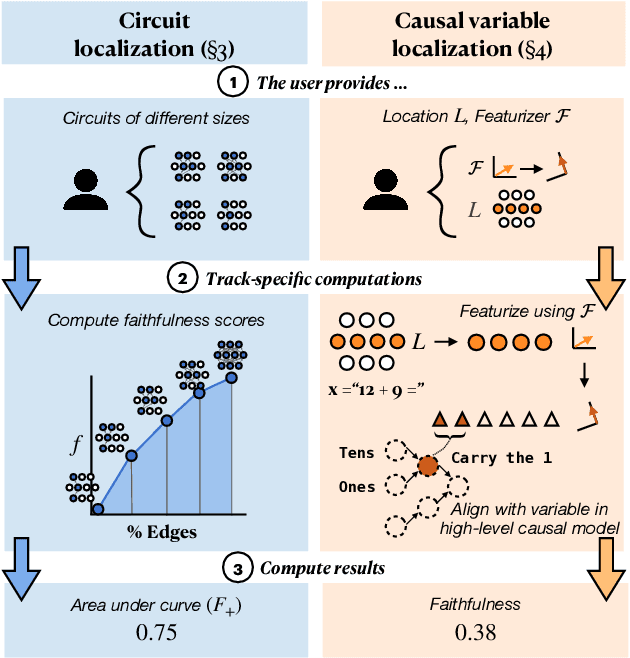
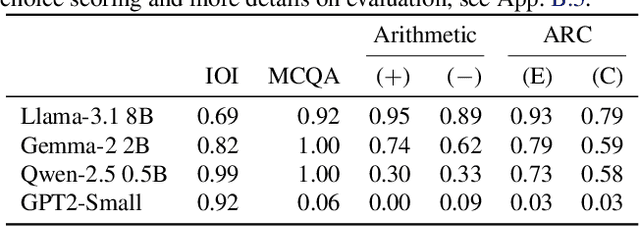
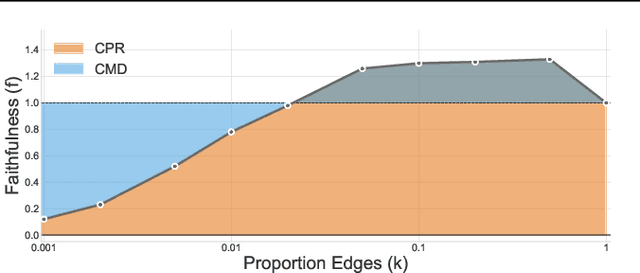
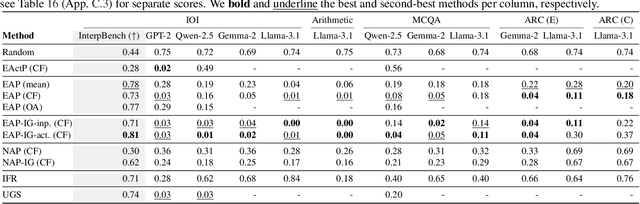
How can we know whether new mechanistic interpretability methods achieve real improvements? In pursuit of meaningful and lasting evaluation standards, we propose MIB, a benchmark with two tracks spanning four tasks and five models. MIB favors methods that precisely and concisely recover relevant causal pathways or specific causal variables in neural language models. The circuit localization track compares methods that locate the model components - and connections between them - most important for performing a task (e.g., attribution patching or information flow routes). The causal variable localization track compares methods that featurize a hidden vector, e.g., sparse autoencoders (SAEs) or distributed alignment search (DAS), and locate model features for a causal variable relevant to the task. Using MIB, we find that attribution and mask optimization methods perform best on circuit localization. For causal variable localization, we find that the supervised DAS method performs best, while SAE features are not better than neurons, i.e., standard dimensions of hidden vectors. These findings illustrate that MIB enables meaningful comparisons of methods, and increases our confidence that there has been real progress in the field.
NNsight and NDIF: Democratizing Access to Foundation Model Internals
Jul 18, 2024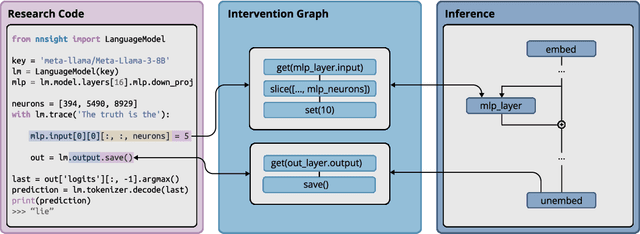



The enormous scale of state-of-the-art foundation models has limited their accessibility to scientists, because customized experiments at large model sizes require costly hardware and complex engineering that is impractical for most researchers. To alleviate these problems, we introduce NNsight, an open-source Python package with a simple, flexible API that can express interventions on any PyTorch model by building computation graphs. We also introduce NDIF, a collaborative research platform providing researchers access to foundation-scale LLMs via the NNsight API. Code, documentation, and tutorials are available at https://www.nnsight.net.