 Add to Chrome
 Add to Firefox
 Add to Edge
ForestMamba: Sparse Mamba with Geometry-guided Queries for 3D Forest Point Cloud Segmentation
Jun 01, 2026
AI-based semantic and instance segmentation of terrestrial and drone LiDAR point clouds is emerging as a transformative approach for converting the complex 3D structure of forests into actionable information for forest monitoring and biodiversity assessment. However, forest LiDAR scenes remain highly challenging due to their large data volumes, irregular sampling density, overlapping and complex canopy structure, and geographic variability. Existing methods based on sparse convolutions or Transformers achieve promising results, but suffer from two key limitations: Quadratic complexity of attention scales poorly to large forest scenes, and Generic context modeling does not exploit forest structural priors, limiting tree separation in complex regions. To address these challenges, we propose ForestMamba, a structure-aware method that incorporates forest-specific priors into feature encoding, query generation, and query refinement, while replacing quadratic attention with linear-time state-space modeling. First, we introduce a sparse encoder with vertical-priority slab serialization that organizes sparse voxels into vertically coherent sequences for efficient long-range context modeling. Second, we propose a geometry-guided query initialization strategy based on an on-the-fly multi-scale Canopy Height Model (CHM), where canopy maxima provide ecologically meaningful query seeds, supplemented by Farthest Point Sampling (FPS) to cover understory trees. Third, we design a Mamba-based query decoder that combines local kNN voxel aggregation with a spatial dual-path Mamba for query refinement with linear computational complexity. Extensive experiments across seven forest regions demonstrate that ForestMamba consistently outperforms existing baselines in both segmentation tasks, while achieving 3 times faster inference and 2.3 times lower GPU memory than Transformer-based methods.

Multi-proposal Collaboration and Multi-task Training for Weakly-supervised Video Moment Retrieval
May 14, 2026This study focuses on weakly-supervised Video Moment Retrieval (VMR), aiming to identify a moment semantically similar to the given query within an untrimmed video using only video-level correspondences, without relying on temporal annotations during training. Previous methods either aggregate predictions for all instances in the video, or indirectly address the task by proposing reconstructions for the query. However, these methods often produce low-quality temporal proposals, struggle with distinguishing misaligned moments in the same video, or lack stability due to a reliance on a single auxiliary task. To address these limitations, we present a novel weakly-supervised method called Multi-proposal Collaboration and Multi-task Training (MCMT). Initially, we generate multiple proposals and derive corresponding learnable Gaussian masks from them. These masks are then combined to create a high-quality positive sample mask, highlighting video clips most relevant to the query. Concurrently, we classify other clips in the same video as the easy negative sample and the entire video as the hard negative sample. During training, we introduce forward and inverse masked query reconstruction tasks to impose more substantial constraints on the network, promoting more robust and stable retrieval performance. Extensive experiments on two standard benchmarks affirm the effectiveness of the proposed method in VMR.
* 26 pages, 4 figures. Preprint version of the article published in International Journal of Machine Learning and Cybernetics
Facet-Level Persona Control by Trait-Activated Routing with Contrastive SAE for Role-Playing LLMs
Feb 22, 2026Personality control in Role-Playing Agents (RPAs) is commonly achieved via training-free methods that inject persona descriptions and memory through prompts or retrieval-augmented generation, or via supervised fine-tuning (SFT) on persona-specific corpora. While SFT can be effective, it requires persona-labeled data and retraining for new roles, limiting flexibility. In contrast, prompt- and RAG-based signals are easy to apply but can be diluted in long dialogues, leading to drifting and sometimes inconsistent persona behavior. To address this, we propose a contrastive Sparse AutoEncoder (SAE) framework that learns facet-level personality control vectors aligned with the Big Five 30-facet model. A new 15,000-sample leakage-controlled corpus is constructed to provide balanced supervision for each facet. The learned vectors are integrated into the model's residual space and dynamically selected by a trait-activated routing module, enabling precise and interpretable personality steering. Experiments on Large Language Models (LLMs) show that the proposed method maintains stable character fidelity and output quality across contextualized settings, outperforming Contrastive Activation Addition (CAA) and prompt-only baselines. The combined SAE+Prompt configuration achieves the best overall performance, confirming that contrastively trained latent vectors can enhance persona control while preserving dialogue coherence.
View-aware Cross-modal Distillation for Multi-view Action Recognition
Nov 17, 2025The widespread use of multi-sensor systems has increased research in multi-view action recognition. While existing approaches in multi-view setups with fully overlapping sensors benefit from consistent view coverage, partially overlapping settings where actions are visible in only a subset of views remain underexplored. This challenge becomes more severe in real-world scenarios, as many systems provide only limited input modalities and rely on sequence-level annotations instead of dense frame-level labels. In this study, we propose View-aware Cross-modal Knowledge Distillation (ViCoKD), a framework that distills knowledge from a fully supervised multi-modal teacher to a modality- and annotation-limited student. ViCoKD employs a cross-modal adapter with cross-modal attention, allowing the student to exploit multi-modal correlations while operating with incomplete modalities. Moreover, we propose a View-aware Consistency module to address view misalignment, where the same action may appear differently or only partially across viewpoints. It enforces prediction alignment when the action is co-visible across views, guided by human-detection masks and confidence-weighted Jensen-Shannon divergence between their predicted class distributions. Experiments on the real-world MultiSensor-Home dataset show that ViCoKD consistently outperforms competitive distillation methods across multiple backbones and environments, delivering significant gains and surpassing the teacher model under limited conditions.
MultiTSF: Transformer-based Sensor Fusion for Human-Centric Multi-view and Multi-modal Action Recognition
Apr 03, 2025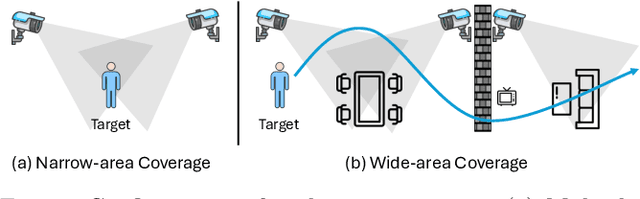
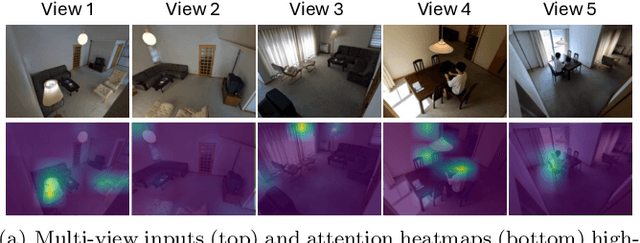
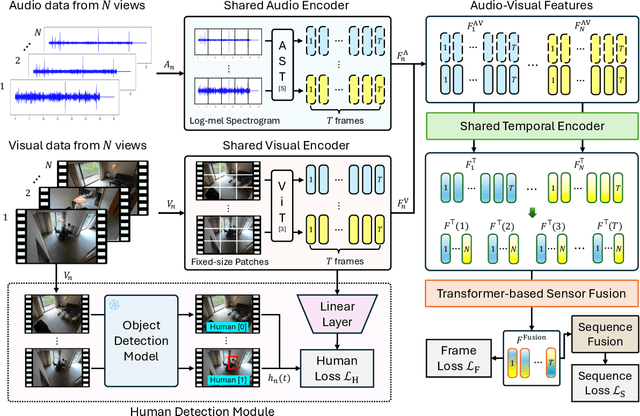
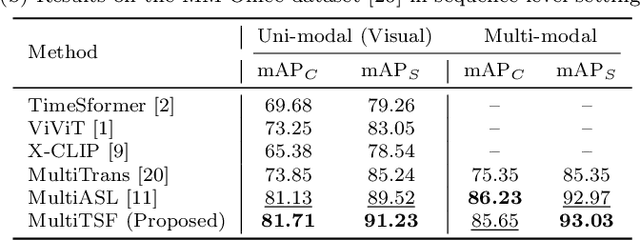
Action recognition from multi-modal and multi-view observations holds significant potential for applications in surveillance, robotics, and smart environments. However, existing methods often fall short of addressing real-world challenges such as diverse environmental conditions, strict sensor synchronization, and the need for fine-grained annotations. In this study, we propose the Multi-modal Multi-view Transformer-based Sensor Fusion (MultiTSF). The proposed method leverages a Transformer-based to dynamically model inter-view relationships and capture temporal dependencies across multiple views. Additionally, we introduce a Human Detection Module to generate pseudo-ground-truth labels, enabling the model to prioritize frames containing human activity and enhance spatial feature learning. Comprehensive experiments conducted on our in-house MultiSensor-Home dataset and the existing MM-Office dataset demonstrate that MultiTSF outperforms state-of-the-art methods in both video sequence-level and frame-level action recognition settings.
MultiSensor-Home: A Wide-area Multi-modal Multi-view Dataset for Action Recognition and Transformer-based Sensor Fusion
Apr 03, 2025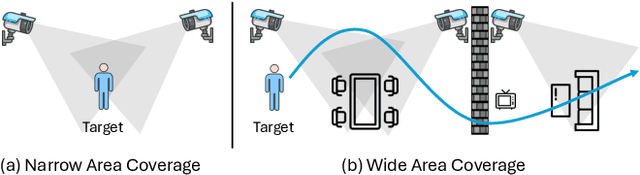
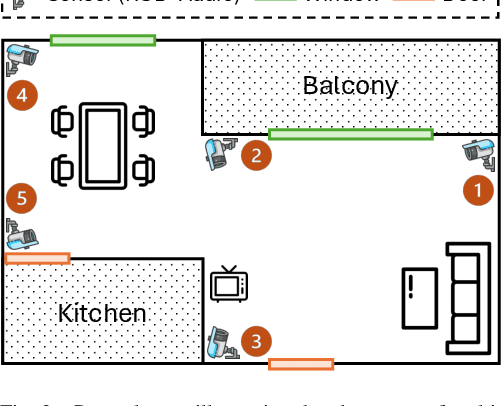
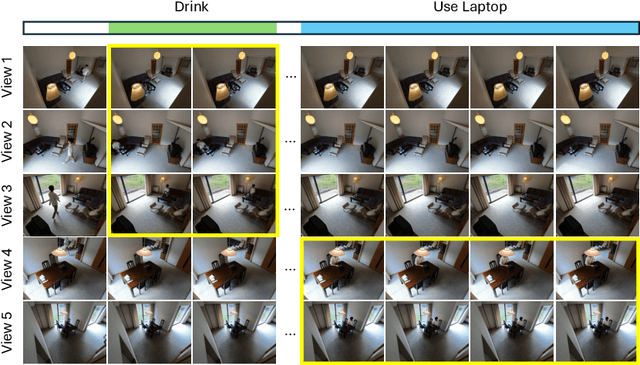
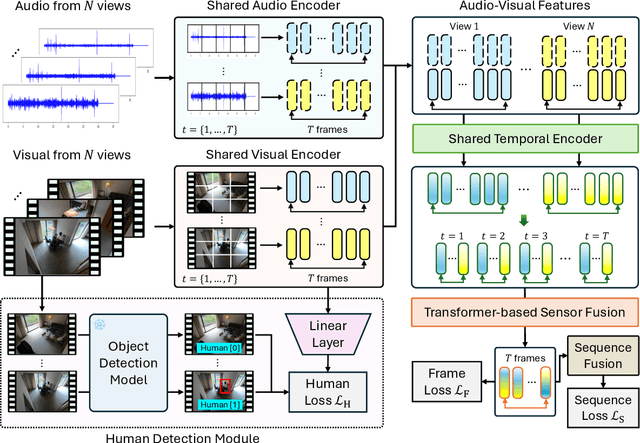
Multi-modal multi-view action recognition is a rapidly growing field in computer vision, offering significant potential for applications in surveillance. However, current datasets often fail to address real-world challenges such as wide-area environmental conditions, asynchronous data streams, and the lack of frame-level annotations. Furthermore, existing methods face difficulties in effectively modeling inter-view relationships and enhancing spatial feature learning. In this study, we propose the Multi-modal Multi-view Transformer-based Sensor Fusion (MultiTSF) method and introduce the MultiSensor-Home dataset, a novel benchmark designed for comprehensive action recognition in home environments. The MultiSensor-Home dataset features untrimmed videos captured by distributed sensors, providing high-resolution RGB and audio data along with detailed multi-view frame-level action labels. The proposed MultiTSF method leverages a Transformer-based fusion mechanism to dynamically model inter-view relationships. Furthermore, the method also integrates a external human detection module to enhance spatial feature learning. Experiments on MultiSensor-Home and MM-Office datasets demonstrate the superiority of MultiTSF over the state-of-the-art methods. The quantitative and qualitative results highlight the effectiveness of the proposed method in advancing real-world multi-modal multi-view action recognition.
Action Selection Learning for Multi-label Multi-view Action Recognition
Oct 04, 2024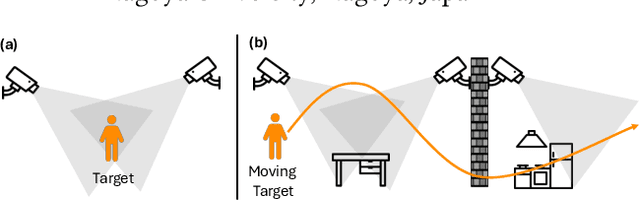
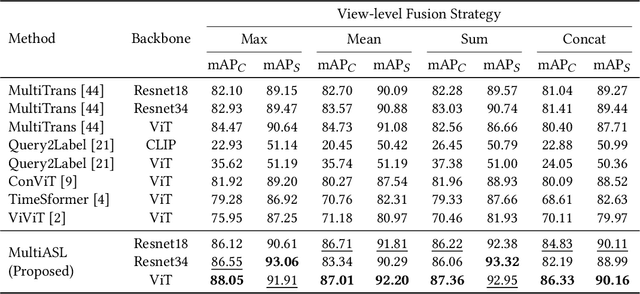
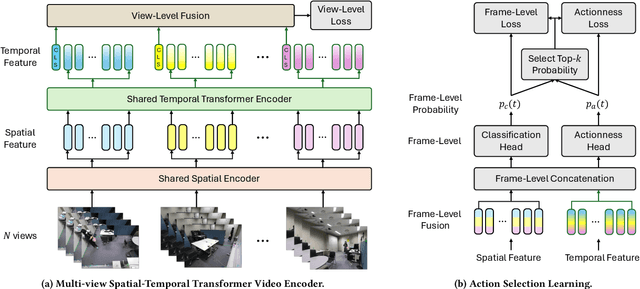

Multi-label multi-view action recognition aims to recognize multiple concurrent or sequential actions from untrimmed videos captured by multiple cameras. Existing work has focused on multi-view action recognition in a narrow area with strong labels available, where the onset and offset of each action are labeled at the frame-level. This study focuses on real-world scenarios where cameras are distributed to capture a wide-range area with only weak labels available at the video-level. We propose the method named MultiASL (Multi-view Action Selection Learning), which leverages action selection learning to enhance view fusion by selecting the most useful information from different viewpoints. The proposed method includes a Multi-view Spatial-Temporal Transformer video encoder to extract spatial and temporal features from multi-viewpoint videos. Action Selection Learning is employed at the frame-level, using pseudo ground-truth obtained from weak labels at the video-level, to identify the most relevant frames for action recognition. Experiments in a real-world office environment using the MM-Office dataset demonstrate the superior performance of the proposed method compared to existing methods.
Tracking Small Birds by Detection Candidate Region Filtering and Detection History-aware Association
May 27, 2024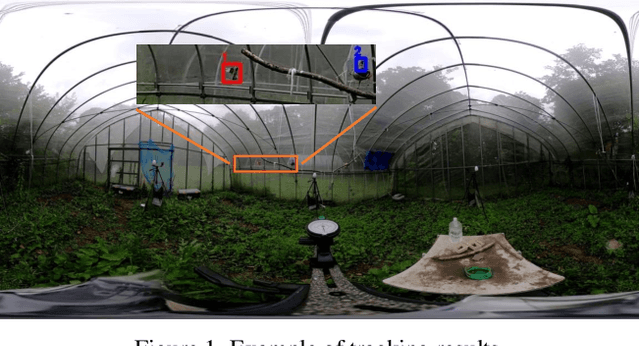
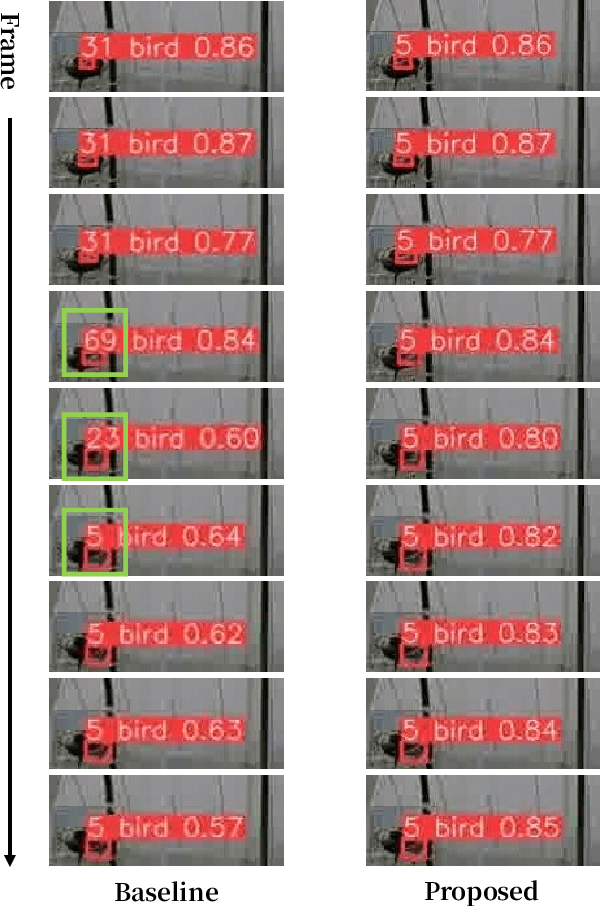
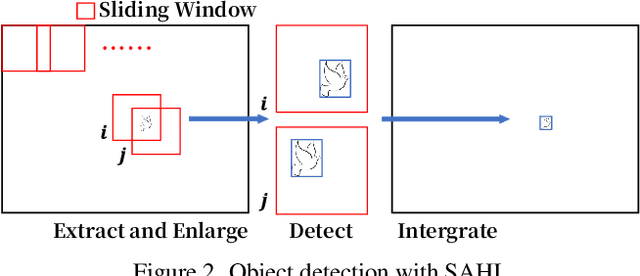
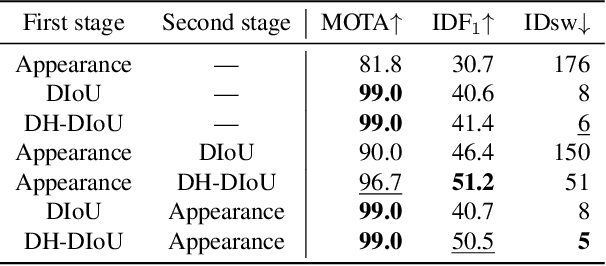
This paper focuses on tracking birds that appear small in a panoramic video. When the size of the tracked object is small in the image (small object tracking) and move quickly, object detection and association suffers. To address these problems, we propose Adaptive Slicing Aided Hyper Inference (Adaptive SAHI), which reduces the candidate regions to apply detection, and Detection History-aware Similarity Criterion (DHSC), which accurately associates objects in consecutive frames based on the detection history. Experiments on the NUBird2022 dataset verifies the effectiveness of the proposed method by showing improvements in both accuracy and speed.
One-Stage Open-Vocabulary Temporal Action Detection Leveraging Temporal Multi-scale and Action Label Features
Apr 30, 2024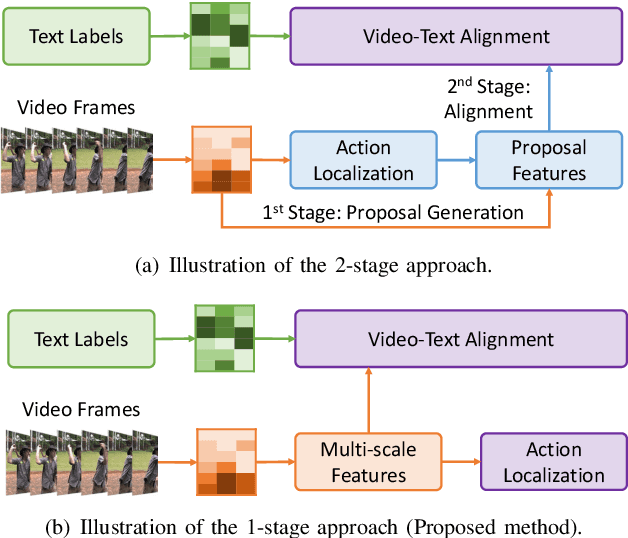
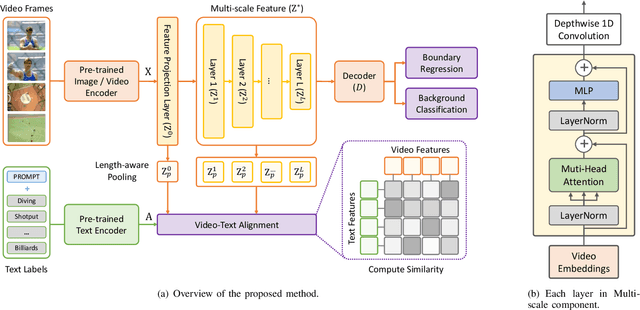
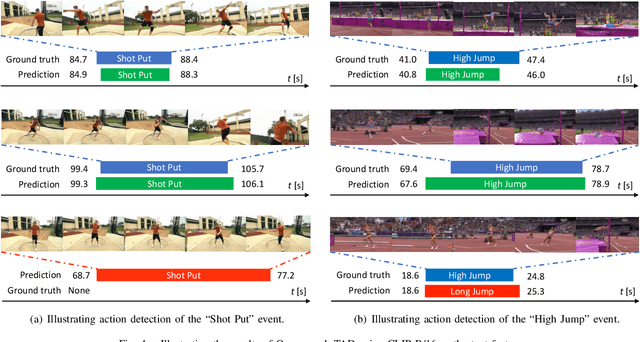
Open-vocabulary Temporal Action Detection (Open-vocab TAD) is an advanced video analysis approach that expands Closed-vocabulary Temporal Action Detection (Closed-vocab TAD) capabilities. Closed-vocab TAD is typically confined to localizing and classifying actions based on a predefined set of categories. In contrast, Open-vocab TAD goes further and is not limited to these predefined categories. This is particularly useful in real-world scenarios where the variety of actions in videos can be vast and not always predictable. The prevalent methods in Open-vocab TAD typically employ a 2-stage approach, which involves generating action proposals and then identifying those actions. However, errors made during the first stage can adversely affect the subsequent action identification accuracy. Additionally, existing studies face challenges in handling actions of different durations owing to the use of fixed temporal processing methods. Therefore, we propose a 1-stage approach consisting of two primary modules: Multi-scale Video Analysis (MVA) and Video-Text Alignment (VTA). The MVA module captures actions at varying temporal resolutions, overcoming the challenge of detecting actions with diverse durations. The VTA module leverages the synergy between visual and textual modalities to precisely align video segments with corresponding action labels, a critical step for accurate action identification in Open-vocab scenarios. Evaluations on widely recognized datasets THUMOS14 and ActivityNet-1.3, showed that the proposed method achieved superior results compared to the other methods in both Open-vocab and Closed-vocab settings. This serves as a strong demonstration of the effectiveness of the proposed method in the TAD task.
MVA2023 Small Object Detection Challenge for Spotting Birds: Dataset, Methods, and Results
Jul 18, 2023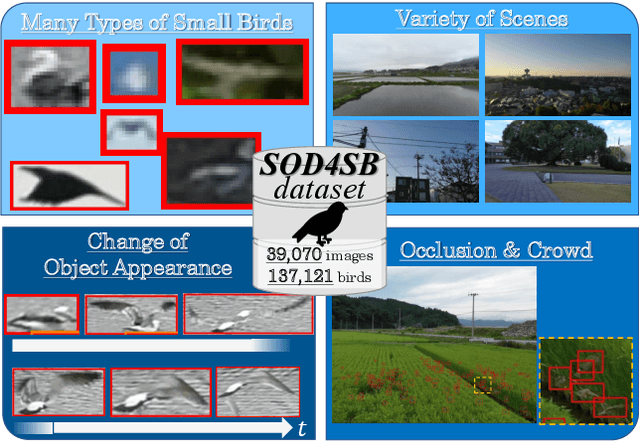
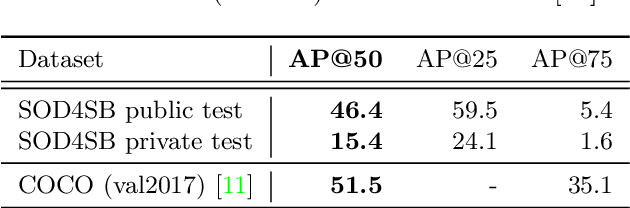
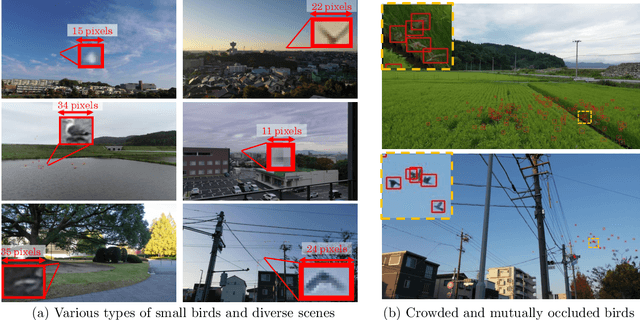
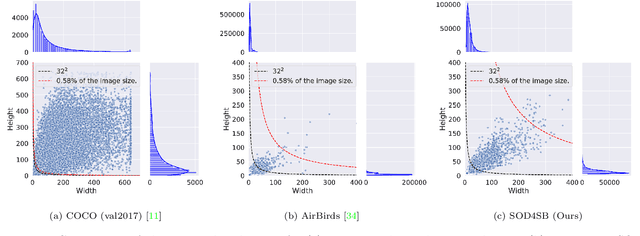
Small Object Detection (SOD) is an important machine vision topic because (i) a variety of real-world applications require object detection for distant objects and (ii) SOD is a challenging task due to the noisy, blurred, and less-informative image appearances of small objects. This paper proposes a new SOD dataset consisting of 39,070 images including 137,121 bird instances, which is called the Small Object Detection for Spotting Birds (SOD4SB) dataset. The detail of the challenge with the SOD4SB dataset is introduced in this paper. In total, 223 participants joined this challenge. This paper briefly introduces the award-winning methods. The dataset, the baseline code, and the website for evaluation on the public testset are publicly available.