 Add to Chrome
 Add to Firefox
 Add to Edge
Zero-Shot Mission-Level Evaluation for Aerial MLLM Agents
Jul 24, 2026
Multimodal Large Language Models (MLLMs) are emerging as core reasoning modules for embodied agents, yet it remains unclear how well general-purpose models can solve long-horizon embodied tasks from a single high-level instruction. We introduce MissionBench, a benchmark for mission-level evaluation of MLLMs in aerial 3D environments. It comprises 120 missions across five simulated 3D environments and four task families. Agents must autonomously plan, navigate, and report outcomes using only egocentric observations and its action history, without aerial-specific fine-tuning. Across 22 open- and closed-source MLLMs, the strongest model succeeds on fewer than 35% of missions compared to 84.4% human performance, highlighting the difficulty of multi-step embodied tasks. Despite large variations between model families, we observe gains from scaling, indicating that larger general-purpose models possess stronger zero-shot embodied capabilities. Our analysis shows that mission-level competence requires coordinating multiple capabilities beyond spatial perception, including multi-step planning and adaptive reasoning. This motivates closed-loop evaluation and highlights both the promise and risk of scaling-driven improvements for embodied AI.

FlexPath: Learned Semantic Path Priors for Image-Based Planning
Jun 08, 2026Recent learning-based path planners use neural networks to process visual map representations and approximate heuristics for classical search algorithms, yielding near-optimal paths with reduced search effort. However, these methods are tied to the shortest-path objective implicit in their supervision, which limits their flexibility to accommodate alternative criteria. We introduce FlexPath, a two-stage framework that decouples feasibility from preference. In Stage 1, we use imitation learning to acquire a task-independent spatial prior over feasible paths from visual map inputs. In Stage 2, differentiable Path Shape Objectives (PSOs) adapt this prior toward task-specific criteria without relearning path structure, requiring only efficient objective-level adaptation. A single pretrained model can be adapted to multiple objectives. For shortest-path planning, FlexPath reduces search effort on TMP by 14.3% compared to the state-of-the-art TransPath, while also finding lower-cost paths on average and demonstrating strong zero-shot generalization across three unseen domains. For obstacle clearance with minimum clearance distance 2, it achieves 96.8% full obstacle avoidance while maintaining low search cost. The framework further extends to semantic-aware avoidance and waypoint guidance via objective-level adaptation, and remains compatible with classical planners at inference time. Data and code are available at https://github.com/FraunhoferIVI/FlexPath.
High Temporal Consistency through Semantic Similarity Propagation in Semi-Supervised Video Semantic Segmentation for Autonomous Flight
Mar 19, 2025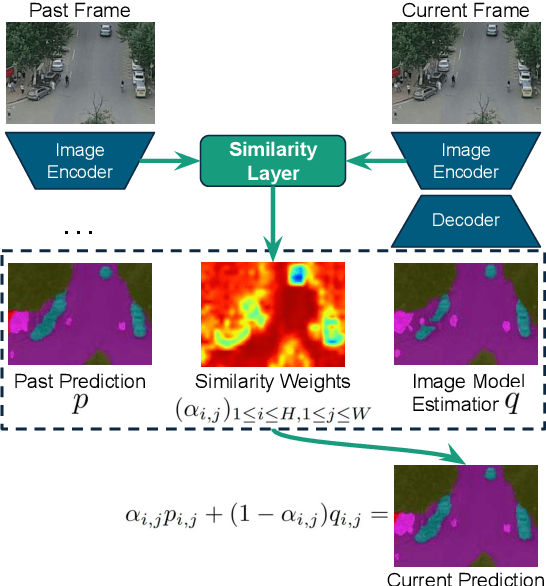
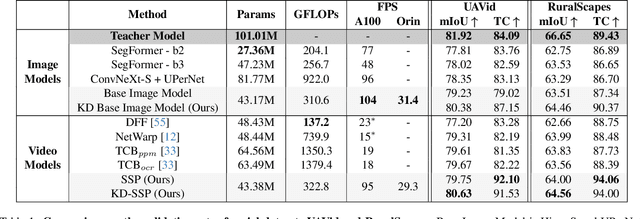
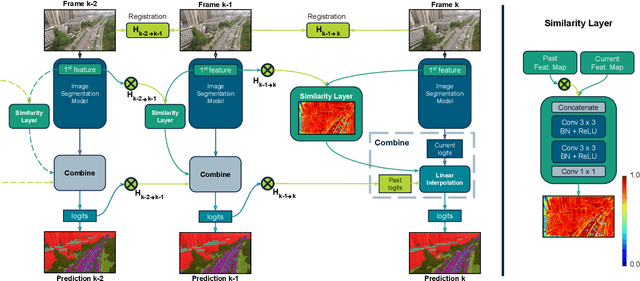
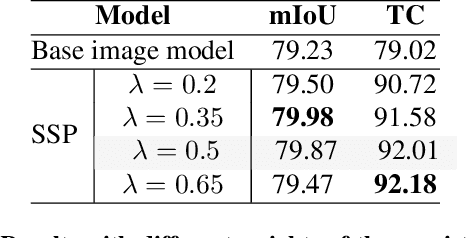
Semantic segmentation from RGB cameras is essential to the perception of autonomous flying vehicles. The stability of predictions through the captured videos is paramount to their reliability and, by extension, to the trustworthiness of the agents. In this paper, we propose a lightweight video semantic segmentation approach-suited to onboard real-time inference-achieving high temporal consistency on aerial data through Semantic Similarity Propagation across frames. SSP temporally propagates the predictions of an efficient image segmentation model with global registration alignment to compensate for camera movements. It combines the current estimation and the prior prediction with linear interpolation using weights computed from the features similarities of the two frames. Because data availability is a challenge in this domain, we propose a consistency-aware Knowledge Distillation training procedure for sparsely labeled datasets with few annotations. Using a large image segmentation model as a teacher to train the efficient SSP, we leverage the strong correlations between labeled and unlabeled frames in the same training videos to obtain high-quality supervision on all frames. KD-SSP obtains a significant temporal consistency increase over the base image segmentation model of 12.5% and 6.7% TC on UAVid and RuralScapes respectively, with higher accuracy and comparable inference speed. On these aerial datasets, KD-SSP provides a superior segmentation quality and inference speed trade-off than other video methods proposed for general applications and shows considerably higher consistency. The code will be made publicly available upon acceptance.
Pseudo-Label Transfer from Frame-Level to Note-Level in a Teacher-Student Framework for Singing Transcription from Polyphonic Music
Mar 30, 2022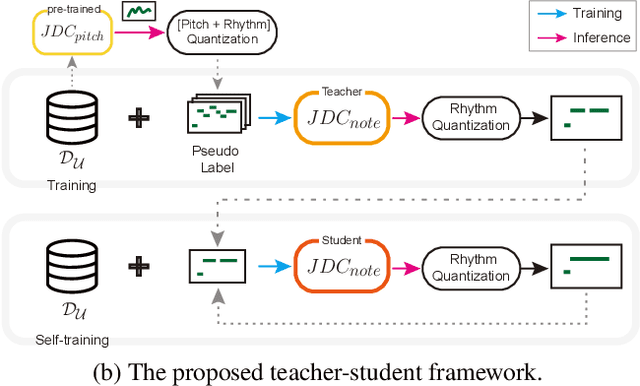
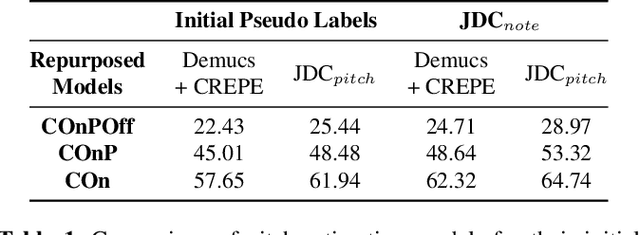
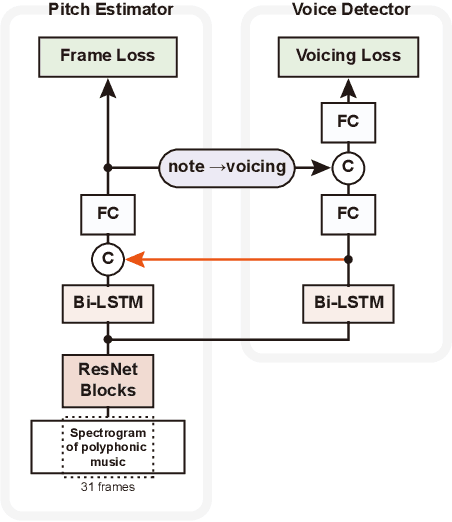
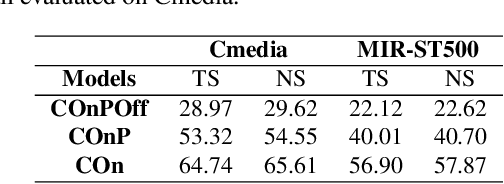
Lack of large-scale note-level labeled data is the major obstacle to singing transcription from polyphonic music. We address the issue by using pseudo labels from vocal pitch estimation models given unlabeled data. The proposed method first converts the frame-level pseudo labels to note-level through pitch and rhythm quantization steps. Then, it further improves the label quality through self-training in a teacher-student framework. To validate the method, we conduct various experiment settings by investigating two vocal pitch estimation models as pseudo-label generators, two setups of teacher-student frameworks, and the number of iterations in self-training. The results show that the proposed method can effectively leverage large-scale unlabeled audio data and self-training with the noisy student model helps to improve performance. Finally, we show that the model trained with only unlabeled data has comparable performance to previous works and the model trained with additional labeled data achieves higher accuracy than the model trained with only labeled data.