 Add to Chrome
 Add to Firefox
 Add to Edge
Beyond Single Object: Learning 3D Relations with Large Language Models
Aug 16, 2026
We address a fundamental gap in 3D-LLMs: existing models focus on single-object/scene description, struggling with detailed, inter-object comparison. We propose a framework for detailed object-level reasoning across multiple objects with three components: (1) MO3D (Multi-Object in 3D), an instruction dataset requiring fine-grained multi-object comparison; (2) Multi-3DLLM, using a minimal Patch-Interaction Transformer (PIT) that models inter-/intra-object relationships while preserving local geometry; (3) Mini-apps, two application-driven benchmarks (Shape Mating, Change Captioning) that probe geometric understanding for practical use. Recent 3D-LLMs and 2D-VLMs perform poorly on these tasks, lacking both comparison-centric design and geometric awareness. In contrast, Multi-3DLLM trained on our mixture data learns geometric reasoning, surpasses all baselines on MO3D, and provides positive transfer to single-object classification.

Seeing Red, Thinking Bad: Color Bias in Vision Language Models
Aug 14, 2026Vision language models (VLMs) are increasingly used in industrial decision-making systems, such as recruitment support and recommendation. This motivates careful analysis of how VLMs process visual and textual information. In this work, we study how VLMs interpret text rendered as an image, and investigate the influence of visual styling biases. To this end, we introduce Stealth Visual Prompts, which subtly change visual styling of text, such as color and contrast, while preserving semantic content. Using these prompts, we systematically control the visual styling of words in text and measure their impact on the analysis performed by VLMs. We further analyze how such visual perturbations affect the latent representations of the vision encoder. From our experiments, we observed that coloring positive words in green consistently shifts sentiment predictions toward a positive direction. As a result, VLMs often fail to properly account for negative words present in the text. Our analysis suggests that this behavior is correlated with changes in the latent representations of the vision encoder induced by color variations. In addition, we show that reducing text--background contrast increases reliance on visually salient cues and leads to more incorrect Visual Question Answering (VQA) outputs. These results suggest that the visual styling of rendered text can guide VLMs' interpretation in ways that diverge from human semantic understanding. Project page: https://github.com/KohsukeIde/color-bias-vlm
* 15 pages. Accepted to ICPR 2026
Zero-Shot Mission-Level Evaluation for Aerial MLLM Agents
Jul 24, 2026Multimodal Large Language Models (MLLMs) are emerging as core reasoning modules for embodied agents, yet it remains unclear how well general-purpose models can solve long-horizon embodied tasks from a single high-level instruction. We introduce MissionBench, a benchmark for mission-level evaluation of MLLMs in aerial 3D environments. It comprises 120 missions across five simulated 3D environments and four task families. Agents must autonomously plan, navigate, and report outcomes using only egocentric observations and its action history, without aerial-specific fine-tuning. Across 22 open- and closed-source MLLMs, the strongest model succeeds on fewer than 35% of missions compared to 84.4% human performance, highlighting the difficulty of multi-step embodied tasks. Despite large variations between model families, we observe gains from scaling, indicating that larger general-purpose models possess stronger zero-shot embodied capabilities. Our analysis shows that mission-level competence requires coordinating multiple capabilities beyond spatial perception, including multi-step planning and adaptive reasoning. This motivates closed-loop evaluation and highlights both the promise and risk of scaling-driven improvements for embodied AI.
3D sans 3D Scans: Scalable Pre-training from Video-Generated Point Clouds
Dec 28, 2025Despite recent progress in 3D self-supervised learning, collecting large-scale 3D scene scans remains expensive and labor-intensive. In this work, we investigate whether 3D representations can be learned from unlabeled videos recorded without any real 3D sensors. We present Laplacian-Aware Multi-level 3D Clustering with Sinkhorn-Knopp (LAM3C), a self-supervised framework that learns from video-generated point clouds from unlabeled videos. We first introduce RoomTours, a video-generated point cloud dataset constructed by collecting room-walkthrough videos from the web (e.g., real-estate tours) and generating 49,219 scenes using an off-the-shelf feed-forward reconstruction model. We also propose a noise-regularized loss that stabilizes representation learning by enforcing local geometric smoothness and ensuring feature stability under noisy point clouds. Remarkably, without using any real 3D scans, LAM3C achieves higher performance than the previous self-supervised methods on indoor semantic and instance segmentation. These results suggest that unlabeled videos represent an abundant source of data for 3D self-supervised learning.
Industrial Synthetic Segment Pre-training
May 20, 2025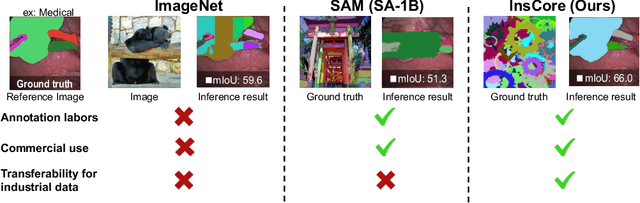
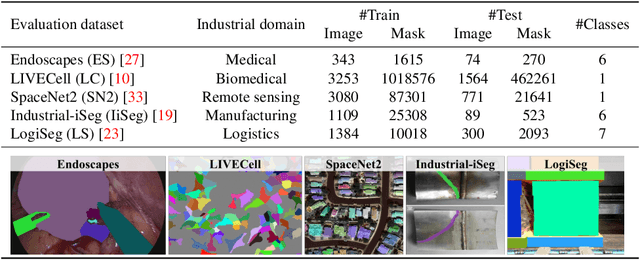
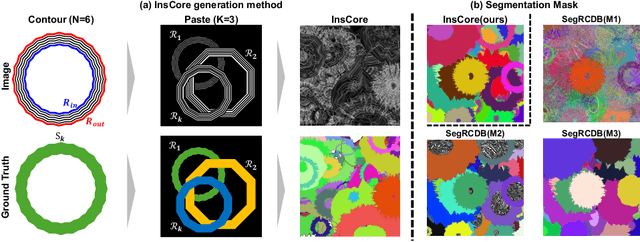

Pre-training on real-image datasets has been widely proven effective for improving instance segmentation. However, industrial applications face two key challenges: (1) legal and ethical restrictions, such as ImageNet's prohibition of commercial use, and (2) limited transferability due to the domain gap between web images and industrial imagery. Even recent vision foundation models, including the segment anything model (SAM), show notable performance degradation in industrial settings. These challenges raise critical questions: Can we build a vision foundation model for industrial applications without relying on real images or manual annotations? And can such models outperform even fine-tuned SAM on industrial datasets? To address these questions, we propose the Instance Core Segmentation Dataset (InsCore), a synthetic pre-training dataset based on formula-driven supervised learning (FDSL). InsCore generates fully annotated instance segmentation images that reflect key characteristics of industrial data, including complex occlusions, dense hierarchical masks, and diverse non-rigid shapes, distinct from typical web imagery. Unlike previous methods, InsCore requires neither real images nor human annotations. Experiments on five industrial datasets show that models pre-trained with InsCore outperform those trained on COCO and ImageNet-21k, as well as fine-tuned SAM, achieving an average improvement of 6.2 points in instance segmentation performance. This result is achieved using only 100k synthetic images, more than 100 times fewer than the 11 million images in SAM's SA-1B dataset, demonstrating the data efficiency of our approach. These findings position InsCore as a practical and license-free vision foundation model for industrial applications.