 Add to Chrome
 Add to Firefox
 Add to Edge
FlexPath: Learned Semantic Path Priors for Image-Based Planning
Jun 08, 2026
Recent learning-based path planners use neural networks to process visual map representations and approximate heuristics for classical search algorithms, yielding near-optimal paths with reduced search effort. However, these methods are tied to the shortest-path objective implicit in their supervision, which limits their flexibility to accommodate alternative criteria. We introduce FlexPath, a two-stage framework that decouples feasibility from preference. In Stage 1, we use imitation learning to acquire a task-independent spatial prior over feasible paths from visual map inputs. In Stage 2, differentiable Path Shape Objectives (PSOs) adapt this prior toward task-specific criteria without relearning path structure, requiring only efficient objective-level adaptation. A single pretrained model can be adapted to multiple objectives. For shortest-path planning, FlexPath reduces search effort on TMP by 14.3% compared to the state-of-the-art TransPath, while also finding lower-cost paths on average and demonstrating strong zero-shot generalization across three unseen domains. For obstacle clearance with minimum clearance distance 2, it achieves 96.8% full obstacle avoidance while maintaining low search cost. The framework further extends to semantic-aware avoidance and waypoint guidance via objective-level adaptation, and remains compatible with classical planners at inference time. Data and code are available at https://github.com/FraunhoferIVI/FlexPath.

Hierarchical Lead Critic based Multi-Agent Reinforcement Learning
Feb 25, 2026Cooperative Multi-Agent Reinforcement Learning (MARL) solves complex tasks that require coordination from multiple agents, but is often limited to either local (independent learning) or global (centralized learning) perspectives. In this paper, we introduce a novel sequential training scheme and MARL architecture, which learns from multiple perspectives on different hierarchy levels. We propose the Hierarchical Lead Critic (HLC) - inspired by natural emerging distributions in team structures, where following high-level objectives combines with low-level execution. HLC demonstrates that introducing multiple hierarchies, leveraging local and global perspectives, can lead to improved performance with high sample efficiency and robust policies. Experimental results conducted on cooperative, non-communicative, and partially observable MARL benchmarks demonstrate that HLC outperforms single hierarchy baselines and scales robustly with increasing amounts of agents and difficulty.
Revisiting Safe Exploration in Safe Reinforcement learning
Sep 02, 2024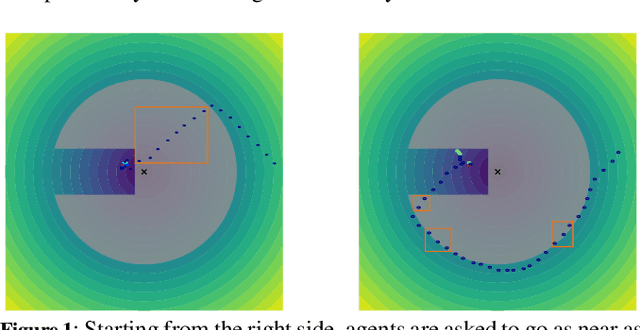
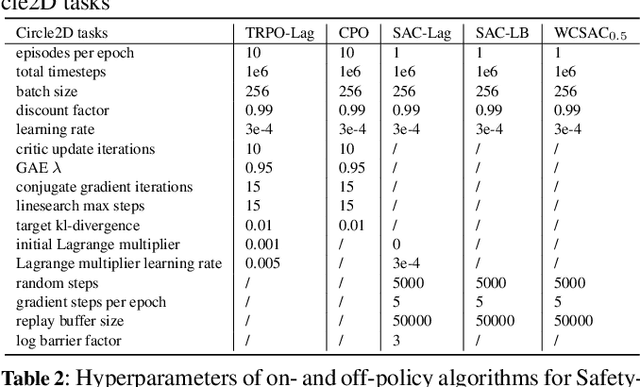
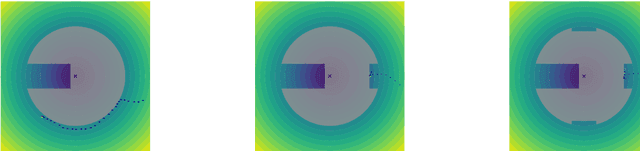
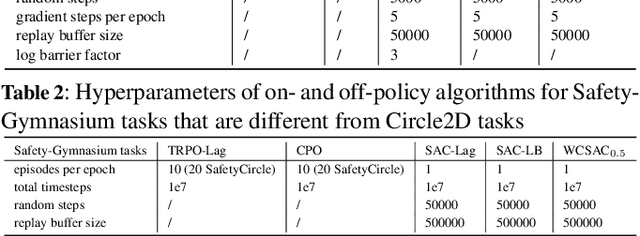
Safe reinforcement learning (SafeRL) extends standard reinforcement learning with the idea of safety, where safety is typically defined through the constraint of the expected cost return of a trajectory being below a set limit. However, this metric fails to distinguish how costs accrue, treating infrequent severe cost events as equal to frequent mild ones, which can lead to riskier behaviors and result in unsafe exploration. We introduce a new metric, expected maximum consecutive cost steps (EMCC), which addresses safety during training by assessing the severity of unsafe steps based on their consecutive occurrence. This metric is particularly effective for distinguishing between prolonged and occasional safety violations. We apply EMMC in both on- and off-policy algorithm for benchmarking their safe exploration capability. Finally, we validate our metric through a set of benchmarks and propose a new lightweight benchmark task, which allows fast evaluation for algorithm design.