 Add to Chrome
 Add to Firefox
 Add to Edge
FlexPath: Learned Semantic Path Priors for Image-Based Planning
Jun 08, 2026
Recent learning-based path planners use neural networks to process visual map representations and approximate heuristics for classical search algorithms, yielding near-optimal paths with reduced search effort. However, these methods are tied to the shortest-path objective implicit in their supervision, which limits their flexibility to accommodate alternative criteria. We introduce FlexPath, a two-stage framework that decouples feasibility from preference. In Stage 1, we use imitation learning to acquire a task-independent spatial prior over feasible paths from visual map inputs. In Stage 2, differentiable Path Shape Objectives (PSOs) adapt this prior toward task-specific criteria without relearning path structure, requiring only efficient objective-level adaptation. A single pretrained model can be adapted to multiple objectives. For shortest-path planning, FlexPath reduces search effort on TMP by 14.3% compared to the state-of-the-art TransPath, while also finding lower-cost paths on average and demonstrating strong zero-shot generalization across three unseen domains. For obstacle clearance with minimum clearance distance 2, it achieves 96.8% full obstacle avoidance while maintaining low search cost. The framework further extends to semantic-aware avoidance and waypoint guidance via objective-level adaptation, and remains compatible with classical planners at inference time. Data and code are available at https://github.com/FraunhoferIVI/FlexPath.

SOCC-ICP: Semantics-Assisted Odometry based on Occupancy Grids and ICP
May 14, 2026Reliable pose estimation in previously unseen environments is a fundamental capability of autonomous systems. Existing LiDAR odometry methods typically employ point-, surfel-, or NDT-based map representations, which are distinct from the semantic occupancy grids commonly used for downstream tasks such as motion planning. We introduce SOCC-ICP, a semantics-assisted odometry framework that jointly performs Semantic OCCupancy grid mapping and LiDAR scan alignment. Each map voxel encodes geometric and semantic statistics, enabling adaptive point-to-point or point-to-plane ICP based on local planarity. Further, the occupancy grid naturally filters dynamic objects through raycasting-based free-space updates. Across diverse evaluation scenarios, SOCC-ICP achieves performance competitive with state-of-the-art LiDAR odometry and remains robust in geometrically degenerate environments, even in the absence of semantic cues. When semantic labels are available, integrating them into map construction, downsampling, and correspondence weighting yields further accuracy gains. By unifying odometry and semantic occupancy grid mapping within a single representation, SOCC-ICP eliminates redundant map structures and directly provides a map suitable for downstream robotic applications.
SafeLand: Safe Autonomous Landing in Unknown Environments with Bayesian Semantic Mapping
Mar 18, 2026Autonomous landing of uncrewed aerial vehicles (UAVs) in unknown, dynamic environments poses significant safety challenges, particularly near people and infrastructure, as UAVs transition to routine urban and rural operations. Existing methods often rely on prior maps, heavy sensors like LiDAR, static markers, or fail to handle non-cooperative dynamic obstacles like humans, limiting generalization and real-time performance. To address these challenges, we introduce SafeLand, a lean, vision-based system for safe autonomous landing (SAL) that requires no prior information and operates only with a camera and a lightweight height sensor. Our approach constructs an online semantic ground map via deep learning-based semantic segmentation, optimized for embedded deployment and trained on a consolidation of seven curated public aerial datasets (achieving 70.22% mIoU across 20 classes), which is further refined through Bayesian probabilistic filtering with temporal semantic decay to robustly identify metric-scale landing spots. A behavior tree then governs adaptive landing, iteratively validates the spot, and reacts in real time to dynamic obstacles by pausing, climbing, or rerouting to alternative spots, maximizing human safety. We extensively evaluate our method in 200 simulations and 60 end-to-end field tests across industrial, urban, and rural environments at altitudes up to 100m, demonstrating zero false negatives for human detection. Compared to the state of the art, SafeLand achieves sub-second response latency, substantially lower than previous methods, while maintaining a superior success rate of 95%. To facilitate further research in aerial robotics, we release SafeLand's segmentation model as a plug-and-play ROS package, available at https://github.com/markus-42/SafeLand.
Hierarchical Lead Critic based Multi-Agent Reinforcement Learning
Feb 25, 2026Cooperative Multi-Agent Reinforcement Learning (MARL) solves complex tasks that require coordination from multiple agents, but is often limited to either local (independent learning) or global (centralized learning) perspectives. In this paper, we introduce a novel sequential training scheme and MARL architecture, which learns from multiple perspectives on different hierarchy levels. We propose the Hierarchical Lead Critic (HLC) - inspired by natural emerging distributions in team structures, where following high-level objectives combines with low-level execution. HLC demonstrates that introducing multiple hierarchies, leveraging local and global perspectives, can lead to improved performance with high sample efficiency and robust policies. Experimental results conducted on cooperative, non-communicative, and partially observable MARL benchmarks demonstrate that HLC outperforms single hierarchy baselines and scales robustly with increasing amounts of agents and difficulty.
IPFormer: Visual 3D Panoptic Scene Completion with Context-Adaptive Instance Proposals
Jun 25, 2025Semantic Scene Completion (SSC) has emerged as a pivotal approach for jointly learning scene geometry and semantics, enabling downstream applications such as navigation in mobile robotics. The recent generalization to Panoptic Scene Completion (PSC) advances the SSC domain by integrating instance-level information, thereby enhancing object-level sensitivity in scene understanding. While PSC was introduced using LiDAR modality, methods based on camera images remain largely unexplored. Moreover, recent Transformer-based SSC approaches utilize a fixed set of learned queries to reconstruct objects within the scene volume. Although these queries are typically updated with image context during training, they remain static at test time, limiting their ability to dynamically adapt specifically to the observed scene. To overcome these limitations, we propose IPFormer, the first approach that leverages context-adaptive instance proposals at train and test time to address vision-based 3D Panoptic Scene Completion. Specifically, IPFormer adaptively initializes these queries as panoptic instance proposals derived from image context and further refines them through attention-based encoding and decoding to reason about semantic instance-voxel relationships. Experimental results show that our approach surpasses state-of-the-art methods in overall panoptic metrics PQ$^\dagger$ and PQ-All, matches performance in individual metrics, and achieves a runtime reduction exceeding 14$\times$. Furthermore, our ablation studies reveal that dynamically deriving instance proposals from image context, as opposed to random initialization, leads to a 3.62% increase in PQ-All and a remarkable average improvement of 18.65% in combined Thing-metrics. These results highlight our introduction of context-adaptive instance proposals as a pioneering effort in addressing vision-based 3D Panoptic Scene Completion.
High Temporal Consistency through Semantic Similarity Propagation in Semi-Supervised Video Semantic Segmentation for Autonomous Flight
Mar 19, 2025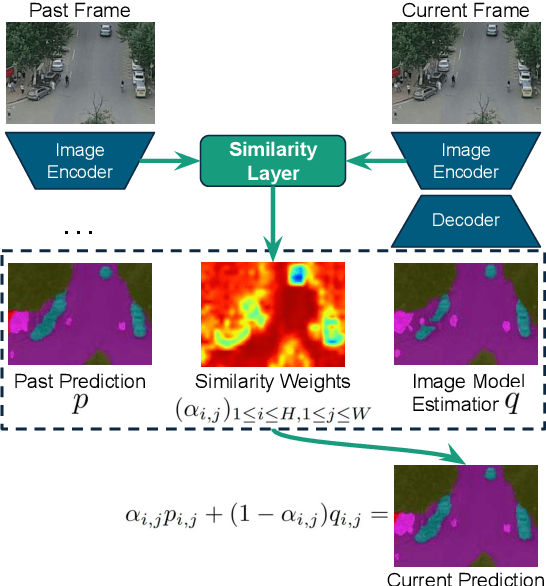
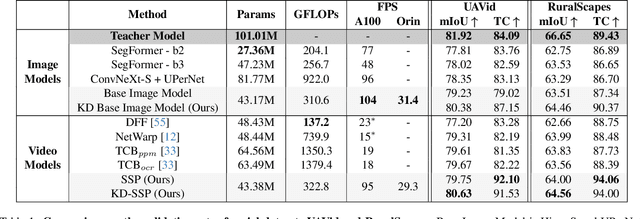
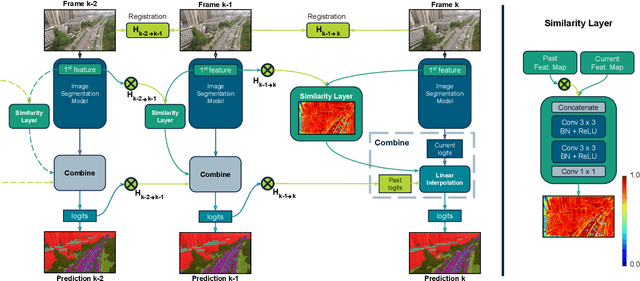
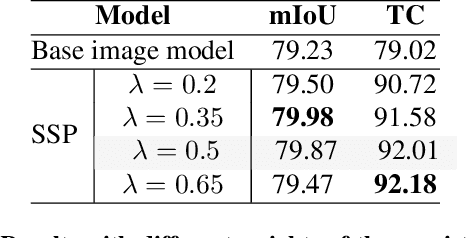
Semantic segmentation from RGB cameras is essential to the perception of autonomous flying vehicles. The stability of predictions through the captured videos is paramount to their reliability and, by extension, to the trustworthiness of the agents. In this paper, we propose a lightweight video semantic segmentation approach-suited to onboard real-time inference-achieving high temporal consistency on aerial data through Semantic Similarity Propagation across frames. SSP temporally propagates the predictions of an efficient image segmentation model with global registration alignment to compensate for camera movements. It combines the current estimation and the prior prediction with linear interpolation using weights computed from the features similarities of the two frames. Because data availability is a challenge in this domain, we propose a consistency-aware Knowledge Distillation training procedure for sparsely labeled datasets with few annotations. Using a large image segmentation model as a teacher to train the efficient SSP, we leverage the strong correlations between labeled and unlabeled frames in the same training videos to obtain high-quality supervision on all frames. KD-SSP obtains a significant temporal consistency increase over the base image segmentation model of 12.5% and 6.7% TC on UAVid and RuralScapes respectively, with higher accuracy and comparable inference speed. On these aerial datasets, KD-SSP provides a superior segmentation quality and inference speed trade-off than other video methods proposed for general applications and shows considerably higher consistency. The code will be made publicly available upon acceptance.