 Add to Chrome
 Add to Firefox
 Add to Edge
Learning Admissible Heuristics via Cost Partitioning
Jun 03, 2026
Admissible heuristics are essential for optimal planning, yet learning them remains challenging due to the risk of overestimation. Cost partitioning combines multiple abstraction heuristics while preserving admissibility, but computing optimal partitions online is expensive. We propose a framework that learns to infer admissible cost partitions by leveraging the Lagrangian dual equivalence between cost partitioning and multiplier prediction. Planning states and patterns are encoded as labelled graphs, and an action-centric variant of the Weisfeiler-Leman algorithm extracts structural feature vectors. A deep architecture with axial self-attention and a softmax output layer maps these features to cost weights that satisfy the partition constraints by construction, ensuring admissibility. Experiments demonstrate reduced node expansions compared to suboptimal partitioning baselines while maintaining strict admissibility. To our knowledge, this is the first machine-learned heuristic guaranteed to be admissible.

Learning Lifted Action Models from Unsupervised Visual Traces
Apr 21, 2026Efficient construction of models capturing the preconditions and effects of actions is essential for applying AI planning in real-world domains. Extensive prior work has explored learning such models from high-level descriptions of state and/or action sequences. In this paper, we tackle a more challenging setting: learning lifted action models from sequences of state images, without action observation. We propose a deep learning framework that jointly learns state prediction, action prediction, and a lifted action model. We also introduce a mixed-integer linear program (MILP) to prevent prediction collapse and self-reinforcing errors among predictions. The MILP takes the predicted states, actions, and action model over a subset of traces and solves for logically consistent states, actions, and action model that are as close as possible to the original predictions. Pseudo-labels extracted from the MILP solution are then used to guide further training. Experiments across multiple domains show that integrating MILP-based correction helps the model escape local optima and converge toward globally consistent solutions.
On the Ability of Transformers to Verify Plans
Mar 20, 2026Transformers have shown inconsistent success in AI planning tasks, and theoretical understanding of when generalization should be expected has been limited. We take important steps towards addressing this gap by analyzing the ability of decoder-only models to verify whether a given plan correctly solves a given planning instance. To analyse the general setting where the number of objects -- and thus the effective input alphabet -- grows at test time, we introduce C*-RASP, an extension of C-RASP designed to establish length generalization guarantees for transformers under the simultaneous growth in sequence length and vocabulary size. Our results identify a large class of classical planning domains for which transformers can provably learn to verify long plans, and structural properties that significantly affects the learnability of length generalizable solutions. Empirical experiments corroborate our theory.
Exploring Plan Space through Conversation: An Agentic Framework for LLM-Mediated Explanations in Planning
Mar 02, 2026When automating plan generation for a real-world sequential decision problem, the goal is often not to replace the human planner, but to facilitate an iterative reasoning and elicitation process, where the human's role is to guide the AI planner according to their preferences and expertise. In this context, explanations that respond to users' questions are crucial to improve their understanding of potential solutions and increase their trust in the system. To enable natural interaction with such a system, we present a multi-agent Large Language Model (LLM) architecture that is agnostic to the explanation framework and enables user- and context-dependent interactive explanations. We also describe an instantiation of this framework for goal-conflict explanations, which we use to conduct a user study comparing the LLM-powered interaction with a baseline template-based explanation interface.
AI Planning: A Primer and Survey (Preliminary Report)
Dec 07, 2024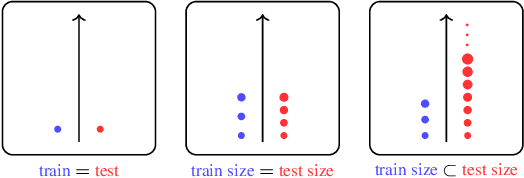
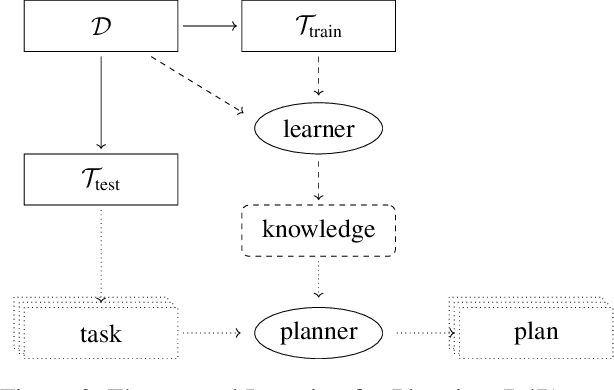
Automated decision-making is a fundamental topic that spans multiple sub-disciplines in AI: reinforcement learning (RL), AI planning (AP), foundation models, and operations research, among others. Despite recent efforts to ``bridge the gaps'' between these communities, there remain many insights that have not yet transcended the boundaries. Our goal in this paper is to provide a brief and non-exhaustive primer on ideas well-known in AP, but less so in other sub-disciplines. We do so by introducing the classical AP problem and representation, and extensions that handle uncertainty and time through the Markov Decision Process formalism. Next, we survey state-of-the-art techniques and ideas for solving AP problems, focusing on their ability to exploit problem structure. Lastly, we cover subfields within AP for learning structure from unstructured inputs and learning to generalise to unseen scenarios and situations.
Graph Learning for Planning: The Story Thus Far and Open Challenges
Dec 03, 2024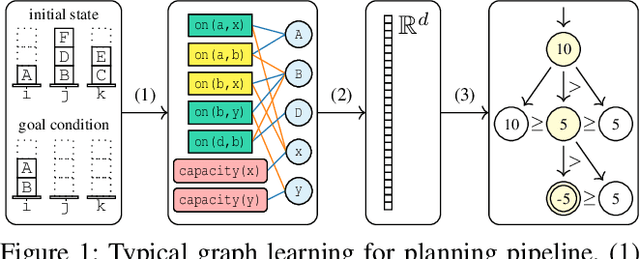
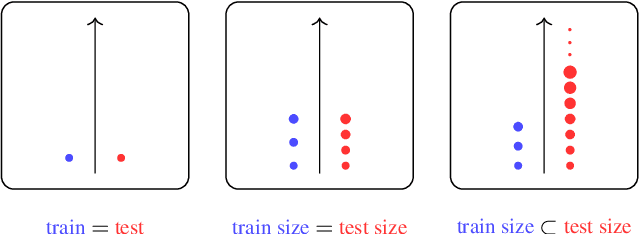
Graph learning is naturally well suited for use in planning due to its ability to exploit relational structures exhibited in planning domains and to take as input planning instances with arbitrary number of objects. In this paper, we study the usage of graph learning for planning thus far by studying the theoretical and empirical effects on learning and planning performance of (1) graph representations of planning tasks, (2) graph learning architectures, and (3) optimisation formulations for learning. Our studies accumulate in the GOOSE framework which learns domain knowledge from small planning tasks in order to scale up to much larger planning tasks. In this paper, we also highlight and propose the 5 open challenges in the general Learning for Planning field that we believe need to be addressed for advancing the state-of-the-art.
Graph Learning for Numeric Planning
Oct 31, 2024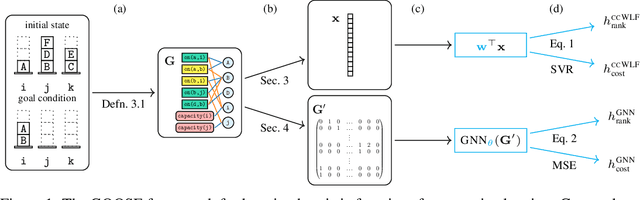


Graph learning is naturally well suited for use in symbolic, object-centric planning due to its ability to exploit relational structures exhibited in planning domains and to take as input planning instances with arbitrary numbers of objects. Numeric planning is an extension of symbolic planning in which states may now also exhibit numeric variables. In this work, we propose data-efficient and interpretable machine learning models for learning to solve numeric planning tasks. This involves constructing a new graph kernel for graphs with both continuous and categorical attributes, as well as new optimisation methods for learning heuristic functions for numeric planning. Experiments show that our graph kernels are vastly more efficient and generalise better than graph neural networks for numeric planning, and also yield competitive coverage performance compared to domain-independent numeric planners. Code is available at https://github.com/DillonZChen/goose
Novelty Heuristics, Multi-Queue Search, and Portfolios for Numeric Planning
Apr 11, 2024
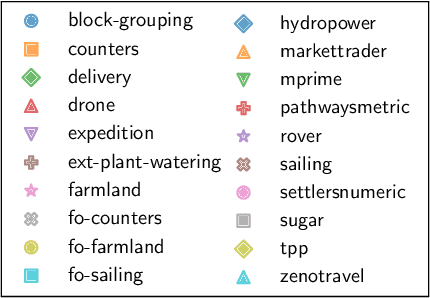

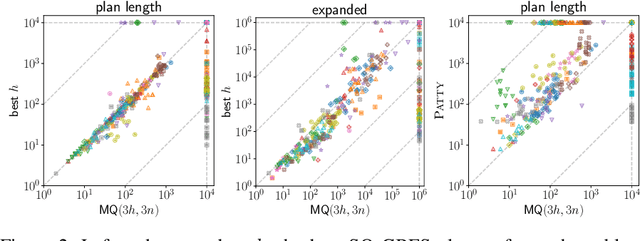
Heuristic search is a powerful approach for solving planning problems and numeric planning is no exception. In this paper, we boost the performance of heuristic search for numeric planning with various powerful techniques orthogonal to improving heuristic informedness: numeric novelty heuristics, the Manhattan distance heuristic, and exploring the use of multi-queue search and portfolios for combining heuristics.
Return to Tradition: Learning Reliable Heuristics with Classical Machine Learning
Mar 25, 2024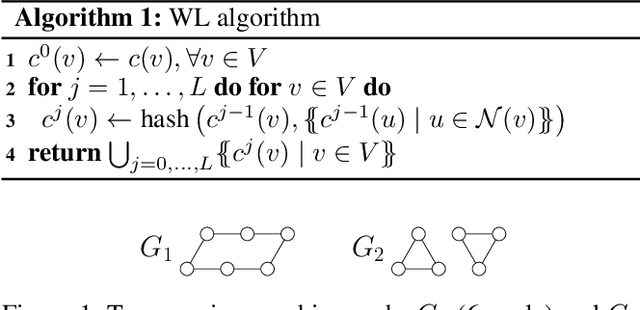
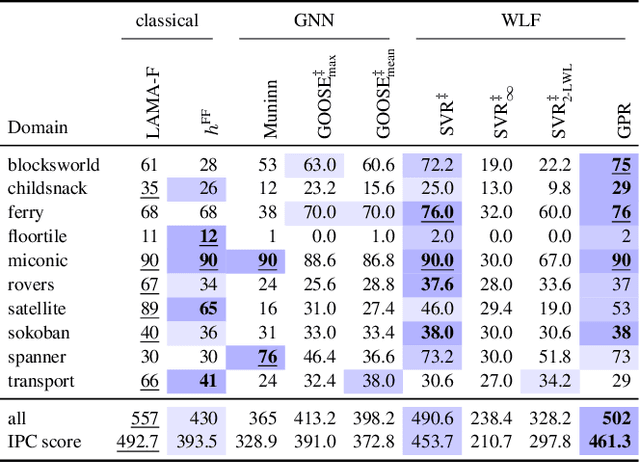
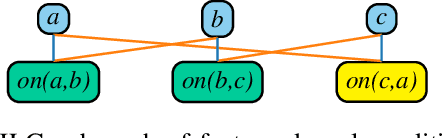

Current approaches for learning for planning have yet to achieve competitive performance against classical planners in several domains, and have poor overall performance. In this work, we construct novel graph representations of lifted planning tasks and use the WL algorithm to generate features from them. These features are used with classical machine learning methods which have up to 2 orders of magnitude fewer parameters and train up to 3 orders of magnitude faster than the state-of-the-art deep learning for planning models. Our novel approach, WL-GOOSE, reliably learns heuristics from scratch and outperforms the $h^{\text{FF}}$ heuristic in a fair competition setting. It also outperforms or ties with LAMA on 4 out of 10 domains on coverage and 7 out of 10 domains on plan quality. WL-GOOSE is the first learning for planning model which achieves these feats. Furthermore, we study the connections between our novel WL feature generation method, previous theoretically flavoured learning architectures, and Description Logic Features for planning.
Learning Domain-Independent Heuristics for Grounded and Lifted Planning
Dec 20, 2023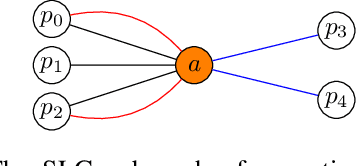
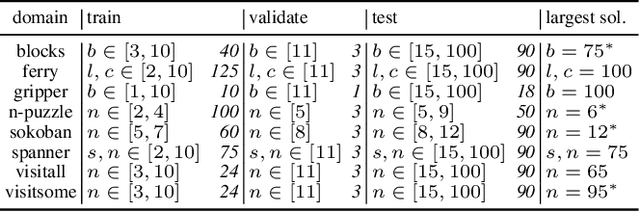
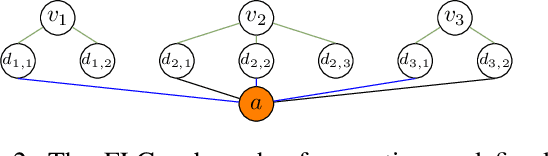
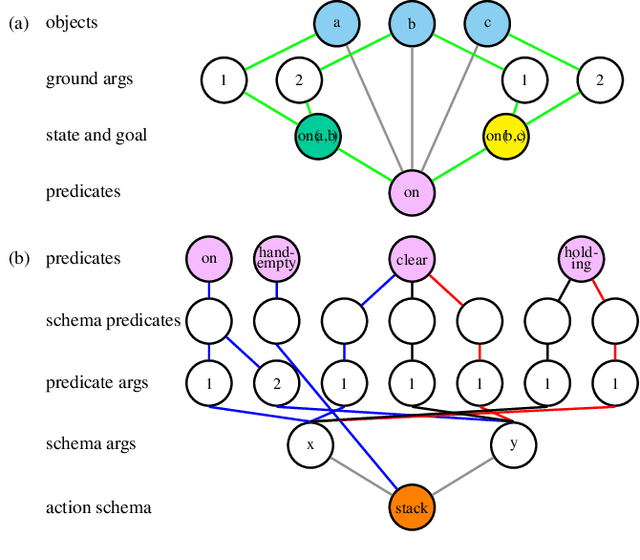
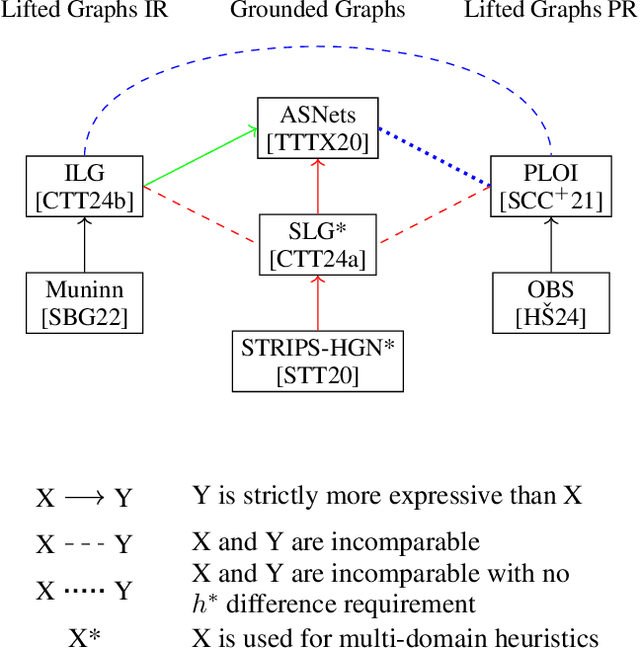
We present three novel graph representations of planning tasks suitable for learning domain-independent heuristics using Graph Neural Networks (GNNs) to guide search. In particular, to mitigate the issues caused by large grounded GNNs we present the first method for learning domain-independent heuristics with only the lifted representation of a planning task. We also provide a theoretical analysis of the expressiveness of our models, showing that some are more powerful than STRIPS-HGN, the only other existing model for learning domain-independent heuristics. Our experiments show that our heuristics generalise to much larger problems than those in the training set, vastly surpassing STRIPS-HGN heuristics.